Yates Mill
The charred beams are still there. In 1865, Union soldiers set fire to the entrance of this mill south of Raleigh, supposedly on the word of a widow who blamed the mill's owner for her husband's murder. The fire failed. The beams blackened but held, and the mill kept standing, as it had since the 1750s, as it would through abandonment, neglect, and a Category 3 hurricane. Yates Mill, the only surviving operable gristmill in Wake County, sits five miles south of downtown Raleigh at the center of a county park that bears its name. For nearly 200 years, the water-powered mill produced lumber, milled corn and wheat, and carded wool. It is one of the oldest buildings in the county, and its story unfolds like a miniature history of North Carolina itself.
A Lord Proprietor's Grant
The land was surveyed for Samuel Pearson in October 1756, granted to him by the Earl of Granville, one of the colony's Lord Proprietors. Pearson built the original mill around that time, and over the following decades he steadily expanded his holdings. By his death in 1802, he owned a substantial tract. But accumulated debts undid the family. In 1819, Pearson's son Simon was forced to sell the mill and its surrounding acreage at a sheriff's auction. William Boylan, a prominent Raleigh businessman and director of the State Bank, bought the property and spent the next 30 years modernizing the operation, adding a sawmill in the 1840s. The mill changed hands again in 1853, when Thomas Briggs, John Primrose, and James Penny acquired it. Each owner adapted the mill to the demands of the era, but the essential function never changed: water turned the wheel, and the wheel ground the grain.
Murder, Fire, and the Civil War
A decade after Briggs, Primrose, and Penny took over, the Civil War transformed the property's story. In the midst of the conflict, the partners sold the mill to Phares and Roxanna Yates, the son-in-law and daughter of James Penny. The sale may have been forced by scandal. Penny was allegedly involved in the murder of a man named Franklin, a Northern sympathizer who, according to local legend, Penny killed over an unpaid $700 mill debt. The consequences arrived in 1865. Franklin's widow reportedly told Federal troops occupying Raleigh that her husband had been killed for his Union sympathies. The soldiers marched to the mill and tried to burn it down, setting fire to the entrance. The attempt failed, leaving only charred wooden beams as evidence. The Yates family gave the mill its permanent name and operated it for the next 83 years, through Reconstruction, the Gilded Age, two world wars, and the arrival of modern industry that would eventually make water-powered gristmills obsolete.
Abandonment and the Storm
In 1948, businessman A. E. Finley acquired the property and built a retreat lodge by the millpond for his family and employees. Demand for custom milling had dried up, and the mill closed in 1953. A decade later, North Carolina State University took over, consolidating the land into a larger experimental farm. The mill was used mainly for storage. It might have simply rotted away. Instead, in 1989, Yates Mill Associates incorporated to begin restoration. The group was seven years into that effort when Hurricane Fran struck in 1996, unleashing rains that burst the mill's 250-year-old stone dam. The damage was severe but not fatal. Yates Mill Associates partnered with Wake County Parks, Recreation and Open Space to rehabilitate both the dam and the mill, creating a historic and environmental park around them. The mill is an example of the Oliver Evans type of grist mill and was restored to its mid-19th-century state, with both corn and wheat grinding machinery operational.
The Wheel Turns Again
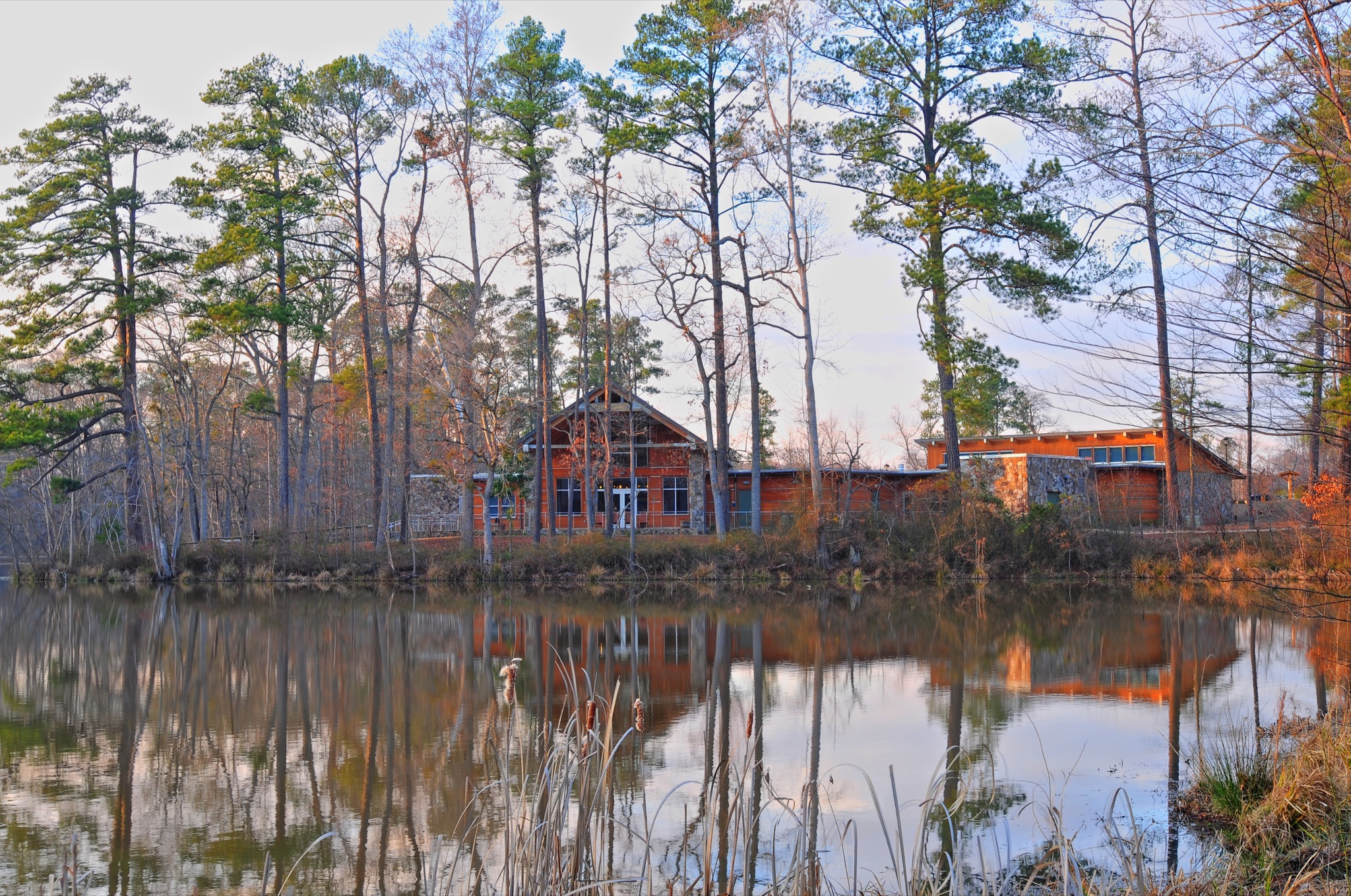
Yates Mill officially reopened to the public on May 20, 2006. Today it stands as the centerpiece of Historic Yates Mill County Park, surrounded by hiking trails, a lake, and the A. E. Finley Center for Education and Research. North Carolina State University uses the park for ongoing natural history research, and the mill itself hosts regular historic tours and corn grinding demonstrations. The restoration was funded by a patchwork of governmental agencies, the university, private foundations, corporations, and individual citizens. Wake County provides the personnel to operate the park, while Yates Mill Associates finances the mill's maintenance through donations and volunteer labor. The park is managed as a native wildlife refuge, dedicated to studying and interpreting the area's cultural, natural, and agricultural heritage. Two hundred and seventy years after Samuel Pearson first dammed the creek and set a wheel turning, water still flows, stones still grind, and the mill still stands, its charred beams a quiet testament to everything it has outlasted.
From the Air
Yates Mill is located at 35.719N, 78.688W, approximately five miles south of downtown Raleigh. The mill and its pond are visible within the tree canopy of Historic Yates Mill County Park. Raleigh-Durham International Airport (KRDU) is approximately 15 nautical miles to the northwest. Best viewed at 1,500-2,500 feet AGL. Look for the millpond surrounded by forested parkland south of the NC State University campus area along Lake Wheeler Road.