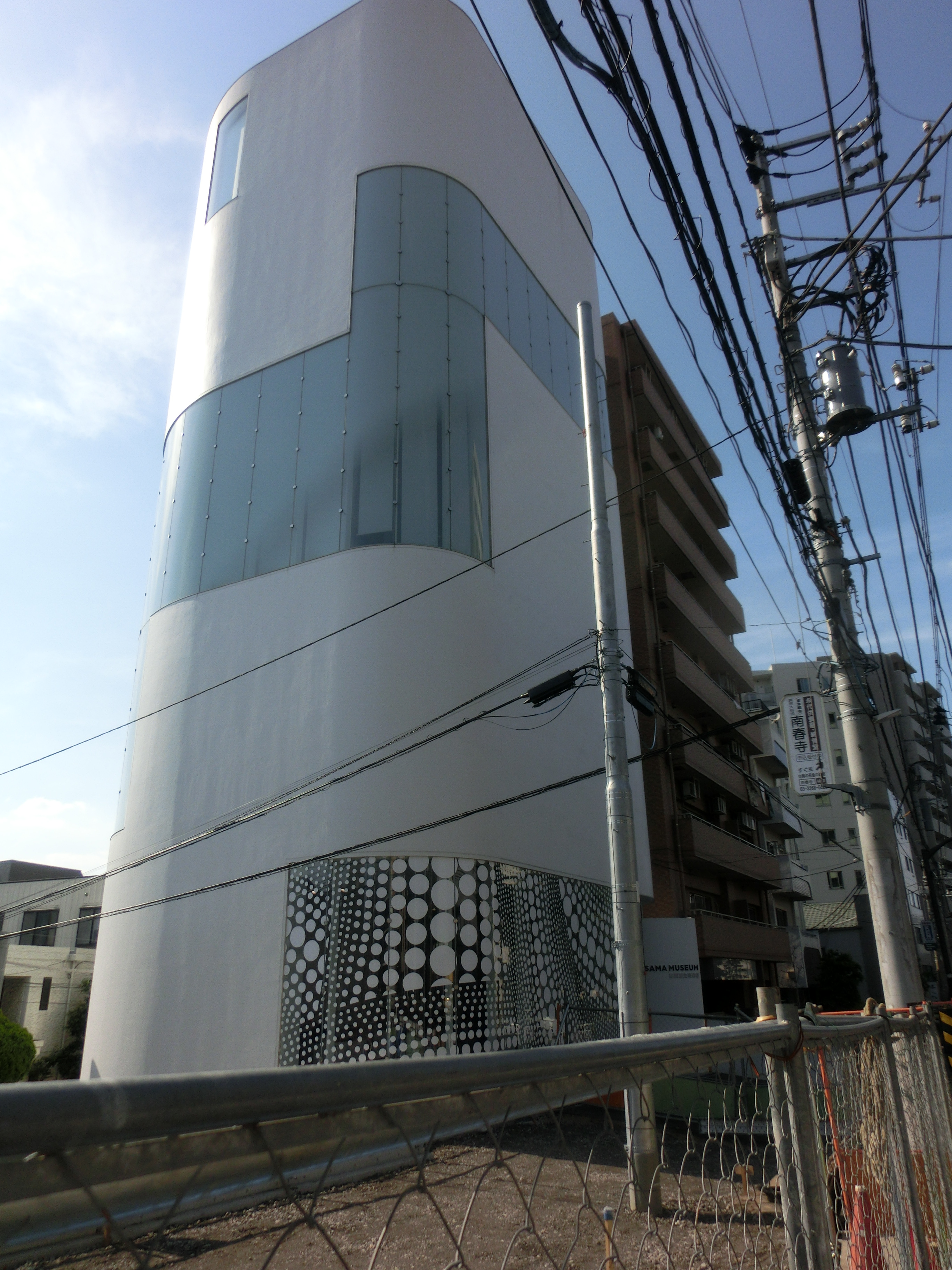
Yayoi Kusama Museum: Infinity in a White Box
Five white cubes, stacked and slightly rotated, rise from a quiet residential street in Shinjuku. Each floor measures less than 131 square meters. There is no grand facade, no towering atrium, no architectural bombast. The Yayoi Kusama Museum opened in October 2017 as the most intimate major art museum in Tokyo, and within a year, Time Out magazine ranked it the number-one experience on its global 'do list.' The restraint of the building is deliberate. Inside, the art overwhelms -- mirrors multiply into infinity, polka dots swarm across every surface, pumpkins glow in hallucinatory color. The architecture by Kume Sekkei steps back so the vision of a single artist can fill every room.
The Girl Who Saw the Dots
Yayoi Kusama was born in 1929 in Matsumoto, a city in Nagano Prefecture surrounded by the Japanese Alps. Her family ran a prosperous plant nursery and seed farm. At the age of ten, she began experiencing vivid hallucinations -- flowers spoke to her, patterns on fabric came alive and spread across entire rooms, dots multiplied until they consumed everything in sight. Rather than retreat from these visions, she painted them. She studied Nihonga painting at the Kyoto Municipal School of Arts and Crafts beginning in 1948, but found the traditional Japanese style suffocating. By the mid-1950s she was staging solo exhibitions in Matsumoto and Tokyo, and in 1957 she left Japan for New York City. There, she threw herself into the avant-garde, creating vast 'infinity net' paintings, staging happenings with nude participants covered in polka dots, and building mirrored environments that shattered the boundary between viewer and artwork. She returned to Japan in 1973 and, by her own choice, has lived in a psychiatric institution since 1977 -- walking to her studio each day to work.
A Building That Breathes Light
The museum building, designed by Kume Sekkei, was completed in 2014 but did not open to visitors until October 1, 2017. Its five above-ground floors and one basement level are compact by design. The ground floor holds the entrance and gift shop. Floors two and three serve as exhibition galleries for Kusama's paintings, sculptures, and works on paper. The fourth floor is reserved for one of her immersive infinity mirror installations -- the inaugural piece was titled Pumpkins Screaming About Love Beyond Infinity. The fifth floor functions as a reading room and archive. Natural light filters down through the stacked volumes, and each exhibition space retains its own character while connecting to the others in a helical flow. The white minimalist exterior creates a serene frame for art that is anything but minimal. The inaugural exhibition displayed 600 of Kusama's works, spanning decades of obsessive, luminous creation.
Polka Dots, Pumpkins, and the Infinite
Kusama's art returns obsessively to a handful of motifs. The polka dot -- which she traces directly to her childhood hallucinations -- appears on sculptures, paintings, room-sized installations, and even trees and buildings in public interventions. Pumpkins became a recurring subject beginning in the 1940s, rendered in paint, sculpture, and mirrored environments. Her infinity rooms, which use mirrors, colored lights, and reflective surfaces to create the illusion of endless space, have become some of the most sought-after art experiences in the world. The museum rotates its exhibitions roughly every six months, drawing from the holdings of the Yayoi Kusama Foundation. Titles alone hint at the emotional range: 'Creation is a Solitary Pursuit, Love Is What Brings You Closer To Art,' 'Every Day I Pray For Love,' and 'I Would Overcome Death And Go On Living.' Each show reframes the same fundamental obsessions through different media, different scales, different intensities of color.
Where Art Meets Devotion
The museum operates on a timed-entry system, admitting small groups every ninety minutes. There are no walk-in visits. This is partly practical -- the building is small -- and partly philosophical: Kusama's art demands attention, not crowds. The restriction means every visitor gets a quiet moment inside the infinity room, standing alone in a space where mirrored walls and LED lights dissolve the floor, ceiling, and self into an endless field of color. It is a controlled encounter with the same boundless repetition that has driven Kusama's work for more than seven decades. She continues to create new work daily, walking from her nearby residence to her studio. She is among the world's most commercially successful living artists, yet the museum that bears her name remains deliberately small, deliberately quiet, a white box on a residential street that opens onto infinity.
From the Air
Located at 35.7032°N, 139.7265°E in Shinjuku ward, western Tokyo. The museum is a small five-story white building in a residential area, difficult to spot from altitude but situated roughly 2 nautical miles west of the Shinjuku skyscraper district, which provides a useful visual landmark. Tokyo Haneda Airport (RJTT) lies approximately 12 nautical miles south-southeast. Narita International Airport (RJAA) is approximately 35 nautical miles east-northeast. Best viewed at low altitude with the Shinjuku skyline as reference.