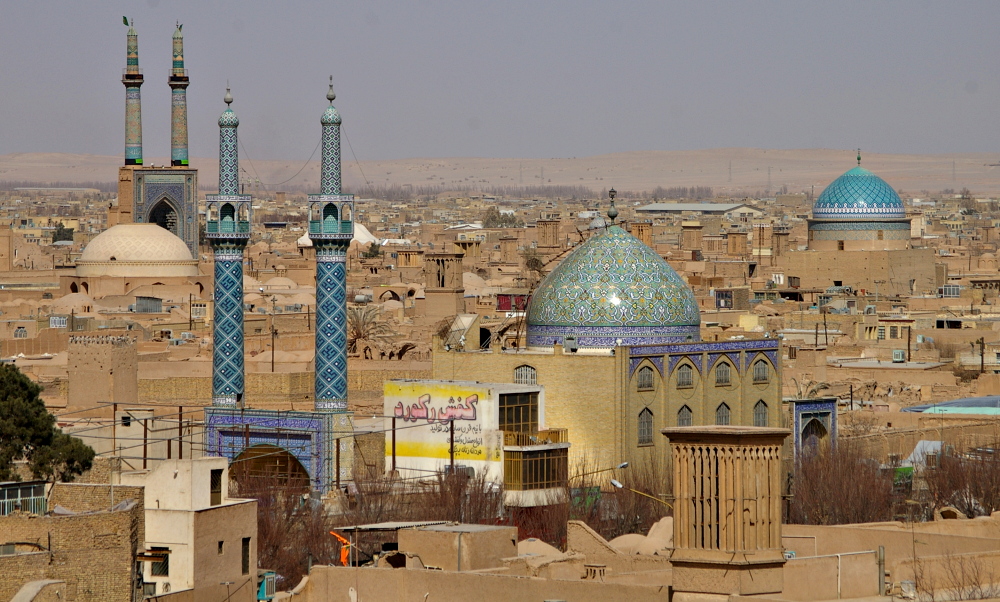
Yazd
From the air, Yazd looks impossible. A city of over 530,000 people spreads across a plateau where summer temperatures routinely exceed 40 degrees Celsius and annual rainfall barely reaches 60 millimeters. There are no rivers. Yet the city has thrived here since the Sassanid period, roughly 224 to 651 AD, and its answer to the question of how is written in its skyline. Hundreds of rectangular towers called badgirs rise above the rooftops, their slatted openings catching even the faintest breeze and channeling it down into the rooms below. These windcatchers give Yazd its Persian nickname, the City of Windcatchers, and they are only the most visible element of an urban design so ingeniously adapted to its environment that UNESCO inscribed the entire historic city as a World Heritage Site in 2017.
Towers That Breathe
The badgir is deceptively simple: a tall chimney-like structure with vertical openings on one or more sides, positioned to capture prevailing winds and funnel cool air into the building below. Some windcatchers are six-sided, some four, some two. The tallest in the world, standing 33.8 meters high, rises from the Dowlat Abad Garden within the city. Yazd has roughly 700 of them, the oldest dating to the 14th century, though the concept may stretch back 2,500 years. Working in concert with the windcatchers is a network of qanats, underground aqueducts that tap mountain aquifers and carry water to the city through gently sloping tunnels, some running for kilometers. The combination of wind cooling and subterranean water created a habitable city in a landscape where neither seemed possible.
Where Fire Has Never Died
Yazd has been a center of Zoroastrian worship for over two millennia. The Ateshkadeh, the city's Zoroastrian fire temple, houses a flame that has burned continuously since approximately 470 AD, making it one of the oldest sacred fires in the world. The flame was kindled during the Sassanid era in the Pars Karyan fire temple in southern Fars. From there it moved to Aqda, where it burned for 700 years, then to Nahid-e Pars temple in Ardakan for another 300 years, before finally being consecrated in its present building in 1934. The temple is one of only nine Atash Behrams, fires of the highest grade, and the only one in Iran; the other eight are in India. For Yazd's Zoroastrian community, the flame is not a symbol. It is a living presence, and its unbroken continuity across fifteen centuries is a statement of persistence.
Mud Brick and Mosaic
Walking through Yazd's historic quarters means navigating a labyrinth of covered passages, arched doorways, and narrow alleys where walls of sun-dried mud brick absorb the heat before it reaches the interior rooms. The construction material is the landscape itself: clay, mud, and adobe, formed into structures whose domes and arches provide both shade and structural integrity. The Jameh Mosque, first built on the site of a Zoroastrian fire temple, was reconstructed by the Ilkhanids between 1324 and 1328 and further expanded under the Muzaffarids and Timurids. Its towering portal and twin minarets are among the most recognized images of Persian architecture. Nearby, the 14th-century mausoleum of Sayyed Rukn ad-Din preserves extraordinary mosaic tilework in turquoise, azure, and white. The old bazaar connects these monuments through a covered commercial corridor that once linked Yazd to the Silk Road trade routes binding China to the Mediterranean.
A Living Crossroads
Yazd sits midway between Isfahan and Kerman, 689 kilometers southeast of Tehran. Its position made it a natural waypoint for caravans, and that commercial history shaped a cosmopolitan character unusual for a city this deep in the desert. Marco Polo passed through in the 13th century and noted its silk trade. Traditional houses have been converted into atmospheric hotels built around central courtyards where guests drink tea and smoke ghalyan under open sky. The bazaar sells carpets, silk fabrics, cashmere, and the confections Yazd is famous for across Iran, particularly the sweets from shops near the Amir Chakhmaq square. Restaurants serve classic Persian dishes like fesenjun and gheime alongside international cuisine. Yazd is connected by daily flights to Tehran and Mashhad, a railway linking Tehran and Kerman, and bus routes to Isfahan, Shiraz, and beyond. Despite its isolation on the map, the city has never been as remote as its desert surroundings suggest.
From the Air
Located at 31.897N, 54.368E in central Iran's desert plateau at approximately 1,200 meters elevation. Yazd Shahid Sadooghi Airport (OIYY/AZD) is 10 km south of the city center. Isfahan International Airport (OIFM) lies 255 km to the northwest; Kerman Airport (OIKK) is a similar distance to the southeast. The city is identifiable from altitude by its distinctive mud-brick color, the forest of windcatcher towers across the old quarter, and the twin minarets of the Jameh Mosque. Best viewed at 3,000-5,000 feet AGL to appreciate the contrast between the dense historic core and the surrounding desert.