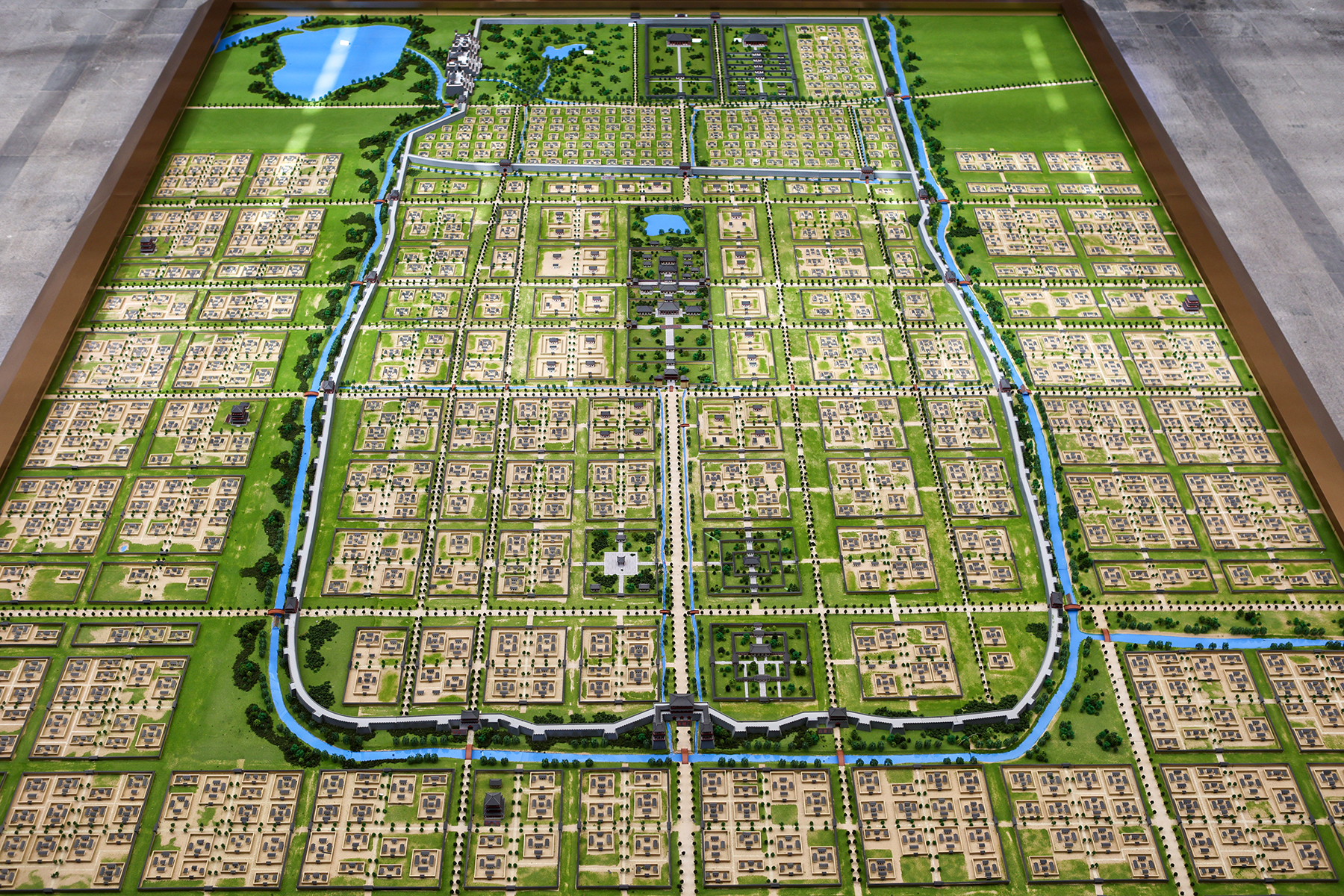
Ye
No city in Chinese history has been capital to more rival dynasties than Ye. Built during the Spring and Autumn period by Duke Huan of Qi, the city straddling what is now Linzhang County in Hebei and neighboring Anyang in Henan spent four centuries as the seat of power for a succession of kingdoms -- Cao Wei, Later Zhao, Ran Wei, Former Yan, Eastern Wei, Northern Qi -- before being razed to the ground in 580 CE by the founder of the Sui dynasty. It was the place where China's greatest warlord built his Bronze Bird Terrace, where 3,000 Buddha statues were buried in a single pit, and where the politics of a fractured empire played out in blood and stone.
Cao Cao's City
In 204 CE, the warlord Cao Cao seized Ye from his rival Yuan Shao's son, finding the inner city destroyed by the siege. He rebuilt it as an imperial capital in all but name. He dug canals to improve irrigation and drainage, constructed the Hall of Civil Splendour as the centerpiece of a new palace complex, and in 210 erected the Bronze Bird Terrace -- a structure that became one of the most celebrated subjects in Chinese poetry. Cao Cao's transformation of Ye was so thorough that he alone, more than any ruler before or after, became synonymous with the city in Chinese cultural memory. In a final irony, when his grandson Cao Huan was forced to abdicate to the Jin dynasty in 266, Cao Huan was sent to live out his days in the very city his grandfather had built.
Capital of the Fractured North
After the Western Jin collapsed, Ye became the prize in a series of brutal power struggles. The Jie-led Later Zhao dynasty made it their capital in 335 under Shi Hu. When Shi Hu died, his adopted grandson Ran Min seized the city and founded the short-lived Ran Wei state in 350, only to be conquered by the Xianbei-led Former Yan two years later. In 534, the general Gao Huan -- a Chinese commander whose loyalties lay with the non-Chinese Tuoba military tradition -- ordered Luoyang's inhabitants to march to Ye at three days' notice, declaring it the capital of the new Eastern Wei dynasty. For most of the sixth century, Hebei functioned as an independent state with Ye as its heart, through both the Eastern Wei and the Northern Qi dynasty that succeeded it.
Razed and Remembered
Ye's end came in 580, when the resistance leader Yuchi Jiong used the city as his base against Yang Jian, the man who would found the Sui dynasty. Yang Jian crushed the resistance and razed Ye to the ground. The region remained restless -- scholars note that Hebei harbored separatist sympathies into the Tang dynasty, and it was from this region that An Lushan launched his devastating rebellion during the reign of Emperor Xuanzong. The city was destroyed a second time after that rebellion's failure. What had been one of China's greatest cities became farmland, its canals and palaces dissolving into the soil of the North China Plain.
Three Thousand Buddhas
Extensive modern excavations have mapped the ruins in remarkable detail, revealing rammed-earth foundations of palaces, workshops, and defensive walls. In 2012, archaeologists made a find of extraordinary scale: nearly 3,000 Buddha statues buried in a single pit outside the ancient city. Most were carved from white marble and limestone and date to the Eastern Wei and Northern Qi dynasties of the sixth century. A community of Sogdian merchants -- traders from Central Asia who operated along the Silk Road network -- also left traces of their residence in Northern Qi-era Ye. The city that was destroyed twice still yields evidence of the cosmopolitan world it once anchored.
From the Air
Located at 36.275N, 114.400E, straddling the border of Linzhang County (Handan, Hebei) and Anyang (Henan). Flat terrain on the North China Plain. Nearest airports: Handan Airport (ZBHD) and Anyang Yuquan (ZHAY). The Yecheng Museum is located near the archaeological site. Recommended viewing altitude: 3,000-5,000 feet AGL.