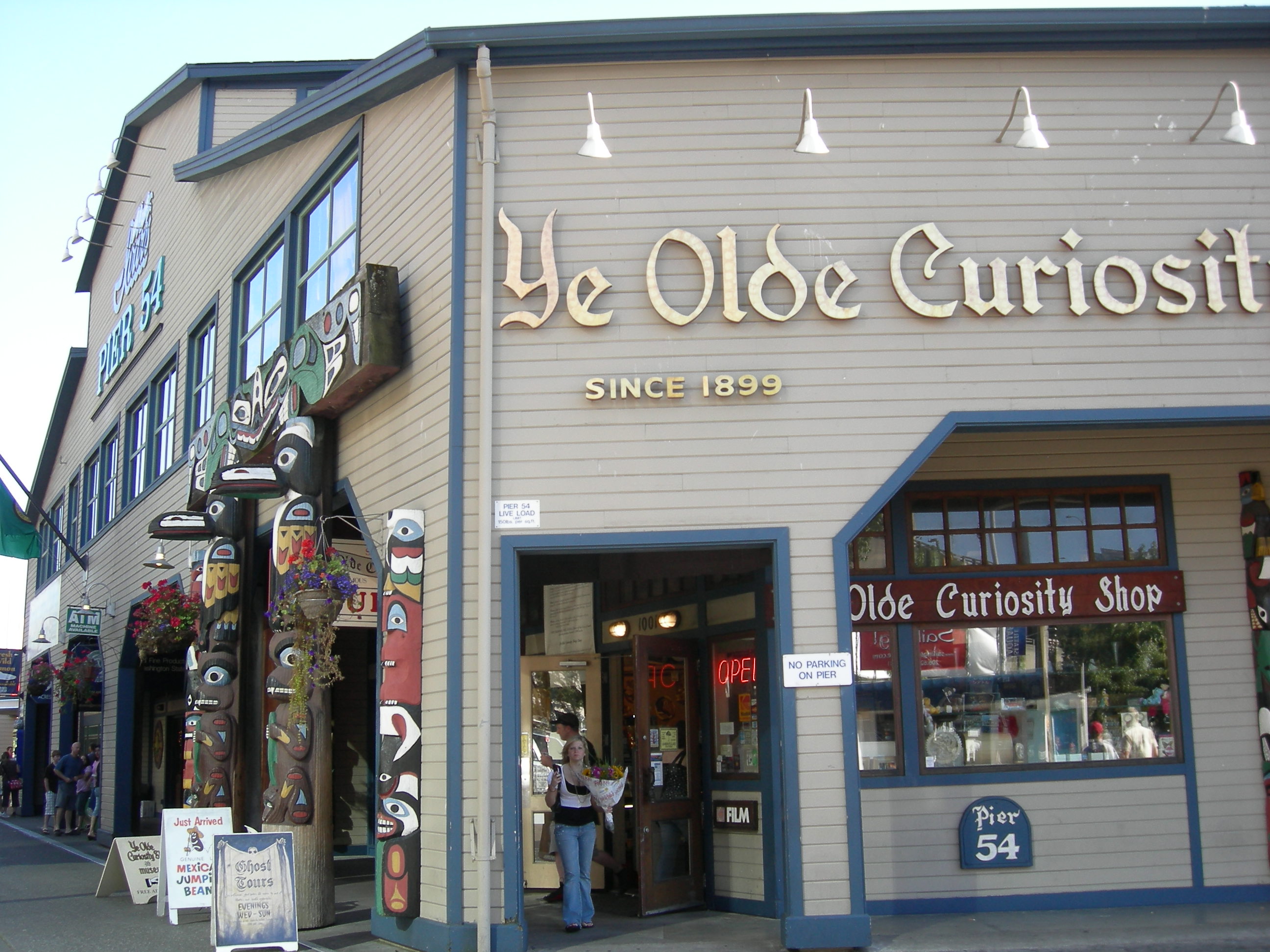
Ye Olde Curiosity Shop
Somewhere between the whale jawbones and the shrunken heads, between the genuine Tlingit totem poles and the souvenir replicas made in Japan, Ye Olde Curiosity Shop found the formula for a 125-year-old business. When J.E. "Daddy" Standley opened his doors on the Seattle waterfront in 1899, the city was a muddy boomtown feeding the Klondike Gold Rush, and anything strange or exotic could find a buyer. Standley obliged with a sprawling inventory that blurred the line between museum and marketplace, ethnographic treasure and carnival sideshow. In 1933, the Seattle Star declared the shop one of the "Seven Wonders of Seattle," the only retail establishment on a list that included the Ballard Locks, the Boeing airplane factory, and Pike Place Market. Today, four generations later, the shop still occupies a pier on Elliott Bay, still draws the curious, and still raises the question Standley himself never cared to answer: where does authentic art end and delightful fakery begin?
A Grocer Becomes a Showman
Joseph Edward Standley was born in Steubenville, Ohio, in 1854, and worked as a grocer in Denver before heading west. He arrived in Seattle at the height of the Klondike frenzy, when prospectors outfitting for the Yukon flooded the waterfront and money moved fast. He founded Ye Olde Curiosity Shop in 1899, stocking it with whatever oddities came his way: Native American baskets and blankets, giant clam shells from the equator, whale jawbones advertised as the largest in the United States, and a hat said to have belonged to Chief Seattle himself. The shop was a jumbled wonderland where a visiting anthropologist might rub elbows with a dockworker, both equally transfixed by a display case of Amazonian shrunken heads. Standley had a showman's instinct for spectacle, and he cultivated it. His exhibit at the 1909 Alaska-Yukon-Pacific Exposition won a gold medal in ethnological collections and drew scholars, collectors, and enormous publicity to an already somewhat famous enterprise.
The Totem Pole Effect
Standley's most lasting influence may be one few visitors recognize: he helped cement Seattle's association with totem poles. Traditionally, the carved monuments belonged to cultures much farther north, among the Tlingit, Haida, and Tsimshian peoples of southeastern Alaska and coastal British Columbia. Standley sold genuine Tlingit poles but also commissioned replicas from Nuu-chah-nulth carvers descended from Vancouver Island families who had settled in Seattle. He even stocked inexpensive souvenir poles manufactured in Japan. The effect was cumulative. By the time anthropologist Alfred Cort Haddon visited Seattle in 1909 to lecture at the exposition, he purchased 109 items from the shop for London's Horniman Free Museum. The shop's guest book recorded visits from chiefs of the Cheyenne and Lakota, and most remarkably, Chief Joseph of the Nez Perce stopped in during 1902, two years before his death. As author Kate Duncan wrote in 2001, Ye Olde Curiosity Shop had become "the most varied and visible Indian collection in the city."
Mummies, Con Men, and Curiosities
Among the shop's most talked-about residents is "Sylvester," a mummy displayed behind glass whose origins trace to one of the Old West's most colorful scoundrels. Originally called "McGinty," the mummy belonged to confidence man Jefferson "Soapy" Smith, who sold it in 1895 in Hillyard, Washington, before meeting his own violent end in Skagway, Alaska, three years later. How Standley acquired the mummy remains part of the shop's mythology, but it became a permanent fixture alongside other grotesque attractions: the shrunken heads, the two-headed calf, the mummified mermaid. Standley never pretended everything was genuine. The appeal lay in the uncertainty, the thrill of wondering what was real among the clutter of the extraordinary. That same spirit kept customers returning decade after decade, making Ye Olde Curiosity Shop one of Seattle's most enduring tourist draws.
A One-Man Chamber of Commerce
Standley was not content merely to run his shop. Described toward the end of his life as a "one-man-chamber-of-commerce," he lent his collections and energy to nearly every civic project that would have him. From 1904, he provided exhibits for the informal museum at Seattle's Alaska Club, which merged in 1908 into the Arctic Club. He supplied ethnological displays for the 1909 exposition's Alaska Building and natural history specimens for the Washington State Building. His Alaskan collection eventually caught the attention of collector George Gustav Heye, who purchased it for the Museum of the American Indian in New York. Standley also helped promote Ravenna Park, providing six totem poles and a war canoe, and played a role in the park's sale to the city in 1911. In 1937, at the age of 83, Standley was struck by a car on Alaskan Way, the road running along the waterfront he had helped make famous. He never fully recovered, but the shop carried on through his descendants, now in its fourth generation of family ownership.
From the Air
Ye Olde Curiosity Shop sits at 47.604N, 122.340W on Pier 54 along Seattle's Central Waterfront, part of the line of piers stretching south from the Seattle Great Wheel. From the air, look for the long row of pier structures extending into Elliott Bay, with the Alaskan Way Viaduct corridor (now surface boulevard) running parallel to the shore. The shop is roughly midway between the ferry terminal at Pier 52 to the south and Pier 57 to the north. Nearest airports: Boeing Field/King County International (KBFI) 5nm south, Seattle-Tacoma International (KSEA) 11nm south. Best viewed at 2,000-3,000 feet on approach from the west over Elliott Bay.