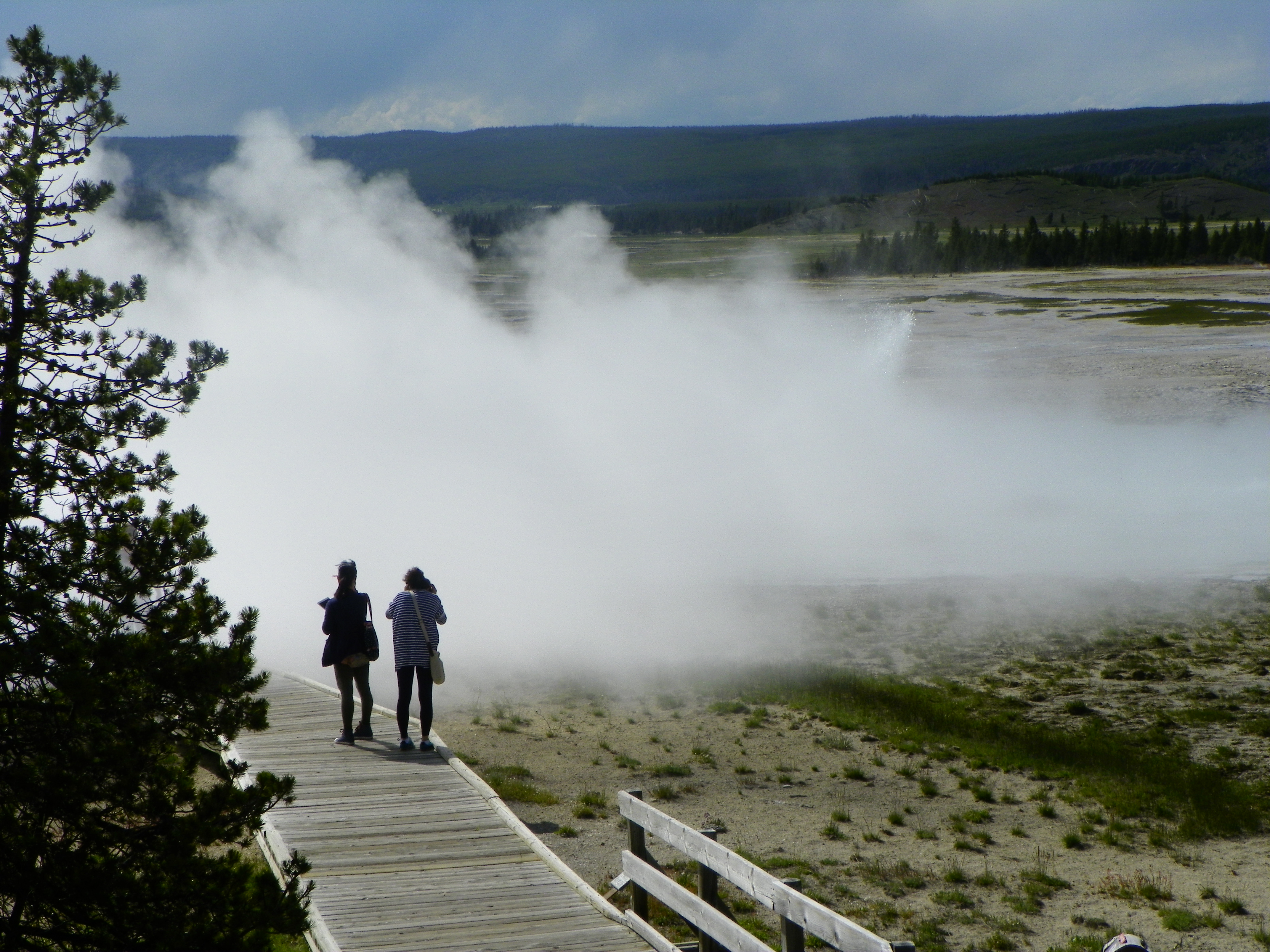
Yellowstone Caldera
The ground beneath Yellowstone rises and falls like slow breathing. Between 2004 and 2008, the caldera floor lifted nearly eight inches, more than three times faster than any movement recorded since measurements began in 1923. Beneath this breathing surface lies a magma chamber containing an estimated 4,000 cubic kilometers of partially molten rock, one of the largest such reservoirs on Earth. The geysers and hot springs that draw millions of visitors each year are symptoms of this underground reality: a supervolcano that has shaped continents and will, eventually, do so again.
Three Catastrophes
Yellowstone has experienced three caldera-forming eruptions, each burying vast swaths of North America in volcanic ash. The first, 2.08 million years ago, produced the Huckleberry Ridge Tuff and formed the Island Park Caldera. Ash from this eruption has been found in the Pacific Ocean, California's Humboldt and Ventura basins, Iowa, Arizona, and Texas. The second eruption, 1.3 million years ago, created the Henry's Fork Caldera and deposited ash as far as Nebraska and Colorado. The most recent, 640,000 years ago, produced the Lava Creek Tuff and carved out the current Yellowstone Caldera. This eruption ejected approximately 240 cubic miles of rock, dust, and volcanic ash into the atmosphere. The pattern suggests major eruptions every 600,000 to 800,000 years, though scientists emphasize that recurrence intervals are neither regular nor predictable.
The Plume Below
Seismic tomography has revealed what drives Yellowstone's volcanism: a cylindrical thermal anomaly extending from the deepest mantle to just beneath the surface. This mantle plume, rooted at the core-mantle boundary nearly 1,800 miles down, feeds the Yellowstone hotspot with heat from Earth's interior. The North American Plate moves southwest at about two centimeters per year over this relatively stationary plume, leaving a track of ancient calderas stretching 500 miles along the Snake River Plain. The oldest identified volcanic center in this chain, the McDermitt caldera complex, dates to 16 million years ago. The plume also erupted the massive Columbia River Basalt Group that covers much of the Pacific Northwest.
The Living Caldera
The current caldera is a compound structure comprising two partially overlapping ring-fault zones centered on the Mallard Lake and Sour Creek domes. Yellowstone Lake's West Thumb, one of the lake's deepest areas, occupies a fourth, younger caldera formed by a post-collapse explosive eruption 174,000 years ago. The most recent lava flow occurred about 70,000 years ago. Today, volcanic activity manifests through more than 10,000 geothermal features: geysers, hot springs, mudpots, and fumaroles. Old Faithful erupts with famous regularity while the ground itself continues its slow rise and fall. Between 1,000 and 2,000 earthquakes occur here annually, most too small to feel, marking the ongoing adjustment of rock to the heat below.
Monitoring the Giant
The Yellowstone Volcano Observatory, a partnership between the USGS, University of Utah, and National Park Service, monitors every tremor, tilt, and temperature change in the caldera. Their message remains consistent: they see no evidence that a cataclysmic eruption will occur in the foreseeable future. The magma chamber, though vast, contains only 6-8 percent molten rock, a proportion scientists consider too low to allow for another supereruption. Research from Arizona State University suggests the chamber could reach eruptive capacity within decades rather than centuries, but reaching capacity and erupting are not the same thing. The real hazards, according to USGS assessments, come from hydrothermal explosions rather than volcanic eruptions. Over 20 large craters have been produced in the past 14,000 years from steam explosions, including the 2-mile-wide Mary Bay crater at Yellowstone Lake's edge.
Heritage of Deep Time
In October 2022, the International Union of Geological Sciences included the Yellowstone volcanic and hydrothermal system among 100 geological heritage sites worldwide. The designation recognizes a place of international scientific relevance, one that has contributed substantially to understanding volcanism, hotspot dynamics, and hydrothermal systems. What visitors see at Yellowstone, the steam rising from prismatic pools, the water arcing from geysers, the elk grazing on caldera floors, represents the visible edge of processes that have shaped this planet for billions of years. The caldera spans parts of Wyoming, Montana, and Idaho, its boundaries invisible to casual observation but mapped precisely through decades of careful science. Beneath the lodgepole pines and bison herds, Earth's interior continues its ancient work.
From the Air
Located at 44.4N, 110.7W spanning portions of Wyoming, Montana, and Idaho within Yellowstone National Park. The caldera rim is not visible as a distinct feature from altitude; instead, look for Yellowstone Lake (which partially fills the caldera), the Grand Canyon of the Yellowstone, and steam plumes from geyser basins. The caldera measures approximately 34 by 45 miles. Recommended viewing altitude: 15,000-20,000 feet AGL for full caldera perspective, or lower for geyser basin detail. West Yellowstone Airport (KWYS) lies outside the western caldera boundary. The Teton Range rises dramatically to the south. Clear conditions essential for full appreciation of this massive volcanic landscape.