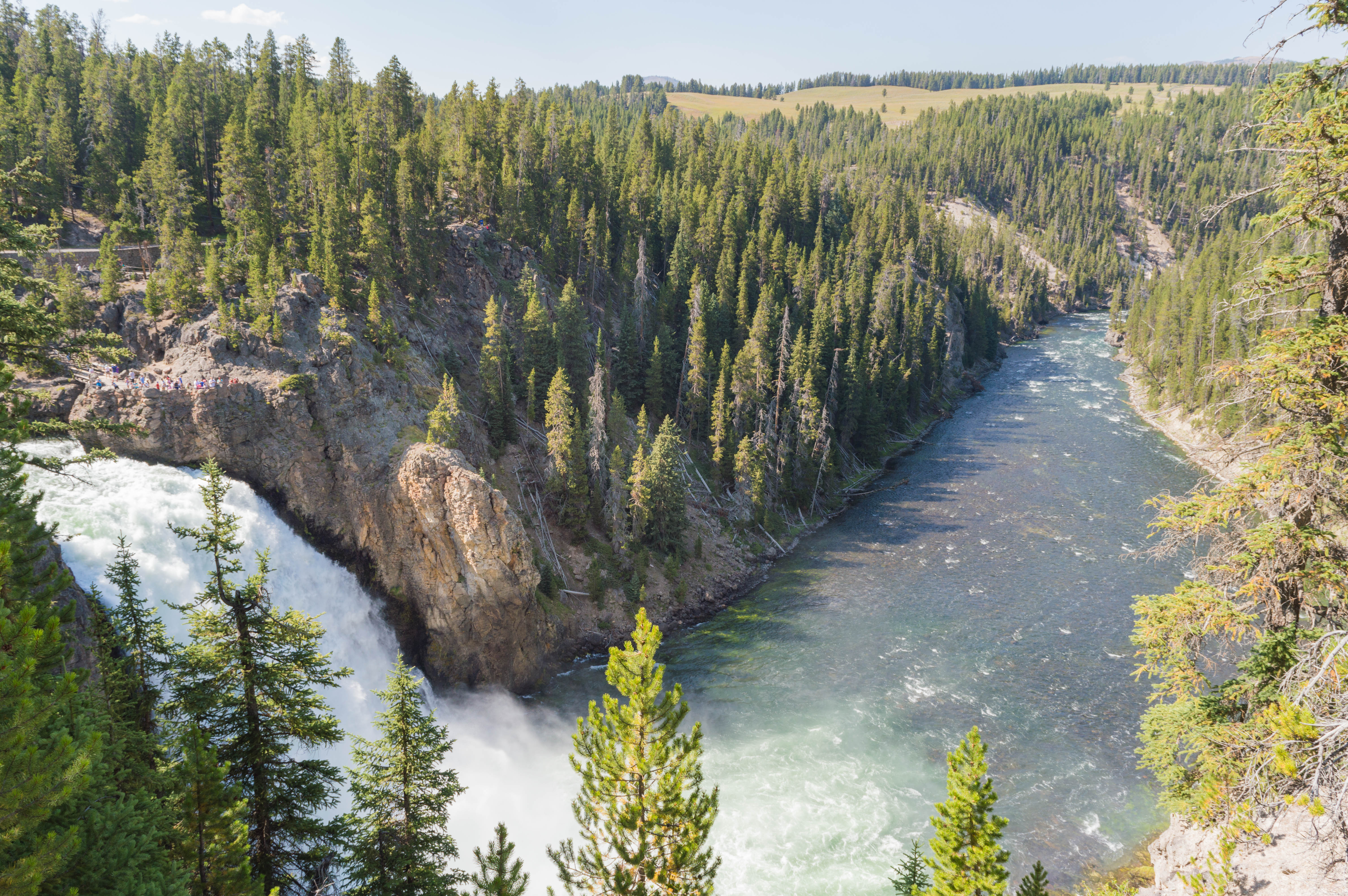
Yellowstone Falls
Captain William Clark heard stories of a great waterfall in the Yellowstone country and wrote them off as frontier tall tales. He should have believed them. Where the Yellowstone River leaves Hayden Valley and begins its northward journey, it encounters a geological boundary between hard rhyolite and softer, glassy lava. The result is two of the most dramatic waterfalls in North America: Upper Falls at 109 feet, followed a quarter-mile downstream by Lower Falls, a 308-foot cascade from 590,000-year-old Canyon Rhyolite that creates the largest-volume waterfall in the Rocky Mountains. The river then carves through the Grand Canyon of the Yellowstone, a chasm reaching depths of 1,200 feet.
Twice Niagara's Height
Lower Falls commands attention through sheer scale. At 308 feet, it stands nearly twice as tall as Niagara Falls, though the Yellowstone River narrows to just 70 feet at the brink compared to Niagara's 2,500-foot crest line. Water volume varies dramatically with the seasons: autumn brings a modest flow, while late spring runoff transforms the falls into thundering power. The hard Canyon Rhyolite lava flow that forms the lip has resisted erosion for nearly 600,000 years, while the softer rock below has been carved away to create the canyon's vertical walls. Upper Falls, though less famous, marks the precise geological boundary where two ancient lava flows meet, the harder rock standing firm while its neighbor erodes backward year by year.
Explorers and Artists
French fur trapper Baptiste Ducharme likely became the first European to see the falls in 1824, returning in 1826 and 1839. Jim Bridger claimed a visit in 1846, and by 1851 was providing Father Pierre-Jean De Smet with maps showing their location. Bridger estimated Lower Falls at 250 feet, modest compared to an 1867 newspaper story that placed its height at "thousands of feet." The Cook-Folsom-Peterson Expedition gave the falls their current names in 1869. But it was the 1871 Hayden Expedition that brought Yellowstone to the nation's imagination. Photographer William Henry Jackson captured the falls on glass plates, while painter Thomas Moran translated the scene into canvases that would convince Congress to create the world's first national park. Private Charles Moore's pencil sketches from 1870 remain the earliest known images.
Winter's Silent Witness
In January 1887, photographer Frank Jay Haynes accomplished something remarkable: the first winter photographs of Lower Falls. The journey required snowshoes and determination, but Haynes captured the falls transformed by cold into a cathedral of ice and mist. Today, multiple vantage points offer summer visitors different perspectives on the spectacle. The Canyon loop road provides parking areas along the north rim, with one steep trail descending to the Brink of Lower Falls. Uncle Tom's Trail once offered access from the east via stairs bolted directly to the canyon cliffs, though it remained closed as of 2022. A one-way loop drive south from Canyon Junction delivers visitors to four viewpoints, including the trail to the very top of Lower Falls.
Moving Pictures
Thomas Edison recognized the falls' cinematic potential early. In 1899, his crew captured Lower Falls on film, creating a motion picture record now preserved in the Library of Congress. The footage captures something photographs cannot: the relentless movement of water, the play of light through mist, the sense of geological time made visible. Ansel Adams photographed the falls in 1941, adding his iconic black-and-white vision to the artistic record. The falls continue to draw photographers and painters seeking to capture what words struggle to convey. Artists have attempted to represent this place since Private Moore sharpened his pencil in 1870, and the challenge remains undiminished. The canyon walls glow yellow from volcanic gases that altered the rock, the water catches light as it falls, and the whole scene shifts with every change in weather and season.
From the Air
Located at 44.71N, 110.50W in the heart of Yellowstone National Park, where the Yellowstone River enters the Grand Canyon of the Yellowstone. The falls and yellow-walled canyon are unmistakable from the air, particularly when morning light catches the mist. Best viewed at 8,000-10,000 feet AGL for full canyon perspective. Nearest airports: West Yellowstone (KWYS) 30nm southwest, Yellowstone Regional (KCOD) 45nm east. The canyon runs roughly north-south with the falls at its head.