Yellowstone National Park
In 1872, President Ulysses S. Grant signed legislation creating something that had never existed anywhere on Earth: a national park. The land he set aside sprawls across 2.2 million acres, mostly in Wyoming's northwest corner, with fingers reaching into Montana and Idaho. Beneath it all lies a supervolcano whose last eruption, 640,000 years ago, was a thousand times more powerful than Mount St. Helens and covered much of North America in ash. That sleeping giant still powers the world's largest collection of geothermal features - more than 10,000 hot springs, mudpots, and fumaroles, plus 300 geysers accounting for two-thirds of all those on Earth. Old Faithful draws the crowds, but the park's true marvel is that you can stand on a thin crust above one of the planet's most powerful volcanic systems and watch it breathe.
Fire Beneath the Surface
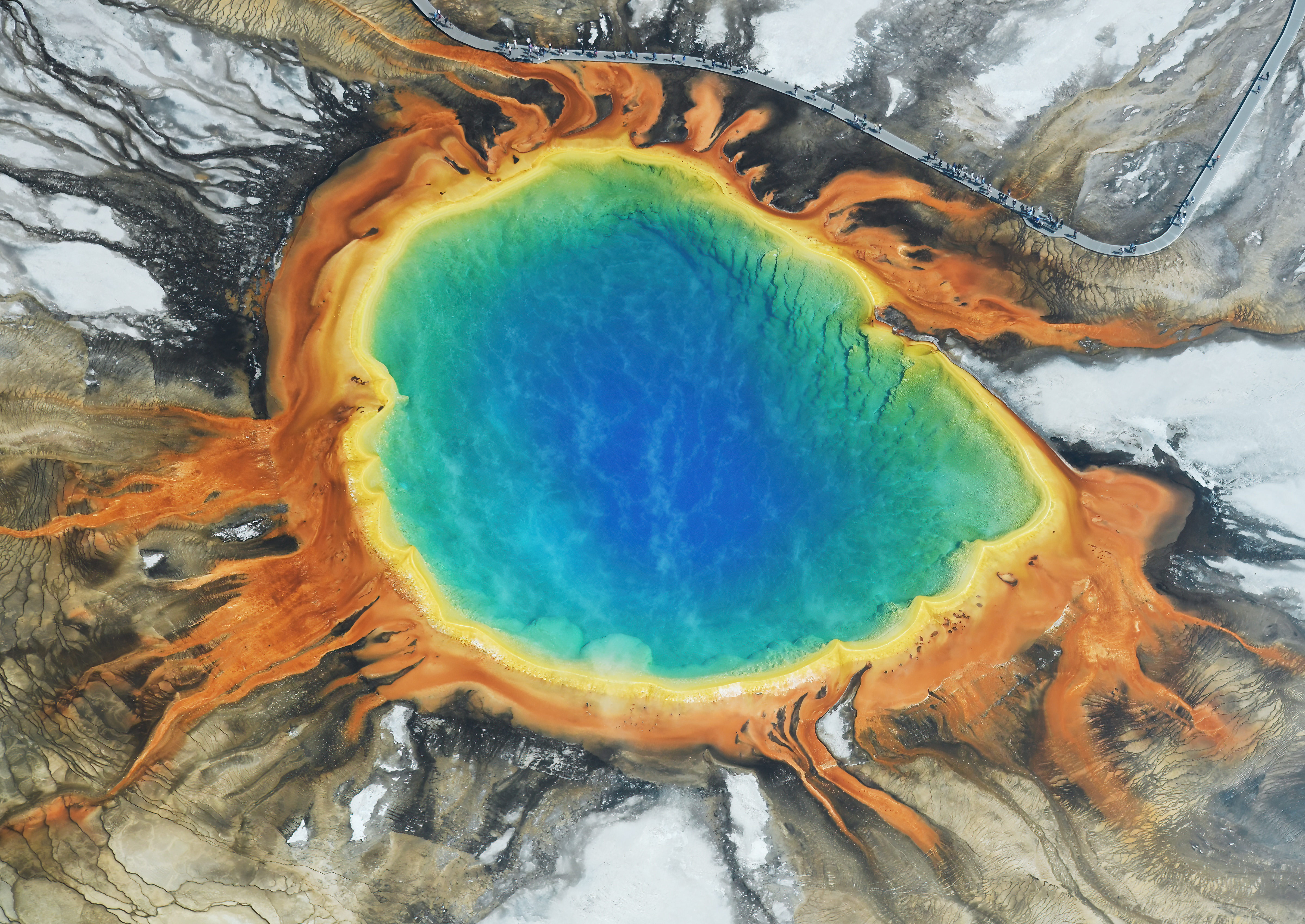
Yellowstone sits atop a magma chamber that releases tremendous heat through the park's hydrothermal features. Snow and rain percolate through permeable rock, meet superheated brine from the magma body, and rise back through natural plumbing systems to emerge as geysers, hot springs, and mudpots. The Norris Geyser Basin contains Steamboat Geyser, the world's tallest, capable of erupting water 300 feet into the air. The Grand Prismatic Spring, larger than a football field, displays rings of color - orange, yellow, green - created by heat-loving bacteria thriving at different temperatures. Old Faithful erupts with famous regularity, but hundreds of other geysers perform on schedules known only to the earth. The caldera left by the last super-eruption measures 30 by 45 miles - too large to perceive from any single vantage point.
Wildlife Kingdom
Yellowstone is the core of the Greater Yellowstone Ecosystem, one of the last large intact temperate ecosystems on Earth. Sixty-seven mammal species live here, including the largest concentration of large mammals in the lower 48 states. Grizzly and black bears roam the backcountry. Gray wolves, hunted to extinction by 1926, were reintroduced from Canada in 1995; more than 100 now inhabit the park, making it one of the best places in America to see them in the wild. The Lamar Valley, in the park's northeast, offers such reliable wolf-watching that devotees call it the Serengeti of North America. Bison - the park protects America's largest herd on public land - create traffic jams when they amble across roads. Elk graze the lawns of Mammoth Hot Springs. Moose, pronghorn, bighorn sheep, and seven other ungulate species complete an assemblage unmatched anywhere in the temperate world.
The Grand Loop
The park's roads form a figure-eight known as the Grand Loop, roughly 140 miles total. The lower loop connects West Thumb on Yellowstone Lake through Old Faithful to Madison, Norris, and Canyon before returning via Lake Village. The upper loop runs from Norris through Mammoth Hot Springs and Tower-Roosevelt to Canyon. Each section offers different character: the golden travertine terraces of Mammoth, the roaring Lower Falls of the Grand Canyon of the Yellowstone, the wildlife-rich Hayden Valley, the otherworldly geyser basins around Old Faithful. The canyon itself drops 1,200 feet through walls stained yellow by hydrothermal action - the color that likely gave the Yellowstone River, and thus the park, its name. Most visitors see only what's visible from roadsides, but more than 1,000 miles of trails lead into backcountry that looks much as it did when the first national park was created.
Winter World
From early November to mid-May, most park roads close to wheeled vehicles. The landscape transforms into something primal: geysers erupting into frigid air, their steam plumes visible for miles; bison and elk congregating near thermal features for warmth; wolves hunting across snow-covered meadows. Winter visitors travel by snowcoach or guided snowmobile along groomed routes. The Old Faithful Snow Lodge and Mammoth Hot Springs Hotel offer the only winter lodging inside the park. Those who make the journey experience Yellowstone at its most elemental - the clash of fire and ice that defines this landscape, unbuffered by summer crowds. The north entrance from Gardiner, Montana, remains open year-round, providing vehicle access to Mammoth and the Lamar Valley, where winter wildlife watching can be spectacular.
Living with Danger
Yellowstone's hazards match its wonders. Thermal features that delight the eye can kill in seconds - scalding water lies under thin crusts, and people have died after falling through. Park regulations require staying on boardwalks, but every year visitors ignore the signs. Bears require food storage in bear-proof containers and awareness of proper distances - 100 yards from wolves and bears, 25 yards from other wildlife. Bison, despite their placid appearance, injure more visitors than any other animal; they can run 35 miles per hour and will charge if approached. Yellowstone Lake, one of the largest high-altitude lakes in the world, generates its own weather and has claimed boats caught in sudden storms. The weather can change from sunny to snowy in minutes at any time of year. Yet for those who respect the rules, Yellowstone offers safe passage through a landscape that predates human existence and will outlast it.
From the Air
Located at 44.62°N, 110.55°W in northwestern Wyoming, with portions extending into Montana and Idaho. The park covers 2.2 million acres centered on a volcanic caldera 30 by 45 miles. Yellowstone Lake is visible as a large body of water in the southeast quadrant. Steam plumes from major geyser basins may be visible in cool conditions. West Yellowstone Airport (KWYS) offers summer access; Jackson Hole Airport (KJAC) in Grand Teton National Park to the south provides year-round service. The figure-eight Grand Loop road system is visible from altitude. Best approached in clear conditions when thermal features and the Grand Canyon of the Yellowstone are visible.