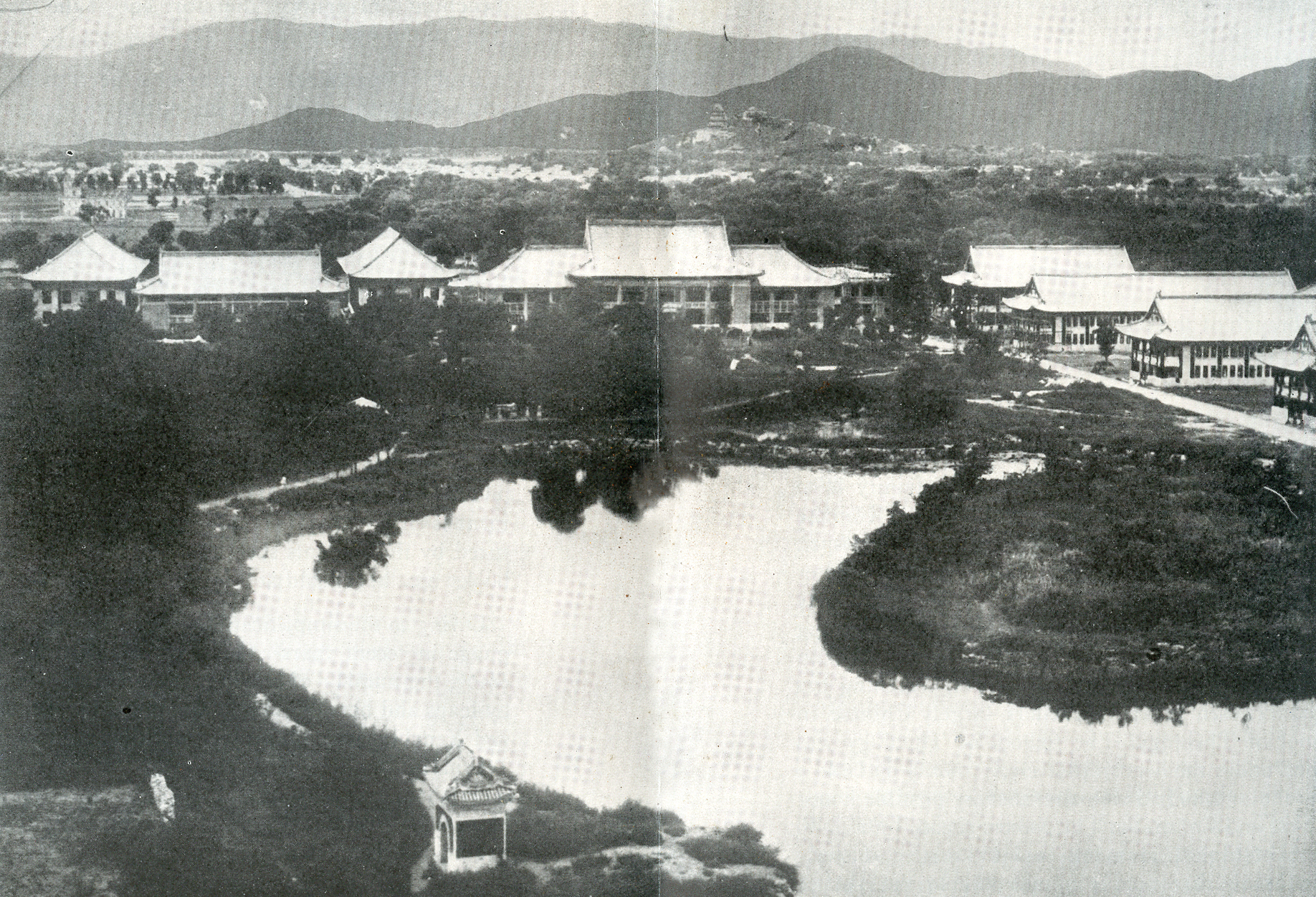
Yenching University
When John Leighton Stuart arrived in Beijing in 1919 to lead a fledgling university, he had almost nothing to work with: four struggling Christian colleges, barely enough students to fill a lecture hall, and a treasury that echoed when you knocked. What he built over the next decade would become one of the finest universities in China, a place where Chinese and Western scholarship met as equals rather than as colonizer and subject. Its name, Yenching, reached back to the ancient State of Yan, whose capital once stood on this same ground more than two thousand years earlier.
A Campus Fit for Scholars
Stuart's first genius move was real estate. He purchased the royal gardens of a Qing Dynasty prince, complete with pavilions, lotus ponds, and centuries-old trees, then hired gardeners from the Imperial gardens to maintain them. The campus that took shape by 1926 blended traditional Chinese architecture with modern academic facilities, a deliberate statement that this was a Chinese university first and a Christian one second. Funding came from an unlikely source: the estate of Charles Martin Hall, the American aluminum magnate behind Alcoa, whose posthumous philanthropy transformed a bare-bones operation into an institution with genuine ambitions.
Where Harvard Met the Warring States
In 1928, Yenching and Harvard jointly founded the Harvard-Yenching Institute, an arrangement that elevated both institutions' work in East Asian humanities and social sciences. The driving force on the Yenching side was William Hung, a sinologist who became chairman of the History Department and dean. Under Hung's leadership, the university published the Harvard-Yenching Sinological Index Series, a monumental reference work that scholars still consult. By 1930, Yenching ranked among China's top universities, distinguished by a degree of academic freedom unusual for the era. Religion was not a requirement for faculty; Stuart wanted the best minds, whatever their beliefs.
War and Occupation
The Second Sino-Japanese War shattered the campus idyll. Japanese military police, the Kempeitai, sealed off the grounds and arrested foreign faculty. The university relocated to Chengdu in Sichuan province, continuing instruction far from home. When the People's Republic was established in 1949, Yenching reopened in Beijing, briefly straddling the old world and the new. But the Korean War proved fatal to the arrangement. The United States froze Chinese assets and banned fund transfers to the PRC, severing the financial lifeline that sustained American-influenced institutions across China.
Dissolution and Legacy
In 1952, Yenching University was absorbed into the reorganization of Chinese higher education. Its campus became the grounds of Peking University, which still occupies the site today. The royal gardens, the pavilions, the carefully tended landscape that Stuart assembled from a prince's inheritance now serve a different institution, but the physical beauty endures. The Harvard-Yenching Institute continues to operate from Cambridge, a living remnant of the partnership. Yenching's brief life, just thirty-three years, produced an outsized legacy: a model for cross-cultural scholarship that treated Chinese intellectual traditions as worthy of serious, equal study rather than missionary conversion projects.
From the Air
Located at 39.99°N, 116.31°E in northwestern Beijing's Haidian District. The former Yenching campus is now Peking University. Nearest airport: Beijing Capital International (ZBAA), approximately 25 km northeast. Beijing Nanyuan (ZBNY) lies about 20 km south. Visible as a large university campus with traditional Chinese architecture amid gardens and lakes.