Yerba Buena Gardens
The name predates the city. Yerba Buena -- 'good herb' in Spanish, referring to the mint that grew wild on the peninsula -- was the original settlement that became San Francisco. The gardens that now carry the name occupy two city blocks between Third and Fourth, Mission and Folsom Streets in the South of Market neighborhood, a public park built atop the Moscone Convention Center that opened in two phases: the first block in October 1993, the second in 1998 with a dedication to Martin Luther King Jr. The gardens transformed a stretch of SoMa that had been parking lots and industrial space into one of the city's most active public spaces.
Built on Top of Something
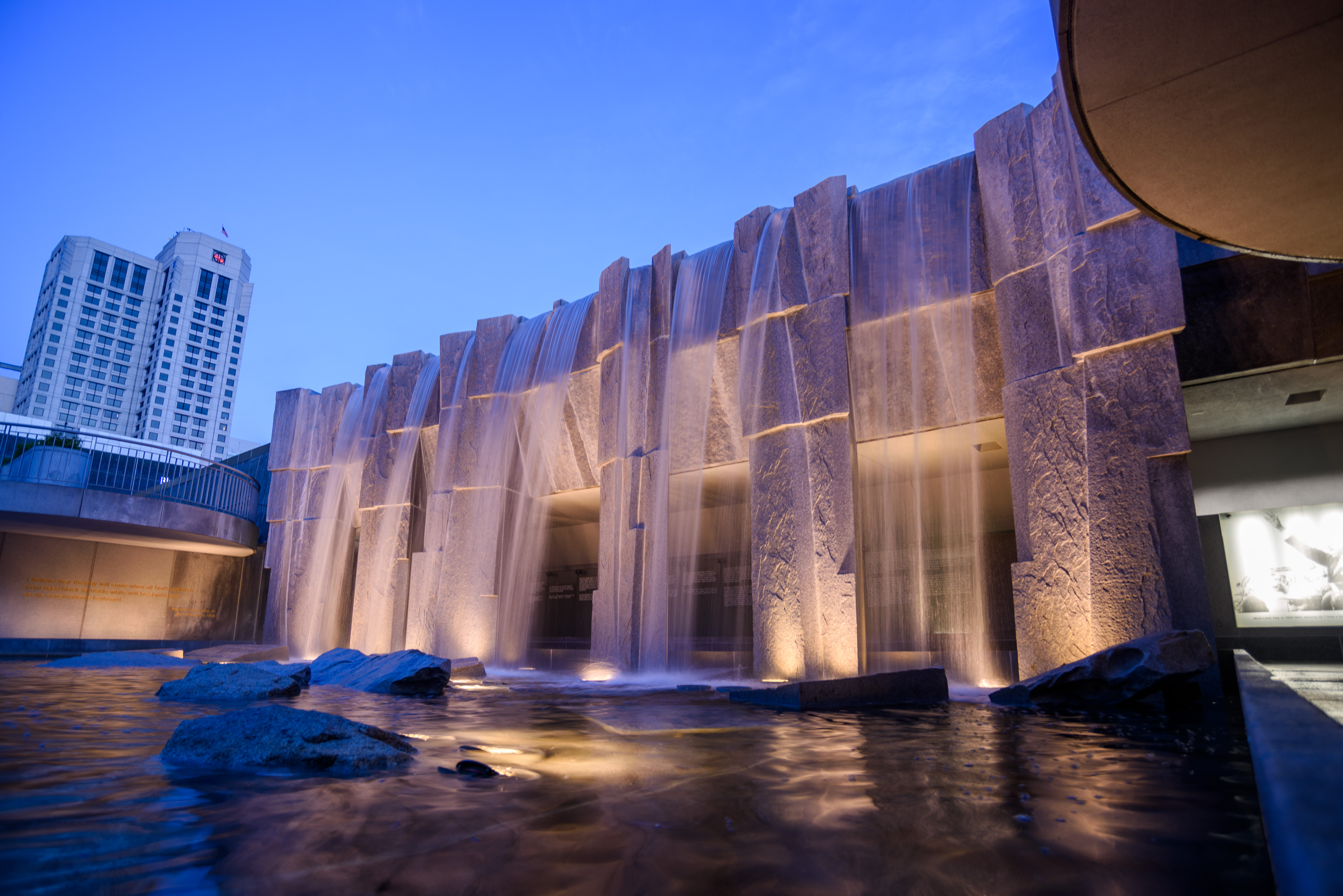
Yerba Buena Gardens sits atop the underground Moscone Convention Center, a structural arrangement that turns the gardens into a rooftop park without most visitors realizing it. The engineering required to create a public park on the roof of a convention center -- with mature trees, a waterfall, and open lawns capable of supporting crowds -- was considerable. The result is a green space that feels grounded and permanent despite being, technically, elevated. The Martin Luther King Jr. memorial waterfall, inscribed with quotations from his speeches, provides the gardens' emotional anchor, its sound masking the traffic on the surrounding streets.
The Cultural Campus
The gardens are surrounded by cultural institutions that collectively form one of the densest arts districts in the city. Yerba Buena Center for the Arts, with galleries and performance spaces designed by Fumihiko Maki, occupies the north side. The Children's Creativity Museum offers interactive exhibits for families. The Metreon entertainment complex and the San Francisco Museum of Modern Art are within walking distance. This clustering of cultural venues around a public park was deliberate -- the gardens were designed as the open-air heart of a cultural campus that would draw visitors south of Market Street, away from the tourist circuit of Fisherman's Wharf and Union Square.
SoMa's Living Room
The gardens have become what urban planners call a 'third place' -- neither home nor office, but the shared public space where city life happens. Office workers eat lunch on the lawns. Families bring children to the playground. Festivals and free concerts fill the esplanade. The space accommodates tech workers from the surrounding startup offices, families from nearby residential neighborhoods, tourists, and the homeless population that has long been part of SoMa's human geography. This mixing of populations is the gardens' greatest achievement and its ongoing challenge: creating a public space that genuinely belongs to everyone in a city where 'everyone' encompasses enormous economic and social distances.
From the Air
Yerba Buena Gardens is at 37.79N, -122.40W in San Francisco's SoMa district, between Third and Fourth Streets. The gardens appear as a green rectangle amid the dense urban grid, adjacent to the Moscone Convention Center. The SF MOMA's distinctive white facade is visible nearby. Nearest airports: KSFO 10nm south, KOAK 8nm east.