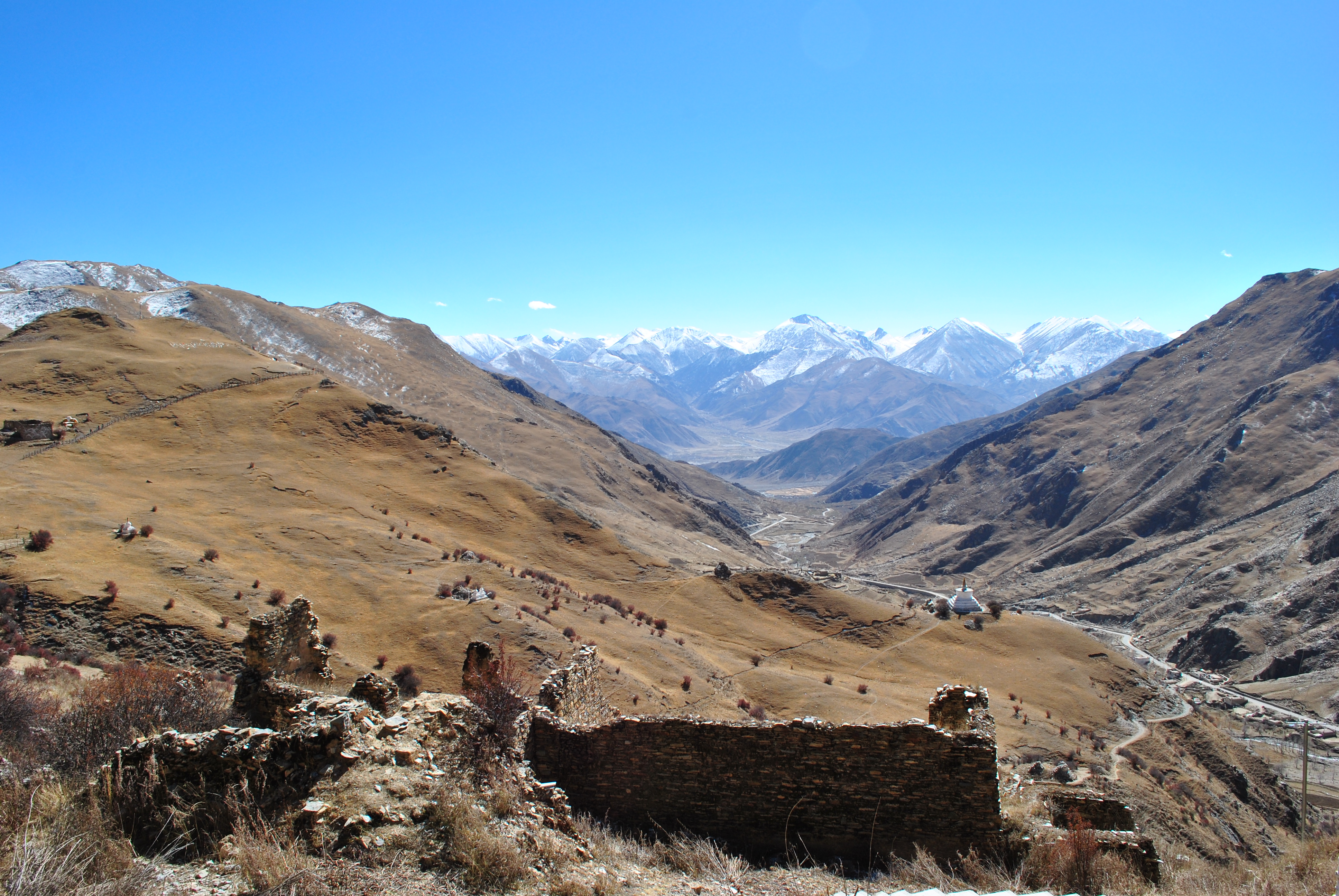
Yerpa
After assassinating the anti-Buddhist emperor Langdarma in 842, the monk Lhalung Pelgyi Dorje fled to Yerpa and hid in a cave. He meditated there for twenty-two years. His hat was kept in that cave until 1959. This is the kind of place Yerpa is -- a site where extreme acts of conscience and extreme acts of stillness have occupied the same limestone cliffs for over a thousand years. Located 16 kilometers northeast of Lhasa on the northern bank of the Kyichu River, then another 10 kilometers into a spectacular valley of pale rock, Yerpa became one of the three most important meditation centers in Central Tibet. Some of its caves predate Buddhism entirely.
Kings and Caves
The caves at Yerpa are tied to the founding mythology of Tibetan Buddhism. Songtsen Gampo, the 7th-century emperor who unified Tibet and is credited with introducing Buddhism to the plateau, is said to have meditated here with his two foreign-born queens. His Tibetan queen, Monza Triucham, founded the Dra Yerpa temple. In the Peu Marsergyi Temple and the Chogyel Puk, the royal family reportedly discovered "self-originated" symbols of the Buddha-body, speech, and mind. Later, both Songtsen Gampo and Trisong Detsen, the 8th-century emperor who made Buddhism Tibet's state religion, are recorded as founding temples at Yerpa. Even the legendary hero Gesar of Ling is said to have visited the valley, leaving arrow holes in the cliff face as proof.
Seven Months in the Dawa Puk
Padmasambhava -- Guru Rinpoche, the tantric master credited with establishing Buddhism in Tibet -- meditated at Yerpa with his yogini companion Yeshe Tsogyal. He spent seven months in the Dawa Puk cave, which is considered one of his three most important places of spiritual attainment. The great Bengali scholar Atisha, who arrived in Tibet in the 11th century and preached extensively in the valley, had a hermitage here that housed 300 monks as late as the 19th century. It served as the summer quarters for the Ramoche Monastery's Upper Tantric College. Several of Guru Rinpoche's disciples are also said to have meditated in these caves, layering the site with centuries of accumulated spiritual significance. Across from the main caves sits an ancient sky burial site, where the dead were offered to vultures in the traditional Tibetan way.
Reformation and Conflict
Yerpa's religious affiliation shifted with the tides of Tibetan politics. The ancient Kadampa monastery Yerpa Drubde passed to Gelug control after Je Tsongkhapa's reformation in the early 15th century. But when the Tsangpa forces fought for control of Lhasa after the death of the 4th Dalai Lama in 1617, the monks of Sera and Drepung revolted in 1618. Many were killed; survivors fled northeast to Taklung. Khonton Rinpoche, who had urged the monks of Sera to avoid violence, retreated to Yerpa until calm returned. The monastery lost its wealth during these conflicts and was placed under the jurisdiction of Taklung Monastery. Yet its contemplative function continued -- some 300 monks lived at Yerpa from at least the beginning of the 19th century until 1959.
Destruction and the Persistence of Stone
In 1959, the Drubde monastery at Yerpa was destroyed. During the Cultural Revolution from 1966 to 1976, the entire complex -- the Drag Yerpa monastery, the Upper Tantric College summer residence, the cave temples -- was completely demolished. Voluntary labor and donations later enabled partial restoration of some cave temples and of Drag Yerpa itself. But the restored site has faced ongoing restrictions. After the disturbances of October 1987, police posted notices on temple doors warning against "counter-revolutionary activities." In 1998, the government demolished chapels that had been rebuilt without authorization. As recently as 2008, the number of monks permitted at Yerpa remained strictly controlled. The limestone cliffs, at least, are indifferent to politics. They hold the caves as they have for centuries, open and silent, waiting for whoever comes next to sit down and be still.
From the Air
Yerpa is located at 29.746N, 91.278E in Dagze County, approximately 16km northeast of Lhasa along the Kyichu River's northern bank, then 10km into the Yerpa Valley. Elevation is approximately 4,200m. Lhasa Gonggar Airport (ZULS) is the nearest major airport, roughly 80km to the southwest. The limestone cliffs of the Yerpa Valley are visible from altitude as pale rock formations against the darker surrounding terrain. A sky burial site is visible opposite the main cave complex.