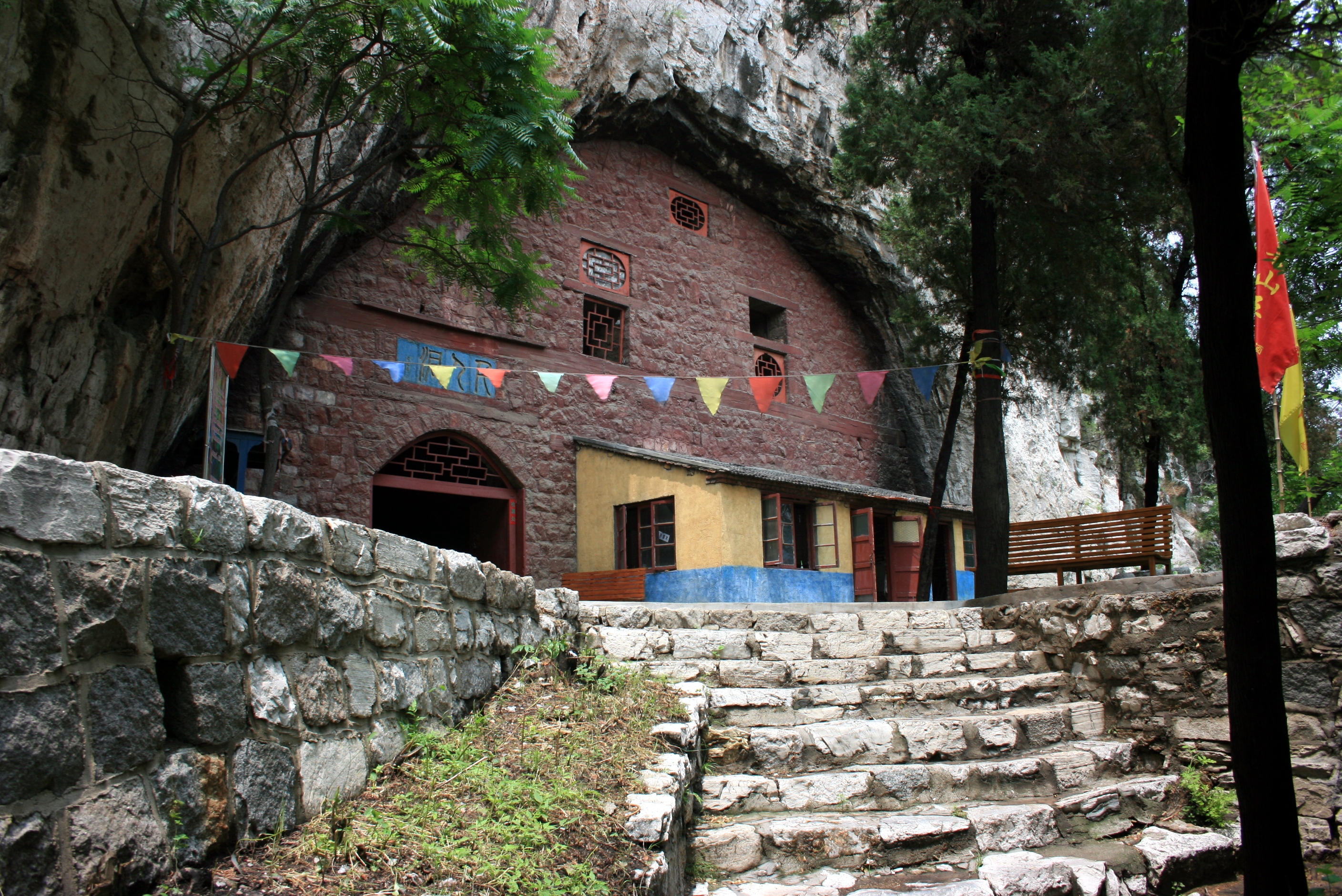
Yiyuan Rong Cave Group
Somewhere in the darkness of Thousand-Men Cave, Chinese soldiers once stored weapons to fight the Japanese. From September 1938 to March 1939, the Eighth Route Army used this cave as an arsenal -- its natural chambers providing concealment that no constructed bunker could match. The cave is one of more than 40 in the Yiyuan Rong Cave Group, a sprawling network of Ordovician limestone formations near the city of Zibo in Shandong Province. Covering approximately 10 square kilometers, it is the largest cluster of limestone caves in China north of the Yangtze River, and its individual caverns bear names that read like chapters from a fantasy novel: Stone-Dragon Cave, Nine-Skies Cave, Coral Cave, Lingzhi Cave.
Four Hundred Million Years Underground
The caves formed in Ordovician limestone, rock that was deposited as marine sediment roughly 450 million years ago, when the area that is now Shandong Province lay beneath a warm, shallow sea. Over the geological ages that followed, groundwater dissolved channels and chambers through the limestone, creating the network of caves that honeycomb the hills north of the town of Tumen. Rong Cave, the group's namesake, lies about 13 kilometers north of town and gives its name to the entire cluster. The geological process that created these caves is the same one at work in any limestone karst landscape -- the slow chemical marriage of water and carbon dioxide eating away at calcium carbonate -- but the scale here is unusual for northern China, where karst formations are less common than in the south.
Names Like Spells
The caves' names reflect centuries of human imagination projected onto underground spaces. Lingzhi Cave takes its name from the lingzhi mushroom, a fungus prized in Chinese medicine and folklore as a symbol of longevity and spiritual power. Shenxian Cave -- "Immortal's Cave" -- evokes the Daoist tradition of hermit sages retreating into mountains and caverns to achieve transcendence. Xuanyun Cave and Nine-Skies Cave suggest cosmic architecture, as though the caves were portals to heavenly realms. Even the more prosaic names carry weight: Resting Cave implies a place of shelter, while Thousand-Men Cave tells you exactly how many soldiers its chambers could conceal. Each name is a compressed story, an invitation to see these underground spaces as something more than geological features.
From Arsenal to Tourist Attraction
The wartime use of Thousand-Men Cave connects the cave group to one of the most consequential periods in Chinese history. The Eighth Route Army, the Communist forces operating in North China during the Second Sino-Japanese War, relied on the region's natural landscape for guerrilla warfare. Caves offered storage, concealment, and shelter in ways that the flat plains of Shandong could not. After the war, several of the major caves were developed as tourist attractions, their chambers illuminated to reveal the stalactites, stalagmites, and flowstone formations that had been growing in darkness for millennia. Today visitors can walk through lit passages that soldiers once navigated by oil lamp, the same geological features that once hid an arsenal now drawing visitors for their beauty.
From the Air
The Yiyuan Rong Cave Group is located at approximately 36.27°N, 118.07°E, about 13 km north of the town of Tumen, under the administration of Zibo, Shandong Province. The cave group spans approximately 10 square kilometers of hilly terrain. From cruising altitude, the area appears as forested hills with occasional exposed limestone formations. Nearest major airport: Jinan Yaoqiang International (ZSJN), approximately 120 km to the west, or Qingdao Jiaodong International (ZSQD), approximately 200 km to the east. The terrain is hilly with moderate elevation.