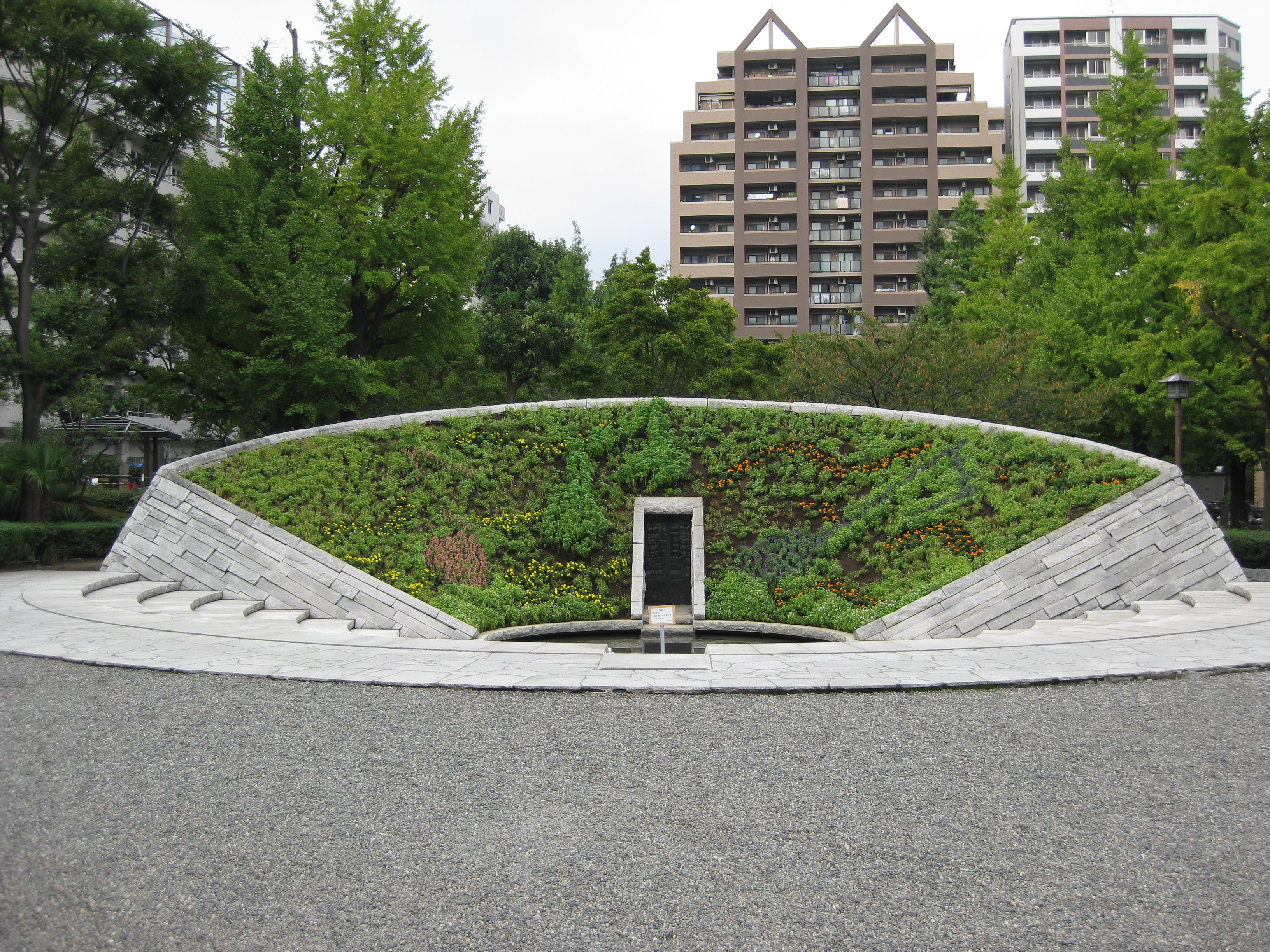
Yokoamichō Park
On September 1, 1923, tens of thousands of people fleeing the Great Kanto Earthquake packed into an open tract of land in the Yokoami district of Sumida, Tokyo. They believed the open ground would protect them from collapsing buildings. Instead, a firestorm swept through the area, and as many as 44,000 people burned to death in a single afternoon. That open tract of land is now Yokoamichō Park, and the ground beneath its quiet walkways and stone memorials holds the ashes of more than 160,000 souls — victims not only of the earthquake but also of the devastating firebombing raids that leveled Tokyo two decades later.
Ashes of the Earthquake
The 1923 Great Kanto Earthquake struck at 11:58 a.m. on a Saturday, just as charcoal stoves across the city were lit for the midday meal. Fires erupted everywhere, driven by typhoon winds into walls of flame. The open land at Yokoami, then a vacant site formerly occupied by an army clothing depot, became an instinctive gathering point for those escaping the inferno. But the firestorm found them there. Wind-driven flames converged on the crowd from multiple directions, creating a vortex of superheated air. In the aftermath, the site was designated a memorial. The Earthquake Memorial Hall, completed in 1930, rises above the park as a solemn marker. A charnel house nearby contains the ashes of 58,000 victims of the earthquake, gathered from across the devastated city and given a final resting place in this small, contemplative space.
A Second Wave of Grief
History repeated its cruelty at Yokoamichō Park during World War II. Between 1944 and 1945, American B-29 bombers conducted a sustained firebombing campaign against Tokyo. The most devastating raid came on the night of March 9-10, 1945, when over 300 bombers dropped incendiary clusters across the densely packed wooden neighborhoods of eastern Tokyo. The resulting firestorm killed an estimated 100,000 people in a single night. Between 1948 and 1951, the ashes of 105,400 people killed in the bombing raids were interred in the park, joining those of the earthquake victims beneath the same soil. A memorial specifically honoring the bombing victims was opened in March 2001, more than half a century after the raids. The park thus carries a double burden of memory, a place where two of the worst catastrophes in Tokyo's history converge in a single modest green space.
Contested Memory
Every September 1, Yokoamichō Park becomes a flashpoint for one of Japan's most painful unresolved histories. In the chaotic days following the 1923 earthquake, rumors spread that Korean residents were poisoning wells and setting fires. Vigilante mobs, aided in some cases by police and military, killed thousands of Korean and Chinese people in what became known as the Kanto Massacre. Since 1974, memorial ceremonies have been held in the park to honor those victims. But the ceremonies have drawn increasingly organized counter-protests from groups denying the massacre occurred. In 2020, counter-demonstrators displayed signs reading "The massacre of Koreans is a lie," prompting the deployment of 700 police officers to keep the peace. The controversy deepened when Tokyo Governor Yuriko Koike declined to send a commemorative message to the ceremony for the sixth consecutive year in 2022, a break from her predecessors' longstanding tradition.
A Quiet Place of Reckoning
For most of the year, Yokoamichō Park is a tranquil urban space in the Sumida ward, just east of the Sumida River. Visitors walk past the memorial hall, pause at the charnel house, and sit on benches shaded by trees that have grown tall in the decades since the park was established. The quietness can be deceiving. Few places in Tokyo hold so much loss in so small an area. The park stands as both a place of mourning and a living argument about how nations remember their worst moments — the natural disasters that struck without warning, the wartime destruction that rained from above, and the violence that communities inflicted on their own neighbors in moments of panic and prejudice. The dual memorials, one for earthquake victims and one for bombing victims, frame the park as a space where Tokyo confronts the full weight of its twentieth-century suffering.
From the Air
Located at 35.6995°N, 139.7967°E in the Sumida ward of eastern Tokyo, along the east bank of the Sumida River. The park is near Ryogoku, identifiable by the distinctive Ryogoku Kokugikan sumo arena nearby. Nearest airports: Tokyo Haneda (RJTT) approximately 15 km south, Narita (RJAA) approximately 60 km east. Best viewed at low altitude (1,500-3,000 ft) where the park's memorial hall and surrounding dense urban fabric of Sumida are visible. The Sumida River provides a strong visual reference for navigation.