Yokohama Archives of History: Where Japan Met the World
On March 31, 1854, Commodore Matthew Perry stepped ashore at what is now Kaiko Hiroba -- Port Opening Square -- and signed the Convention of Kanagawa, cracking open two centuries of Japanese isolation in a single afternoon. Today, the building standing next to that landing site holds the paper trail of everything that followed: treaties and trade disputes, earthquake reports and wartime dispatches, the personal diaries of diplomats who watched a feudal nation transform into a modern power in a single generation. The Yokohama Archives of History is not a museum of objects. It is a museum of documents -- the raw, handwritten, ink-stained record of what happens when two civilizations collide and then, slowly, learn to do business.
The Consulate That Survived
The archives occupy the former British Consulate in Naka ward, central Yokohama, just steps from Yamashita Park and the waterfront. The original consulate building was destroyed in the Great Kanto earthquake of 1923, which killed more than 100,000 people across the region and leveled much of Yokohama. The replacement, completed in 1931, served as Britain's diplomatic outpost in Yokohama until 1972, when the consulate finally closed. The building carries its history on its walls: plaques commemorate consulate employees killed in the 1923 earthquake and British sailors who died during the Bombardment of Kagoshima in 1863 -- a naval engagement that occurred less than a decade after Perry's arrival, when the new openness between Japan and the West was still volatile and dangerous. The British Court for Japan sat in the consulate compound from 1879 to 1900, adjudicating disputes between British subjects and Japanese citizens under the extraterritorial treaty system. Before that, the British Provincial Court for Kanagawa operated from the same site beginning in 1865.
Ink and Newsprint
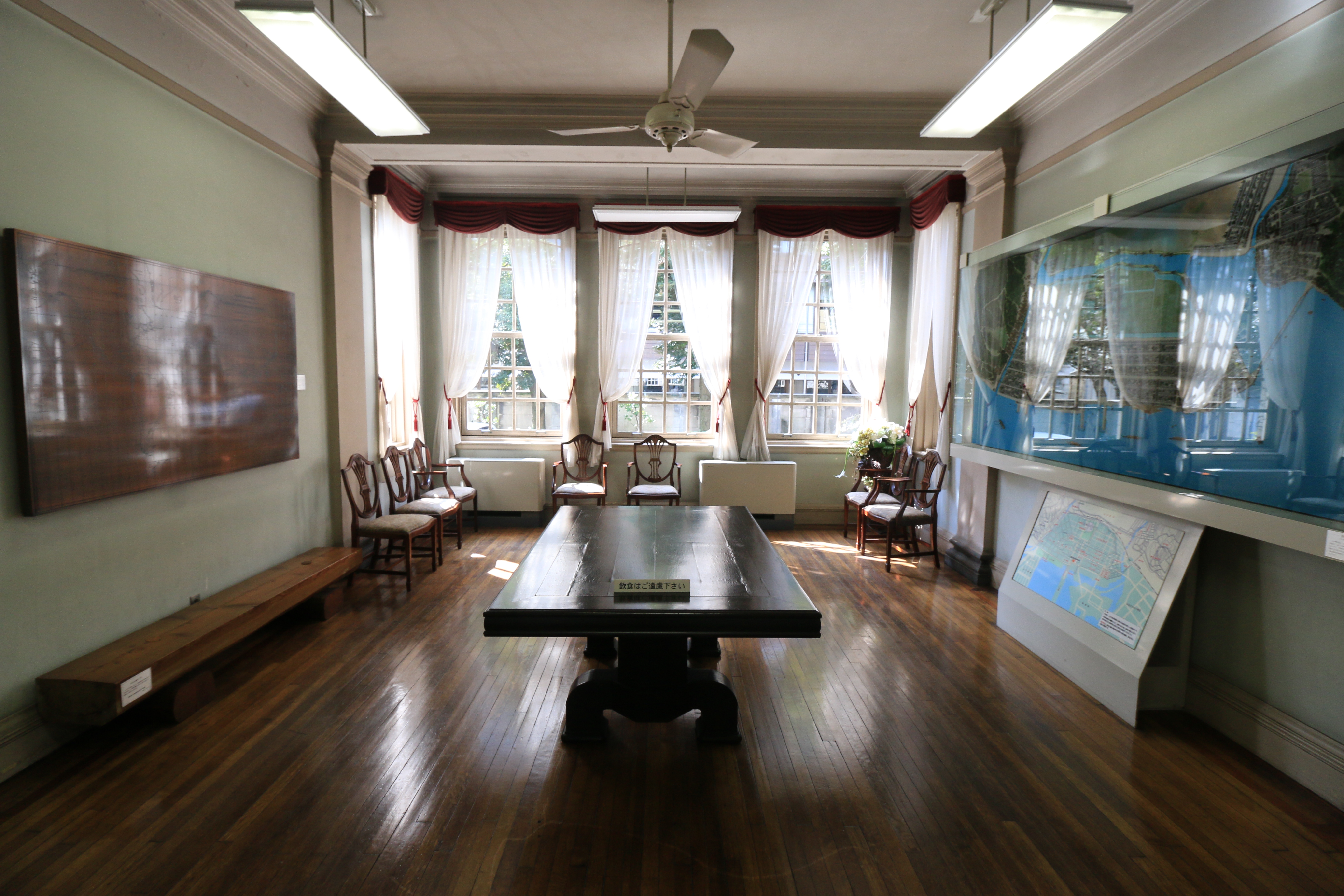
The archives' reading room holds a collection that would make any historian of Meiji-era Japan weep with gratitude. Papers of Ernest Satow -- the British diplomat and scholar who witnessed the fall of the Tokugawa shogunate firsthand and wrote one of the definitive Western accounts of the Meiji Restoration -- are stored here. Shelves hold foreign and Japanese newspapers from the Meiji period, including the Japan Daily Herald, the Japan Weekly Mail, and the Japan Punch, a satirical magazine founded by British cartoonist Charles Wirgman in 1862. Many of these fragile originals have been painstakingly copied onto fresh paper, so visitors can handle and photocopy them freely. Collections of diplomatic papers trace Japan's foreign relations through decades of negotiation, confrontation, and transformation. The ground floor exhibition room, free to the public, tells the broader story of Yokohama's evolution from a sleepy fishing village into one of Asia's great international ports.
Port of First Contact
Yokohama's identity as a gateway city was not accidental. When the Tokugawa shogunate agreed to open ports to foreign trade in the 1850s, Yokohama was chosen partly because it was far enough from Edo -- modern Tokyo -- to keep foreign influence at a comfortable distance. The plan backfired spectacularly. Within years, Yokohama had become a cosmopolitan boomtown, home to American, British, French, Dutch, and Chinese traders, each clustered in their own settlements. The archives document this explosion of cross-cultural contact in granular detail: trade agreements, shipping manifests, consular dispatches, personal correspondence. The Sino-Japanese Friendship and Trade Treaty of 1871 expanded commerce further, and by the 1880s, Yokohama was processing silk exports that fueled Japan's industrial revolution. The archives sit at the epicenter of all of it, on ground where Perry's boots left prints in the sand.
A Living Repository
Unlike grander museums that trade in spectacle, the Yokohama Archives of History operates with quiet purpose. The newly built annex attached to the 1931 consulate building houses the bulk of the collection, while the consulate's ground floor serves as a public exhibition space. Researchers come for the primary sources -- the unfiltered voices of people who lived through Japan's most turbulent century of change. The archives also publish books on Japanese history, available for purchase on-site, distilling their collections into accessible narratives. The museum portion walks visitors through the chronology of Yokohama's opening, from Perry's black ships anchored in the harbor to the foreign settlements that transformed the shoreline. Outside, Kaiko Hiroba marks the exact spot where the convention was signed, a small park that carries enormous historical weight. For a building that houses paper, it contains a remarkable amount of fire -- the kind that starts revolutions, opens borders, and rewrites the future of nations.
From the Air
Located at 35.4475°N, 139.6439°E in central Yokohama's Naka ward, adjacent to Yamashita Park along the waterfront. The former British Consulate building sits near Port Opening Square (Kaiko Hiroba) on the harbor. Yokohama Chinatown is a short distance to the southwest. The Yokohama Bay Bridge is visible to the east. Nearest major airport is Tokyo Haneda (RJTT), approximately 12 nautical miles to the north. Yokohama is also within range of Tokyo Narita (RJAA). Best viewed at 1,500-3,000 feet AGL to spot the waterfront district. The Minato Mirai 21 skyline, including Yokohama Landmark Tower, serves as a prominent visual reference to the northwest.