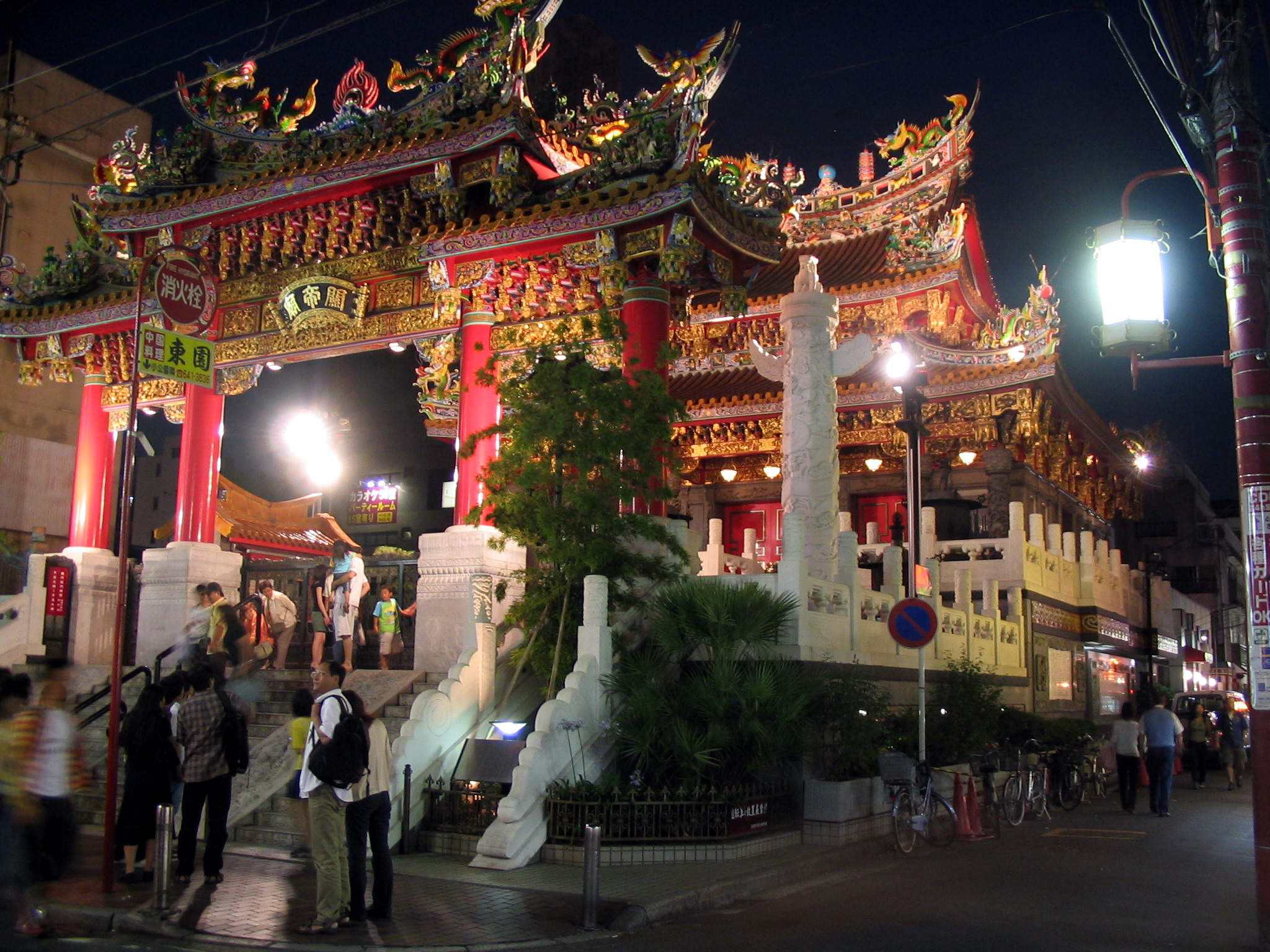
Yokohama Chinatown: Japan's Largest Chinese Quarter
Walk through the Zenrinmon Gate and the air changes. Steam rises from bamboo baskets of pork buns stacked five high. Roasted duck glistens in shop windows. The sound of Cantonese and Mandarin mixes with Japanese, and red lanterns line every sightline. Yokohama Chinatown is Japan's largest Chinese quarter -- bigger than both Kobe's Nankin-machi and Nagasaki's Shinchi Chinatown -- and it has occupied this patch of central Yokohama since Chinese merchants first stepped off trading ships in 1859. With a population of 3,000 to 4,000 residents and roughly 250 Chinese-owned or themed shops and restaurants, it is not a museum piece or a themed attraction. It is a living neighborhood that has been continuously inhabited for more than 160 years, and every decade of that history has left its mark.
Silk Traders and Treaty Ports
When Yokohama's sea port opened in 1859, Chinese immigrants arrived alongside American and British trading companies that had already established operations in China. These companies brought Chinese agents to serve as intermediaries, negotiating with Japanese merchants for the purchase of raw silk and tea -- Japan's major exports at the time. Ferry services soon connected Yokohama to Shanghai and Hong Kong, and a steady stream of Chinese traders began building schools, community centers, and other facilities in what became the nucleus of Chinatown. Government regulations confined all immigrants to the designated foreign settlement area, and the Sino-Japanese Friendship and Trade Treaty of 1871 accelerated growth by formalizing commerce between the two nations. Chinese immigrants took on increasingly diverse professions -- tailors, barbers, printers, restaurateurs -- all compressed into a tight geographic footprint. In 1899, new laws granted Chinese residents greater freedom of movement but imposed strict rules on the types of work they could perform.
Shaken to the Foundations
The Great Kanto earthquake of 1923 devastated Yokohama. Across the region, around 100,000 people were killed and approximately 1.9 million left homeless. Chinatown was no exception. The death toll among Yokohama's Chinese residents reached as many as 1,541 -- roughly one-third of the community's total population of about 4,705 before the disaster. Many survivors chose to return to China rather than rebuild their lives in the rubble. The neighborhood that had taken decades to construct was flattened in minutes. Recovery was slow, and just as the community began to regain its footing, full-scale war erupted between China and Japan in 1937, freezing further growth entirely. The Second Sino-Japanese War severed the trade routes and cultural ties that had nourished Chinatown since its founding. It was not until after the war ended that the neighborhood began to rebuild in earnest.
Gates of Recognition
The postwar decades transformed Yokohama Chinatown from a battered immigrant enclave into one of Japan's signature urban destinations. In 1955, a large goodwill gate was erected, and the area was officially recognized and named Yokohama Chukagai -- Yokohama Chinatown. The real turning point came in 1972, when Japan established diplomatic relations with the People's Republic of China and severed ties with the Republic of China on Taiwan. Japanese interest in Chinese culture surged, and visitors flooded the neighborhood. Chinatown became a major sightseeing spot, its narrow streets packed with tourists sampling Cantonese, Sichuan, Shanghai, and Beijing cuisines. In 2004, the opening of the Minatomirai Line railway and the Motomachi-Chukagai Station brought Chinatown within 35 minutes of Tokyo's Shibuya Station, making it easier than ever to visit. In 2006, the Mazu Miao temple was established to mark the neighborhood's 150th anniversary, adding a significant spiritual landmark to the district.
A Neighborhood, Not a Theme Park
What sets Yokohama Chinatown apart from its counterparts in Kobe and Nagasaki is scale and authenticity. This is not a few blocks of restaurants arranged for tourists. It is a working neighborhood where families have lived for generations, where children attend the Yokohama Overseas Chinese School or the Yokohama Yamate Chinese School, and where the Kwan Tai Temple -- dedicated to the Chinese god of war and commerce -- still draws worshippers alongside sightseers. The ornamental paifang gates mark the boundaries of a district that has endured catastrophic natural disaster, wartime hostility, postwar poverty, and diplomatic rupture without ever disappearing. The restaurants serve everything from street-cart nikuman to elaborate Peking duck banquets, and on Chinese New Year the entire neighborhood erupts in lion dances, firecrackers, and parade floats. From the air, the district's distinctive grid of narrow streets and red-accented architecture stands out sharply against the surrounding Yokohama blocks -- a neighborhood that has kept its identity intact through every upheaval modern history could deliver.
From the Air
Located at 35.4428°N, 139.6459°E in Yokohama's Naka ward. The Chinatown district is identifiable by its dense grid of narrow streets between Yamashita Park to the east and the Motomachi shopping street to the south. The ornamental paifang gates at each entrance are visible at lower altitudes. Yokohama Bay and the harbor are immediately to the east. The Minato Mirai 21 skyline, including Yokohama Landmark Tower, is approximately 1.5 km to the northwest. Nearest major airport is Tokyo Haneda (RJTT), about 12 nautical miles north. Best viewed at 1,500-3,000 feet AGL. The Marine Tower and Yokohama Bay Bridge serve as nearby visual landmarks.