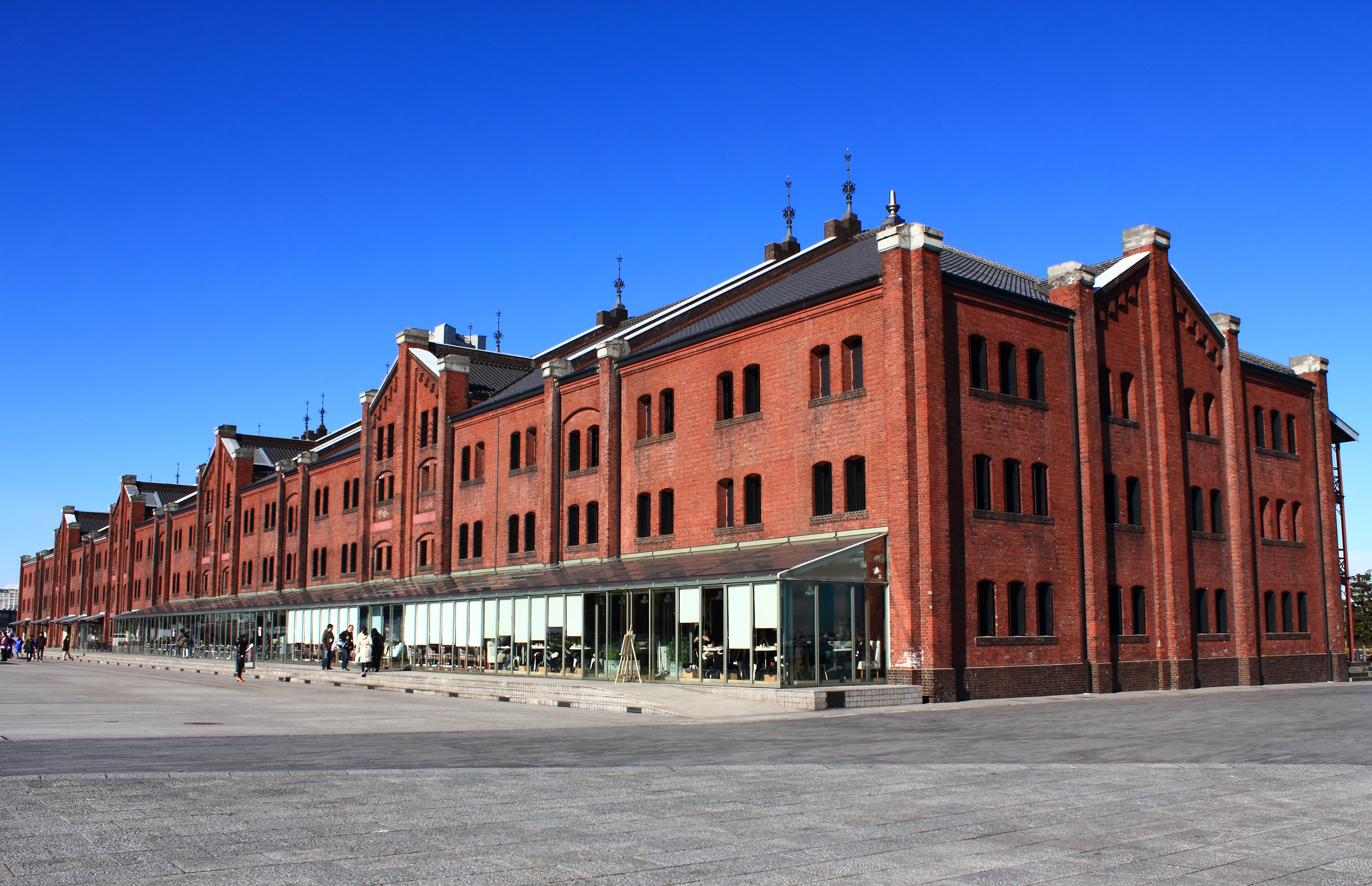
Yokohama Red Brick Warehouse
Tsumaki Yorinaka studied warehouse architecture in Germany, then came home and designed two buildings strong enough to outlast an earthquake that flattened much of Yokohama. The iron frames he embedded between the red bricks of his customs warehouses -- Building No. 2 completed in 1911, Building No. 1 in 1913 -- were an engineering decision that would pay off twelve years later when the Great Kanto Earthquake of 1923 tore through the city. Other structures crumbled. The red brick warehouses cracked and bent but stayed standing. That resilience became their defining trait, carrying them through wartime, occupation, abandonment, and finally a transformation into something Tsumaki could never have imagined: a shopping mall, art space, and seasonal festival ground on the Yokohama waterfront.
Bricks Built for Storms
The warehouses rose from reclaimed land at the Port of Yokohama. The city government had begun harbor expansion in 1899, completing the first phase in 1905 and an extension in 1906. Tsumaki Yorinaka, an architect who served as head of the Ministry of Finance's Temporary Building Department, drew on European models he had studied during time abroad -- particularly British and German port facilities -- to design bonded customs warehouses where imports passed through inspection. Both buildings stand three stories tall, 22.6 meters wide and 17.8 meters high. The iron reinforcement between the bricks was unusual for the era, blending Western industrial techniques with Japanese construction sensibility. When the catastrophic earthquake struck on September 1, 1923, the reinforced structure absorbed the shock. The buildings were damaged but remained intact while much of the surrounding city lay in ruins. Repair work continued until 1930.
Occupation and Silence
After World War II, the American occupation forces requisitioned the warehouses in 1945. For eleven years, until 1956, the buildings served the military rather than Japanese commerce. When they were finally returned, the structures slowly fell out of active use as shipping technology and customs logistics moved to newer, purpose-built facilities. The warehouses sat quietly at the waterfront for decades, their red brick facades weathering while the city of Yokohama reinvented itself around them. The Minato Mirai 21 development brought gleaming towers and modern attractions to the harbor district, but the old customs buildings remained untouched -- too sturdy to demolish easily, too historically significant to ignore, and too idle to justify their prime waterfront location.
The Second Life
On April 12, 2002, the warehouses reopened as the Yokohama Red Brick Warehouse complex. Building No. 1 became a cultural facility housing exhibition spaces and performance halls. Building No. 2 was converted into a commercial space with restaurants, shops, and a third-floor balcony offering harbor views that opened in 2007. The surrounding grounds became Red Brick Park, with plazas and green space connecting the historic structures to the broader Minato Mirai district. Yokohama Chinatown, Yamashita Park, and the modern skyline of Minato Mirai 21 all sit within walking distance, but the warehouses themselves anchor the waterfront with a texture and scale that no glass tower can replicate. The restoration earned recognition as a UNESCO Asia-Pacific Heritage Award winner.
A Year in Festivals
The German architectural DNA of the warehouses makes certain seasonal events feel almost inevitable. Every year from late November through Christmas Day, a German-style Christmas market fills the plaza with wooden stalls, mulled wine, and the glow of string lights against century-old brick. From December through February, the Yokohama Art Rink -- an outdoor ice skating rink operating since 2005 -- doubles as an art exhibition showcasing local artists, blending sport and creativity on the waterfront. An Oktoberfest arrives from late September through mid-October, bringing German beers from long-established breweries and award-winning craft producers rarely available in Japan. In early spring, the Yokohama Strawberry Festival fills the plaza with strawberry sculptures and vendors offering everything from fresh morning-picked Yokohama-grown berries to strawberry dorayaki, daifuku, parfaits, and cakes. The warehouses have also hosted the live Final Stage of SASUKE (known internationally as Ninja Warrior) on New Year's Eve in both 2018 and 2019.
Red Brick from the Air
The two warehouses sit side by side on reclaimed land jutting into Yokohama harbor, their rust-red rooflines unmistakable against the blue-gray water and the steel-and-glass geometry of Minato Mirai. From above, the contrast is striking: buildings designed in the Meiji era, flanked by one of Japan's most modern waterfront developments. The Yokohama Landmark Tower rises nearby, the Cosmo Clock 21 Ferris wheel turns slowly to the northwest, and container ships move through the port that these warehouses once served. Over a century after Tsumaki Yorinaka laid his iron-reinforced bricks, the buildings remain exactly what they have always been -- the sturdiest things on the waterfront.
From the Air
Located at 35.452°N, 139.643°E on reclaimed land at the Port of Yokohama waterfront. The two parallel warehouse buildings with distinctive red-brown rooflines sit adjacent to Red Brick Park along the harbor. Best viewed at 2,000-4,000 feet AGL. The Minato Mirai 21 skyline including the Yokohama Landmark Tower provides a prominent visual reference to the northwest. Tokyo Haneda Airport (RJTT) lies approximately 15 nautical miles northeast. Naval Air Facility Atsugi (RJTA) is about 20 nautical miles west. Yokohama Bay is clearly visible from altitude in clear weather.