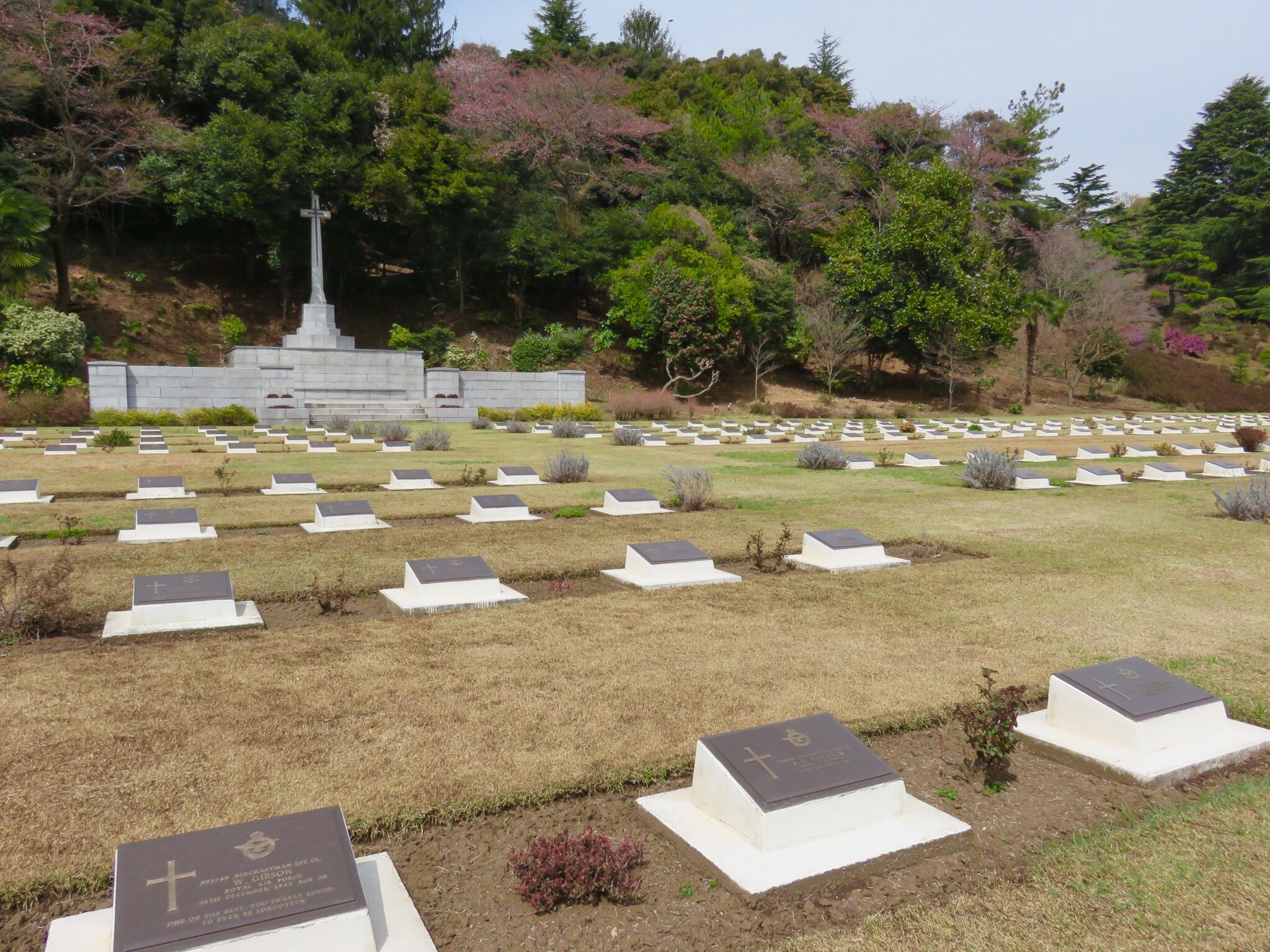
Yokohama War Cemetery
A shrine within the grounds holds an urn containing the ashes of 335 soldiers, sailors, and airmen -- Commonwealth, American, and Dutch service members who died as prisoners of war in Japan and whose remains were cremated. The Yokohama Cremation Memorial stands inside the only cemetery in Japan maintained by the Commonwealth War Graves Commission, a quiet parkland in Hodogaya-ku where 1,555 Commonwealth burials from the Second World War are arranged in four national sections beneath mature trees. The cemetery sits next to the Yokohama Municipal Children's Botanical Garden, and the juxtaposition is almost too pointed: a place built for remembering the dead beside a place designed for the living young.
Names Gathered from Across the Pacific
The cemetery was constructed after the Second World War by the Australian War Graves group, and it holds the remains of soldiers from across the former British Empire and beyond. The dead came mostly from Australia, Canada, New Zealand, India, and the United Kingdom, with additional burials from the Netherlands and the United States. Most died as prisoners of war held in camps across Japan -- men captured in the fall of Singapore, the Dutch East Indies, Hong Kong, and other Pacific battlefields. Others died during the Allied occupation that followed Japan's surrender in 1945. The burial grounds are organized into four main sections: British, Canadian and New Zealand, Australian, and Indian. A Cross of Sacrifice stands in each of the first three sections. The Indian section -- designated the Yokohama Memorial -- features a custom-designed pylon rather than a cross, reflecting the diverse faiths of the Indian service members buried there. Among the 1,555 Commonwealth burials, 53 remain unidentified.
After the Armistice, Another War
A post-war section was added to the cemetery after 1953 to bury 171 soldiers who died fighting in the Korean War between 1950 and 1953. These graves sit alongside the earlier burials but represent a different conflict and a different era -- men who passed through Japan on their way to or from the Korean Peninsula and did not survive the journey or its aftermath. The Korean War section transformed the cemetery from a purely World War II memorial into a broader testament to Commonwealth military sacrifice in the Asia-Pacific region. The addition underscored how quickly the postwar order dissolved into new conflict, and how Japan's geographic position made it a staging ground, a hospital zone, and ultimately a burial place for soldiers fighting wars that had nothing to do with the country itself.
A Crown's Presence
The cemetery has drawn visits from three generations of the British Royal Family. Queen Elizabeth II came in May 1975, thirty years after the war ended, walking among the headstones of soldiers who had fought under her father's command. Princess Diana visited in February 1995, and Prince William followed in February 2015. Each visit renewed public attention on the cemetery and the stories it holds. Annual commemorations bring military veterans and their families to the grounds, and the site serves as a focal point for remembrance services organized by Commonwealth embassies in Tokyo. The cemetery is also linked to an older memorial: a tribute to Commonwealth service personnel from the First World War, unveiled in 1922 by Edward, Prince of Wales, stands at the historic Foreign General Cemetery in the Yamate district of Yokohama's Naka-ku ward.
Quiet Ground in a Busy City
Yokohama is Japan's second-largest city, a sprawling port metropolis of nearly four million people. The war cemetery occupies a small, carefully tended enclosure in Hodogaya-ku, a residential ward in the city's western hills. Mature trees surround the burial sections, creating a parklike atmosphere that feels deliberately apart from the urban density beyond the cemetery walls. The Commonwealth War Graves Commission maintains the grounds to its exacting standards -- the same standards applied to its 23,000 locations in 150 countries worldwide. In Japan, this is the sole site under the Commission's care, making it both a local landmark and a unique point of international remembrance. The children's botanical garden next door brings families past the cemetery entrance regularly, and for many Yokohama residents, the proximity of these two spaces -- one dedicated to loss, the other to growth -- is simply part of the neighborhood's character.
From the Air
Located at 35.434°N, 139.581°E in Hodogaya-ku, a western residential ward of Yokohama. The cemetery is a small green rectangle surrounded by urban development, adjacent to the Yokohama Municipal Children's Botanical Garden. Best viewed below 3,000 feet AGL; the site blends into surrounding parkland from higher altitudes. Tokyo Haneda Airport (RJTT) lies approximately 18 nautical miles northeast. Naval Air Facility Atsugi (RJTA) is about 12 nautical miles west-southwest. The Port of Yokohama and Minato Mirai skyline provide visual orientation to the east.