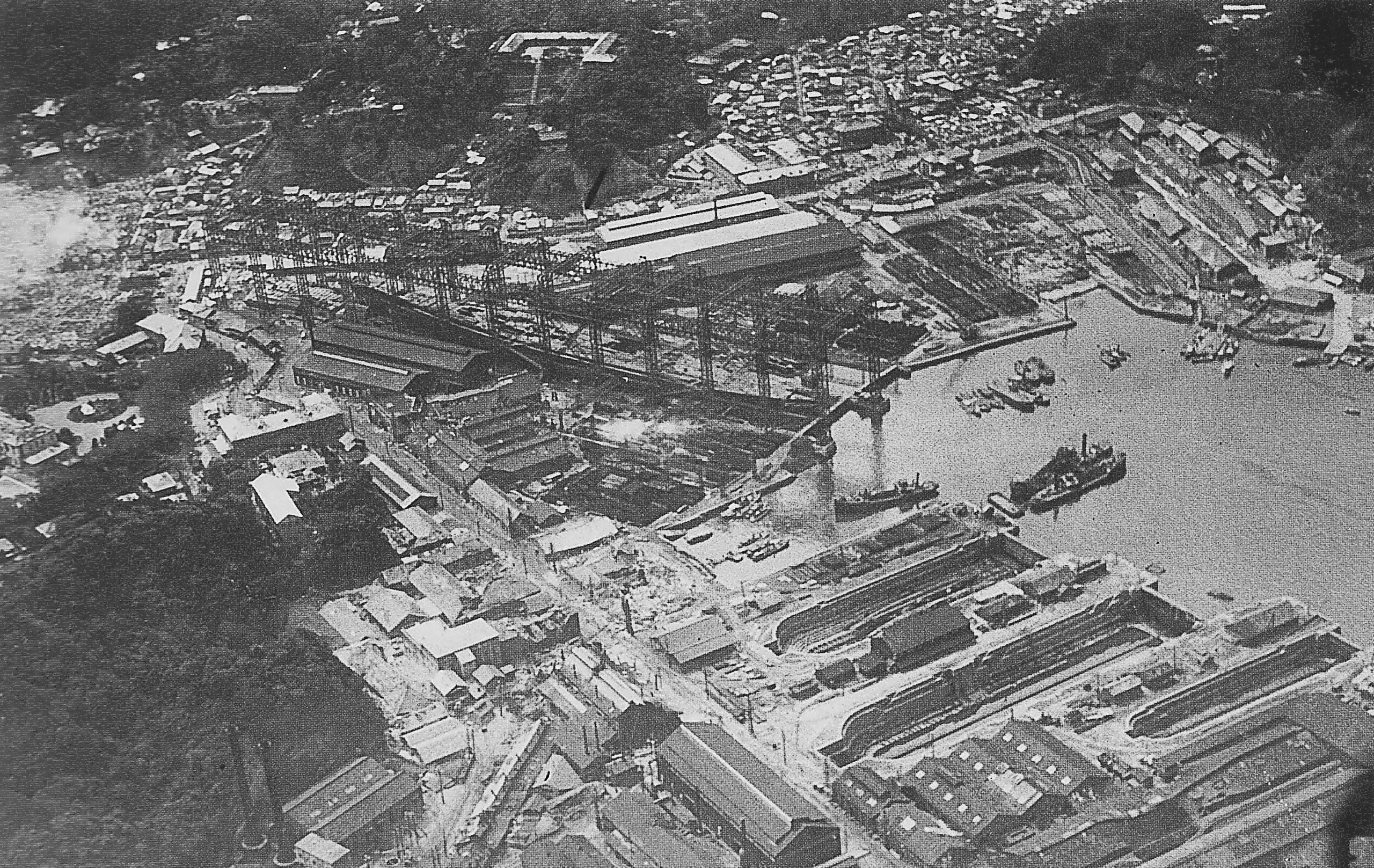
Yokosuka Naval Arsenal: Where a Shogun's Ambition Launched an Empire
A Frenchman named Leonce Verny arrived in Yokosuka in 1865 with a commission that would change the course of naval history. The Tokugawa shogunate, watching Western warships prowl Tokyo Bay with impunity, hired the naval architect to build something Japan had never possessed: a modern shipyard capable of producing Western-style warships. Within a year, construction was underway on the Yokosuka Seisakusho -- complete with foundries, brick factories, an aqueduct, and technical schools to train the Japanese workers who would inherit the facility. The shogunate that ordered the arsenal would not survive to use it. But the shipyard endured, passing through revolution, earthquake, and two world wars to become one of the most consequential military-industrial sites in the Pacific.
Revolution at the Dry Dock
The Tokugawa shogunate collapsed in the Boshin War of 1868-1869, and the new Meiji government seized the arsenal in 1871, renaming it the Yokosuka Zosenjo. That same year, the facility opened its first dry dock -- which remains in operation today, more than 150 years later. Japan's first domestically produced warship, the Saiki, slid into the water the same year. The Yokosuka Naval District was established in 1884 as the first naval district responsible for defending the Japanese home islands, and the shipyard was formally renamed the Yokosuka Naval Arsenal in 1903. The facility had evolved from a foreign-designed experiment into the beating heart of Japan's naval modernization. In 1909, Japan's first domestically designed and produced battleship, the Satsuma, was launched from these very slipways -- proof that the student had surpassed the teacher.
American Submarines for a Japanese Navy
One of the arsenal's stranger chapters involves an American connection. During the Russo-Japanese War of 1904-1905, Japan purchased five Holland Type VII submarines from the American Electric Boat Company. Naval architect Arthur Leopold Busch traveled to Japan to oversee their construction, while electrician Frank Cable trained two Japanese crews to operate the vessels. Busch was the same man who had built the United States Navy's first submarine just five years earlier. Two additional Holland-designed submarines followed by 1906 under a licensing agreement. These seven boats became the Imperial Japanese Navy's entry into underwater warfare -- a capability that would grow dramatically over the following four decades, as Yokosuka's submarine production expanded to include dozens of vessels across multiple classes.
Carrier of Empires
By the 20th century, Yokosuka had become one of the Imperial Japanese Navy's principal shipyards, producing capital ships that would define the Pacific War. The aircraft carrier Hiryu, which launched planes against Pearl Harbor, was built here. So was the fleet carrier Shokaku. The converted carrier Shinano, originally laid down as a Yamato-class battleship, was completed at Yokosuka in 1944 as the largest aircraft carrier ever built at that time. Battleships, cruisers, destroyers, and submarines poured from the arsenal's facilities, while nearby the Yokosuka Naval Air Technical Arsenal designed the combat aircraft that would fly from their decks. The complex was so vast and so vital that it became a target in the Doolittle Raid on April 18, 1942, when one American bomber struck the facility in the first air attack on the Japanese home islands.
The Last Attack and a New Flag
On July 18, 1945, a massive force of American carrier aircraft attacked the Yokosuka Naval Arsenal in one of the war's final major strikes against Japanese naval infrastructure. Less than two months later, on August 30, Allied forces landed at Yokosuka. On October 15, 1945, the Yokosuka Naval Arsenal was officially abolished -- ending nearly eight decades of Japanese warship production on this stretch of Tokyo Bay. The Americans did not demolish the facilities. Instead, the U.S. Navy repurposed them as the Yokosuka Ship Repair Facility, and the property eventually became U.S. Fleet Activities Yokosuka -- the largest American naval installation in the western Pacific. Today, a steam hammer from the original arsenal is preserved at the Verny Commemorative Museum in Yokosuka, named for the French engineer whose work outlasted the government that hired him.
From the Air
Located at 35.29N, 139.66E on the western shore of Tokyo Bay in Yokosuka, Kanagawa Prefecture. The former arsenal grounds are now U.S. Fleet Activities Yokosuka, visible as a large naval base complex with docks and piers on the bay's edge. Best viewed at 3,000-5,000 feet AGL approaching from the east over Tokyo Bay. The Miura Peninsula extends south from the base. Yokosuka is approximately 15 nautical miles south of Yokohama. Nearest significant airports include Naval Air Facility Atsugi (RJTA) approximately 20nm northwest and Tokyo Haneda (RJTT) approximately 25nm north.