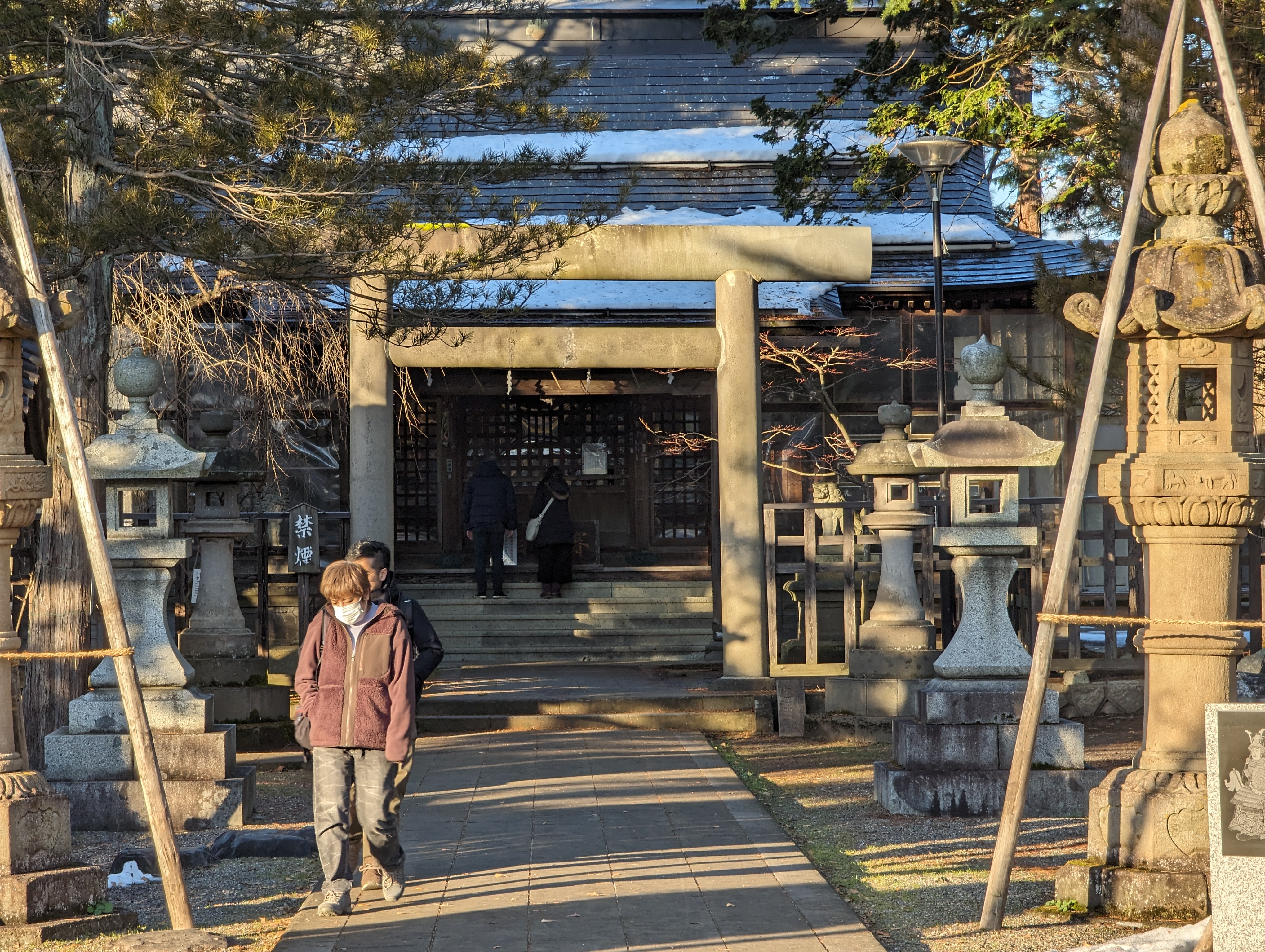
Yonezawa Castle
Date Masamune, the most famous warlord in Tohoku history, was born inside these walls in 1567. He lost an eye to smallpox as a child and grew into the warrior known as the Dokuganryu -- the 'One-Eyed Dragon.' He conquered neighboring clans, schemed against the most powerful men in Japan, and eventually left Yonezawa to build his own empire at Sendai. But Yonezawa Castle outlasted him. It outlasted the clan that replaced him, too, and the shoguns who punished that clan, and the government that finally tore the castle down. Today nothing remains of the original structures. The moat still traces its old rectangle through the center of the city, and on the ground where the donjon once stood, a Shinto shrine honors the family that refused to let go of this place for nearly three centuries.
Seven Centuries of Changing Hands
The first fortification on this site dates to the Kamakura period. In 1238, Oe Tokihiro, younger son of Oe no Hiromoto -- a senior retainer of the Kamakura shogunate -- received lands in Dewa Province and took the name Nagai Tokihiro. The Nagai held the castle for roughly 150 years before the Date clan displaced them during the turbulent Sengoku period. After Date Masamune defeated the Ashina clan in 1589, he shifted his headquarters to Kurokawa Castle in Aizu, leaving a subordinate in charge of Yonezawa. Toyotomi Hideyoshi, the great unifier of Japan, overruled that decision and forced Masamune back. By 1591, Hideyoshi ordered him out entirely, handing the castle to Gamo Ujisato. When Gamo Hideyuki was transferred to Utsunomiya in 1597, Yonezawa passed to Uesugi Kagekatsu, whose vast 1,200,000 koku holdings centered on Aizu.
The Price of Choosing Sides
The Battle of Sekigahara in 1600 redrew the map of Japan, and the Uesugi chose the losing side. Tokugawa Ieyasu stripped them of nearly everything, reducing their domain from 1,200,000 koku to 300,000, centered on Yonezawa. Between 1608 and 1613, the humbled clan renovated the castle, but the renovation itself told the story of their diminished status. The Tokugawa shogunate watched them with suspicion, so the Uesugi kept the defensive earthworks plain -- no stone facing, and a donjon of only three modest stories. Even so, they carried one thing with them that no political punishment could take: the remains of Uesugi Kenshin, the legendary 'God of War,' transported from Echigo Province and enshrined within the castle walls. In 1664, the clan's revenues were halved again to 150,000 koku. Samurai were laid off. Others took up part-time farming. Still, the Uesugi held Yonezawa until the Meiji Restoration ended the feudal era entirely.
Demolition and Memory
The Meiji government dismantled Japan's feudal order with methodical thoroughness. In 1871, Yonezawa Domain became Yonezawa Prefecture. The following year, Uesugi Shrine was established within the castle grounds to honor the clan's ancestors. Then, in 1873, the remaining castle structures were demolished by government order. The second bailey became the site of Yonezawa's city hall. The main bailey was converted into Matsugasaki Park, a public green space, in 1874. In 1876, Uesugi Shrine was moved to its present location atop the site of the old donjon -- a shrine standing on the footprint of a castle that no longer exists, dedicated to a warrior whose bones traveled across provinces to reach it.
Snow Lanterns on the Ruins
Every February, Matsugasaki Park transforms for the Uesugi Snow Lantern Festival. Around 200 snow lanterns and 1,000 smaller snow lamps are carved and lit across the former castle grounds, casting a warm amber glow over the moat and the torii gate of Uesugi Shrine. The festival is framed as an act of remembrance -- appreciation for ancestors and a prayer for lasting peace. Food stalls serve Yonezawa beef and local ramen while stage performances fill the cold night air. The shrine at the center of it all sits quietly above the glow, still honoring Uesugi Kenshin on the ground where his descendants once kept watch over a castle they were too proud, or too stubborn, to abandon.
From the Air
Yonezawa Castle site is located at 37.91N, 140.11E, in the center of Yonezawa city in a flat river valley surrounded by mountains. The castle moat and Matsugasaki Park are visible from the air as a rectangular green space in the urban center. Nearest airports: Yamagata Airport (RJSC), approximately 69 km north, and Fukushima Airport (RJSF), approximately 80 km southeast. Yonezawa sits in a mountain basin -- the Iide and Azuma ranges frame the western and southern horizons. Best viewed from 5,000-8,000 feet, approaching from the east where the valley opens up. Winter months bring heavy snow cover to the region.