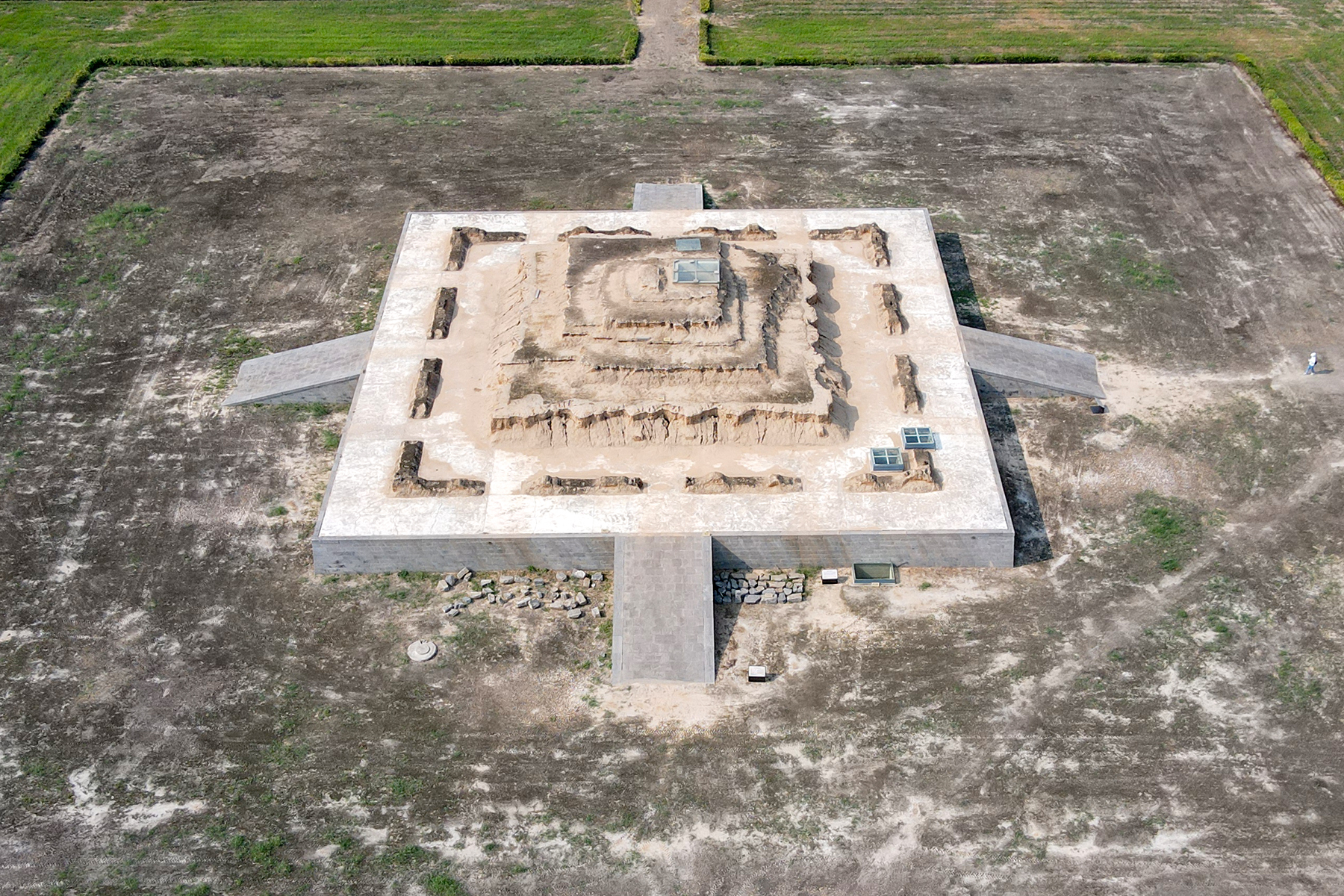
Yongning Pagoda
Yang Xuanzhi, who lived in Luoyang around the year 520, wrote that you could see the pagoda from 50 kilometers away. Standing in the capital of the Northern Wei dynasty, the Yongning Pagoda dominated the skyline as no building before it had anywhere on Earth. Built in 516 AD, this timber-frame tower may have reached 137 meters or higher -- estimates vary, but even the most conservative place it among the tallest structures of the pre-modern world. For 18 years it stood, the architectural ambition of a devout Buddhist empress made manifest in wood, brick, and a spire that scraped the clouds. Then, in 534, lightning struck.
An Empress Reaches for Heaven
The Yongning Pagoda -- the name means "Eternal Peace" -- was built during the Northern Wei dynasty at the Yongning Temple in Luoyang, the dynasty's capital. The Northern Wei rulers were ardent patrons of Buddhism, and the pagoda represented the pinnacle of their architectural devotion. One source claims it rose 90 zhang, roughly 240 meters, plus a 10-zhang pinnacle, but modern scholars consider this an exaggeration. Archaeological excavation has revealed a square rammed-earth foundation measuring 38.2 meters on each side, covered by a 2.2-meter-thick layer of limestone bricks. Pillar bases discovered at each corner suggest the structural framework of a timber-frame tower with a stabilizing masonry core. Scholarly reconstructions estimate the actual height at 137 to 155 meters including the pinnacle -- still tall enough to dwarf anything else in the 6th-century world.
Engineering on the Edge of Possibility
The pagoda combined two structural systems: a complete column grid of timber framing, which provided flexibility and resistance to lateral forces, and a masonry core that added stability and fire resistance to the interior. This dual system was advanced for its era, and the scale at which it was executed -- rising from a foundation wider than a modern basketball court to a height exceeding that of many contemporary skyscrapers -- pushed the technology of timber construction to its limits. The design drew on centuries of Chinese pagoda-building experience, but nothing before it had attempted this height. Nothing would match it for nearly 1,500 years, until the Tianning Temple pagoda in Changzhou was completed in 2007.
Visible for Fifty Kilometers
Yang Xuanzhi's claim that the pagoda could be seen from 50 kilometers is not the boast of a provincial patriot. On the flat plains surrounding Luoyang, a structure of this height would indeed have been visible at great distances, its pinnacle catching light above the horizon long before the city walls came into view. For travelers approaching along the Silk Road from the west, or from the agricultural hinterland to the east, the pagoda would have served as both landmark and statement: here was a dynasty wealthy enough, devout enough, and technically capable enough to build the tallest structure humanity had ever raised. In an age when most buildings were measured in single-story increments, the Yongning Pagoda was a vertical city unto itself.
Fire from the Sky
In 534 AD, lightning struck the pagoda and set it ablaze. A timber-frame structure of this height, with its layers of wooden floors, columns, and roof brackets, would have burned with terrifying intensity. The fire consumed what had been the world's tallest building in what must have been one of the most spectacular conflagrations of the ancient world. Only the rammed-earth foundation and limestone base survived, and these are what modern archaeologists have excavated within the broader Old City of Luoyang site. Today, the Yongning Pagoda exists as a foundation, a set of scholarly measurements, and a model reconstruction at the Han-Wei Luoyang Ancient City Site Museum. The tower that once announced Luoyang's presence across the plains of Henan is now a ghost measured in rammed earth and the testimony of a writer who looked up and marveled.
From the Air
The Yongning Pagoda site is located at 34.72°N, 112.62°E within the Old City of Luoyang archaeological zone, approximately 15 km east of modern Luoyang, Henan Province. Only the rammed-earth foundation survives; the pagoda itself was destroyed by fire in 534 AD. The site lies within the broader UNESCO World Heritage area of the Old City. Nearest airport is Luoyang Beijiao Airport (ZHLY/LYA), roughly 15 km west. Altitude recommendation: 3,000-5,000 feet AGL. The flat terrain that once made the pagoda visible for 50 kilometers now makes the archaeological remains nearly invisible from altitude -- a sharp contrast to the tower that once defined the skyline.