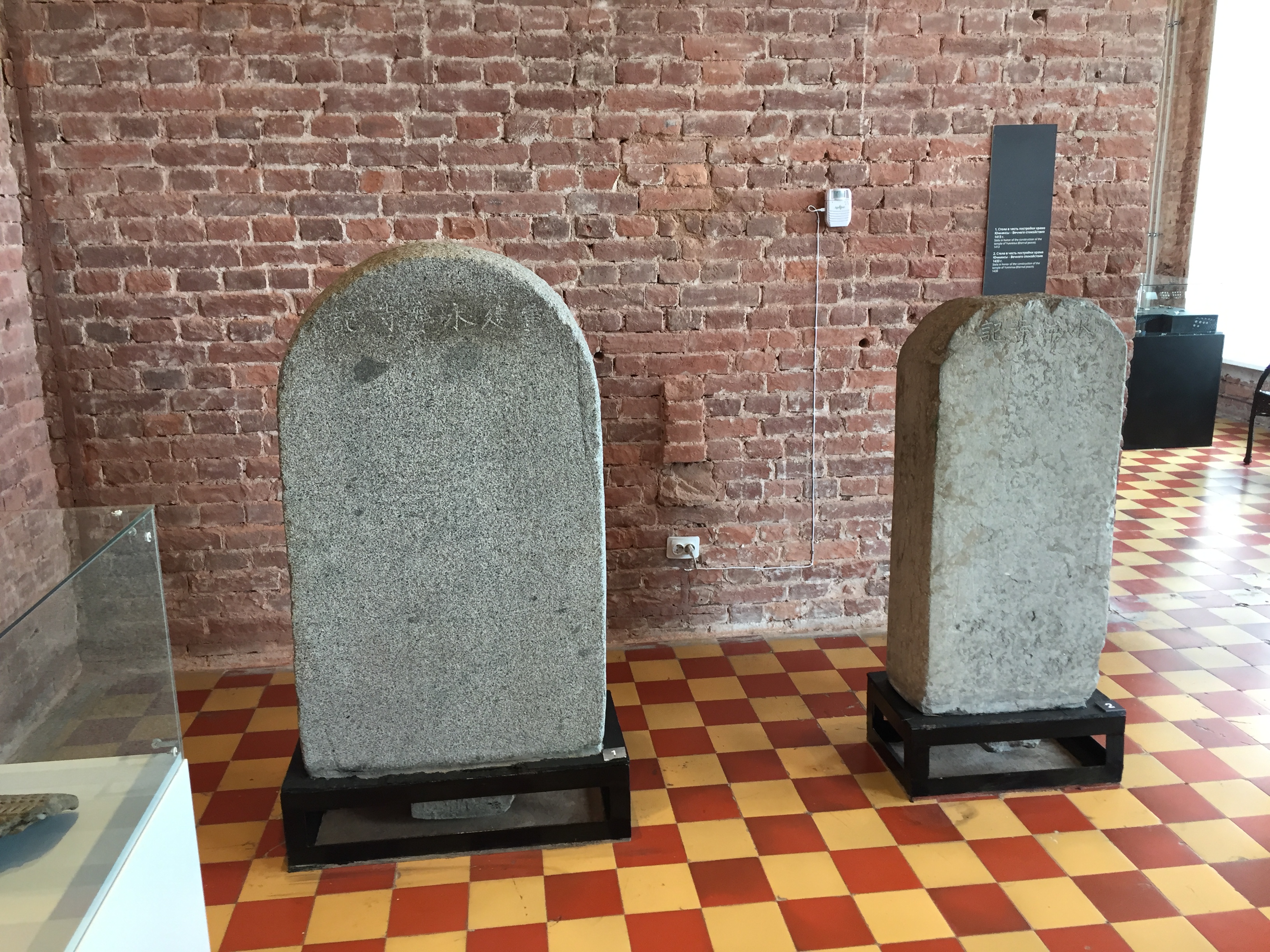
Yongning Temple Stele
Four scripts run vertically down one side of the stone: Chinese, Jurchen, Mongolian, Tibetan. Each renders the same six syllables -- Om mani padme hum -- the Buddhist mantra that means, roughly, "the jewel is in the lotus." That a single prayer needed four writing systems tells you everything about the world this monument was built to claim. In 1413, at a cliff overlooking the Amur River near its mouth on the Sea of Okhotsk, the Ming dynasty eunuch Yishiha erected a stone stele to commemorate a Buddhist temple he had founded at the empire's most remote outpost. More than six centuries later, the Yongning Temple Stele survives as the last monumental inscription ever carved in the Jurchen script -- a language of the people the empire was trying to pacify.
The Eunuch Admiral of the Amur
Yishiha was himself a Haixi Jurchen, one of the peoples the Ming court sought to absorb through a system of titles and loyalty. In 1412, the Yongle Emperor -- the same ruler who dispatched Zheng He across the Indian Ocean -- commanded Yishiha to pacify the Wild Jurchens who had been raiding Chinese outposts along the lower Amur. The following year, Yishiha set out with twenty-five ships, a thousand soldiers, and a contingent of architects and craftsmen. He sailed down the Sungari River and into the Amur, reaching a place the Chinese called Telin, near modern-day Tyr in Russia's Khabarovsk Krai. There, on a cliff above the river, he built the Temple of Eternal Tranquility -- Yongning Temple -- and raised a stone stele to mark it. The inscription praised the Yongle Emperor in Chinese, with abbreviated versions on the reverse in Mongolian and Jurchen. Buddhism was the diplomatic language; the temple was the statement of presence.
A Temple Destroyed, A Temple Rebuilt
Local shamans destroyed the Buddhist sculptures Yishiha had installed, and through the 1420s he returned repeatedly to reassert Ming authority. His final expedition came in 1432, with fifty ships and two thousand soldiers -- a force ten times the size needed merely to rebuild a temple. Yishiha invested a Jurchen chief as the new Nurgan Military Commissioner, then constructed a second Yongning Temple a short distance from the ruins of the first. A new stele, erected in 1433, commemorated the rebuilding in a single Chinese inscription. Where the first stele had spoken in three languages to three peoples, the second spoke only in the voice of the empire. The shift says something about twenty years of diminishing ambition for diplomacy and growing reliance on force.
Written in Stone, Lost in Time
The Jurchen script carved into the 1413 stele represents the final known monumental use of a writing system that would vanish entirely within centuries. The Jurchens' descendants, the Manchus, would eventually conquer China and found the Qing dynasty, but they developed their own script and the old Jurchen characters passed out of use. The stele itself was largely forgotten by the outside world until 1885, when a Qing official named Cao Tingjie journeyed along the Amur and made rubbings of the inscription. A Chinese scholar named Yang Bin may have recorded the stele's existence as early as 1639, but no rubbing was published until Cao's work appeared in 1887. In 1904, the stele was removed to the Vladivostok Museum -- now the Arsenyev Museum -- where it remains alongside its 1433 companion.
Four Prayers, One Stone
What makes the Yongning Temple Stele genuinely remarkable is the mantra carved along its edge. Om mani padme hum appears in Chinese, Jurchen, Mongolian, and Tibetan -- four of the scripts used across the vast territory the Ming claimed to oversee. It is a gesture of inclusion, an acknowledgment that the empire's Buddhist message must reach peoples who read in fundamentally different ways. Similar multilingual Buddhist inscriptions exist elsewhere -- the Cloud Platform at Juyongguan from 1345, the Stele of Sulaiman from 1348 -- but the Yongning stele stands at the geographic extreme of this tradition, placed at the farthest point the Ming bureaucracy ever reached. That it was carved by a Jurchen in service of a Chinese emperor, at a temple built to pacify Jurchens, on a river that would become the border between Russia and China, gives the monument a layered irony that no single translation can capture.
From the Air
Located at 52.94N, 139.76E near the village of Tyr, on the lower Amur River in Khabarovsk Krai, Russia. The original temple site sits on cliffs above the Amur, though the stele is now housed in Vladivostok. Approach from the east over the Sea of Okhotsk or follow the Amur River inland from Nikolayevsk-on-Amur (UHNN). Best viewed at 3,000-5,000 ft. The wide Amur estuary and forested river bluffs are the primary visual landmarks.