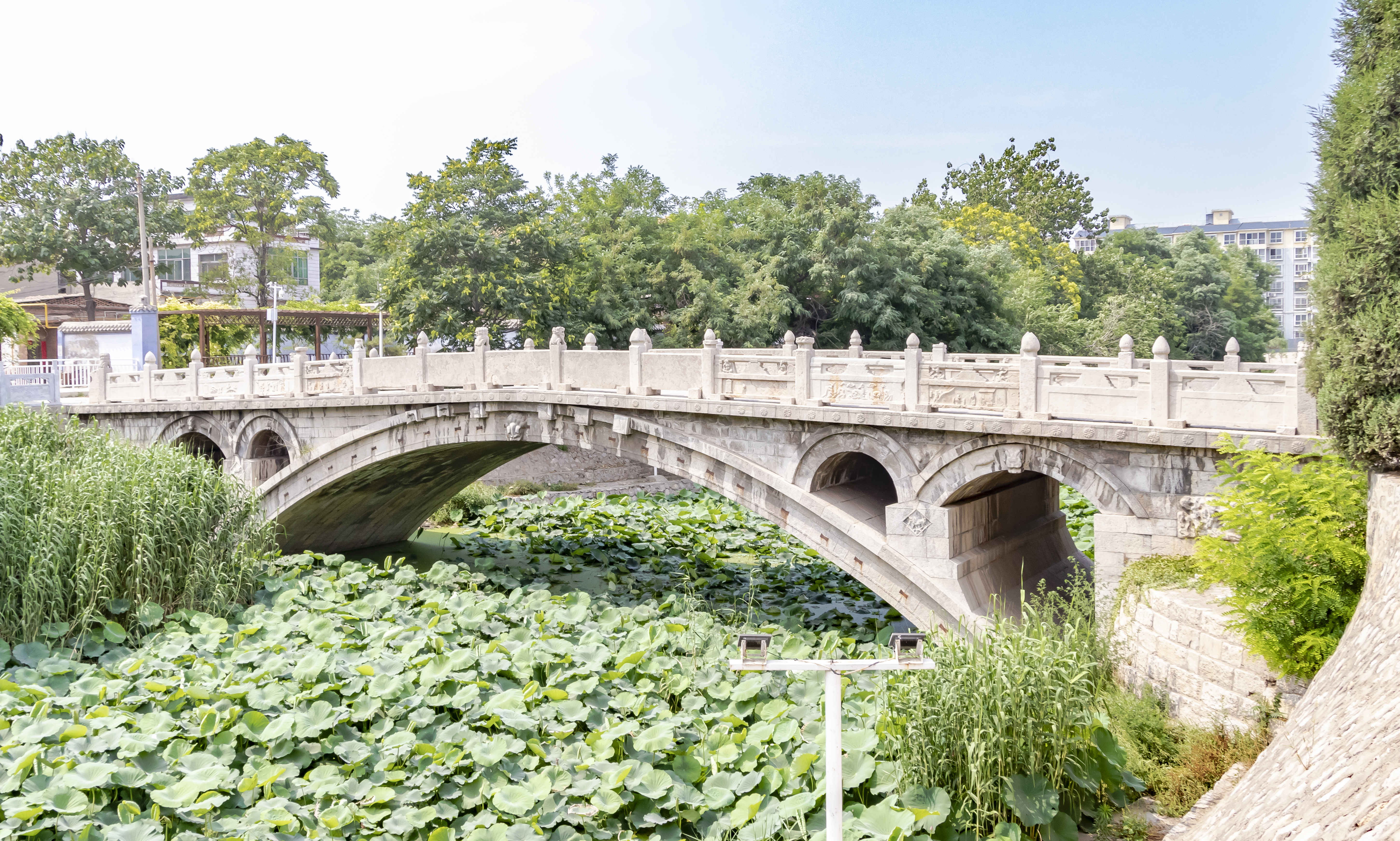
Yongtong Bridge
Just outside the west gate of Zhao County, a modest stone bridge crosses what was once the Ye River -- now called the Qingshui River. Locals have long called it the Small Stone Bridge, a name that only makes sense in the shadow of its famous neighbor, the Anji Bridge, or Great Stone Bridge, a few kilometers to the south. But the Yongtong Bridge is no minor structure. It is an ancient single-hole circular arch bridge whose construction date was debated for centuries, until buried inscriptions finally settled the question.
A Date Unearthed
For generations, scholars disagreed about when the Yongtong Bridge was built. One school of thought placed it in the Mingchang period of the Jin dynasty, between 1190 and 1196. Others argued for earlier origins. The debate persisted because no original documentation survived. Then, in 1986, excavation work beneath the bridge uncovered stone components and inscriptions that pushed the construction date back dramatically. The evidence pointed to the early years of the Yongtai era in the Tang dynasty, around 765 AD -- making the bridge roughly four centuries older than the Jin dynasty estimate. A structure that scholars had tentatively dated to the twelfth century turned out to be an eighth-century creation, a product of the same Tang dynasty that had produced so much of China's greatest art and architecture.
The Little Sibling
Zhao County's identity is inseparable from its bridges. The Anji Bridge, completed in 605 AD, is the world's oldest open-spandrel segmental arch bridge and a designated International Historic Civil Engineering Landmark. The Yongtong Bridge, built roughly 160 years later, shares the same county and the same tradition of stone bridge-building, but uses a different structural approach. Where the Anji Bridge employs a revolutionary shallow segmental arch with open spandrels, the Yongtong Bridge is a more conventional single-hole circular arch. Together, the two bridges demonstrate the range of engineering solutions available to Tang dynasty builders, from the daringly experimental to the proven and reliable. Both have endured for over a millennium on the flat, flood-prone plains of southern Hebei.
Crossing the Old River
The bridge spans the Qingshui River -- formerly the Ye River -- at the western approach to Zhao County's old town center. In the centuries when foot and cart traffic entered towns through formal gates, this bridge marked the threshold. Travelers arriving from the west would cross the Yongtong Bridge, pass through the west gate, and enter the commercial and administrative heart of the county seat. The river itself, flowing through the low-lying North China Plain, was both a resource and a hazard, and the bridge's circular arch was engineered to withstand the seasonal floods that periodically inundated the region. That it continues to stand, more than 1,200 years after its stone blocks were first set in place, speaks to the quality of Tang dynasty masonry and to the fundamental soundness of the circular arch as a structural form.
Stone Testimony
The 1986 discovery of inscriptions beneath the Yongtong Bridge was more than an academic footnote. It transformed understanding of the bridge-building tradition in Zhao County, revealing that the skills demonstrated so spectacularly by Li Chun at the Anji Bridge in 605 AD continued to be practiced and refined in the same locality for at least another 160 years. Zhao County was not a place that built one remarkable bridge and then forgot how. It was a center of stone bridge engineering, a community where the craft was passed down and exercised repeatedly. The Yongtong Bridge, modest in scale but formidable in longevity, is the proof carved in limestone.
From the Air
Located at 37.75N, 114.76E just west of Zhao County town center, Hebei Province. The bridge crosses the Qingshui River (formerly Ye River). Nearest major airport is Shijiazhuang Zhengding International (ZBSJ), approximately 55 km to the northwest. Best viewed at low altitude in clear conditions. The nearby Anji Bridge and Pagoda of Bailin Temple are also visible in the same area.