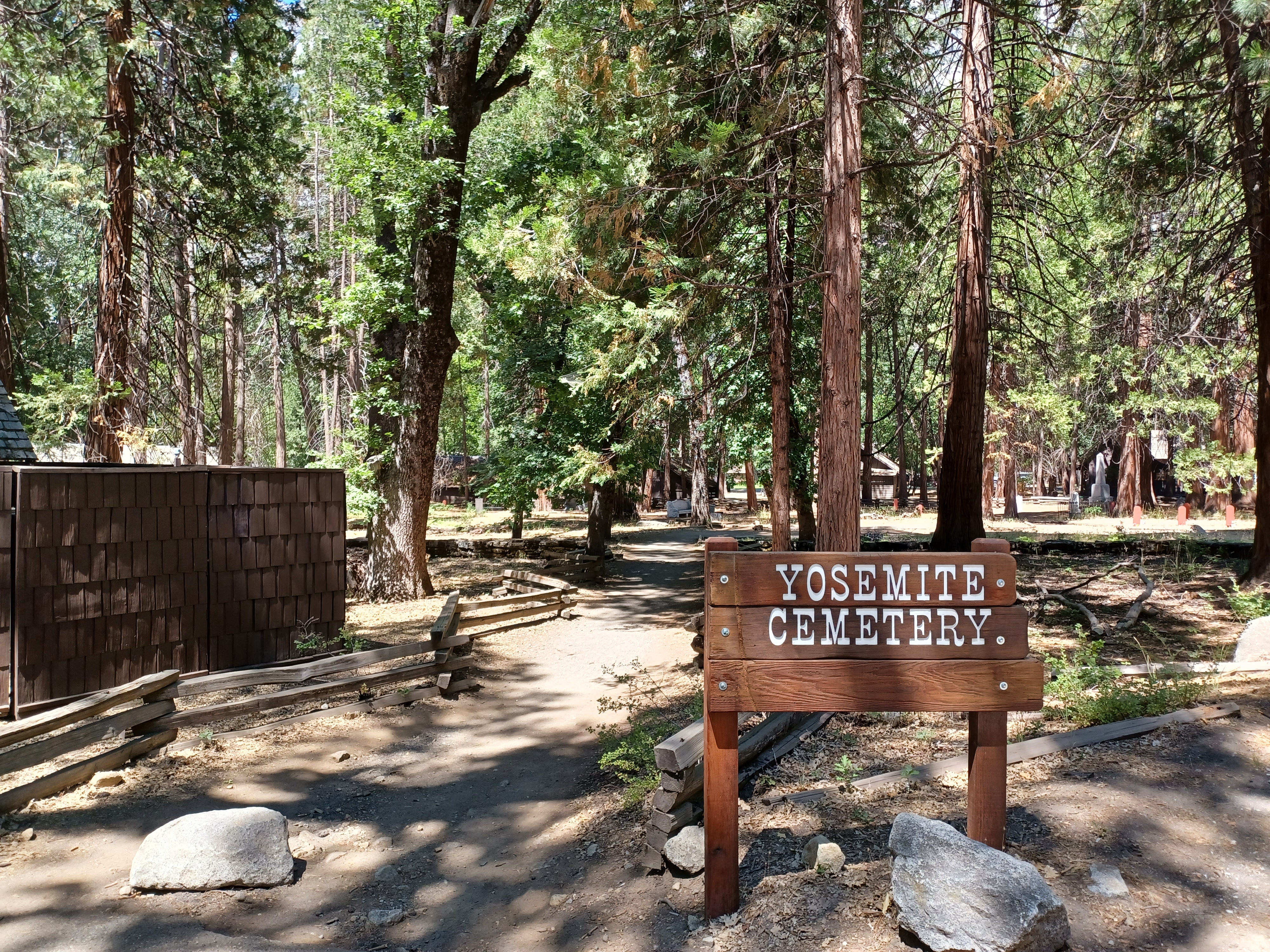
The Pioneers Who Never Left Yosemite
Most visitors walk right past it. A low iron fence, a scattering of weathered headstones beneath black oaks, and a quiet that feels deliberate -- as though the meadow is holding its breath. Yosemite Cemetery sits at the western edge of Yosemite Village, easy to miss on the way to more famous landmarks. But stop here and you'll find names that belong to the valley as surely as Half Dome or El Capitan do. These are the people who built trails up granite cliffs, photographed waterfalls with glass-plate cameras, and fought -- sometimes with each other -- over who this extraordinary place belonged to.
A Climber, a Guardian, and a Photographer
George Anderson lies here. A Scottish-born trail builder and adventurer, Anderson became the first person to reach the summit of Half Dome in 1875, drilling iron eyebolts into the granite and hauling himself up the final dome face by rope. He was 36 years old when he made the ascent. Nine years later, he was dead -- buried in a valley he had helped define. Near Anderson rests Galen Clark, who served as Yosemite's Guardian for decades and was instrumental in the campaign to protect the Mariposa Grove of giant sequoias. Clark arrived in the Sierra Nevada in 1853, already suffering from a lung condition that doctors said would kill him within months. He lived to be 96. Then there is George Fiske, a landscape photographer who spent over 30 years capturing Yosemite's waterfalls, cliffs, and forests with large-format cameras. His images helped shape how Americans imagined the valley long before most could visit.
The Valley's First and Last Settlers
James Chenowith Lamon arrived in Yosemite Valley in 1860 and never left. He planted apple and pear orchards on the valley floor, built a cabin, and became the first person of European descent to settle there year-round. When winter sealed the trails and the tourists vanished, Lamon stayed, weathering months of solitude and snowstorms. His headstone stands among those of the Hutchings family -- James Mason Hutchings, the businessman and promoter who published the first tourist guide to Yosemite, and his daughter Florence, the first non-Ahwahneechee child born in the valley. Florence died at just 17, killed by a falling tree while riding near Yosemite Falls. Her brief life bookends a generation of settlers who saw themselves as the valley's rightful inhabitants, even as the federal government moved to reclaim the land as public trust.
Lucy Brown and the Memory of Ahwahnee
Among the pioneer headstones lies one that tells a different story entirely. Lucy Brown was one of the few Native American survivors of the Mariposa Battalion's 1851 incursion into Yosemite Valley -- the military expedition that forcibly removed the Ahwahneechee people from a homeland they had inhabited for thousands of years. The battalion burned the villages and drove the inhabitants out, and it was this violent act of dispossession that first brought Yosemite to the attention of white Americans. That Brown is buried among the settlers rather than forgotten entirely speaks to the complexity of her position: a witness to the founding trauma of the park, living the rest of her life in a valley that had been taken from her people. Her grave is a reminder that the story of Yosemite did not begin with the pioneers who gave the cemetery its alternate name.
Ranger Townsley and the Duty of Care
Forest Sanford Townsley served as Yosemite's chief ranger for 27 years, from 1916 until his death in 1943. He patrolled the backcountry on horseback, managed the park through two world wars, and oversaw the transition from a place where tourism was chaotic and largely unregulated to one governed by the National Park Service's evolving conservation mission. Townsley's long tenure bridged the era of freewheeling concessionaires and campfire spectacles -- like the famous Yosemite Firefall -- with the more cautious stewardship philosophy that would eventually prevail. His burial here, alongside the climbers and homesteaders he once managed, closes a chapter. The cemetery itself was restored in 2014 by the Yosemite Conservancy, which repaired headstones and cleared overgrowth to preserve a record that granite walls alone cannot hold: the names, dates, and fragile human ambitions of those who tried to make the valley home.
Where Granite Gives Way to Earth
From the air, Yosemite Cemetery is invisible -- a green patch lost among the meadows and oak groves of the valley floor. But it occupies a particular kind of threshold. The park's visitors come for geology measured in millions of years and waterfalls that reshape themselves with every season. The cemetery offers something on a different scale: lifespans measured in decades, ambitions that succeeded or ended in obscurity, and the plain fact that people lived and died in a place most of us only pass through. Stand among the headstones on a quiet morning and the valley's famous verticality feels less imposing. The scale shifts. The granite still soars, but here the story is horizontal -- the slow accumulation of generations who staked their claim on a piece of the Sierra Nevada and were, in the end, gathered into it.
From the Air
Located at 37.749N, 119.589W on the Yosemite Valley floor, at the west end of Yosemite Village. Best viewed at 3,000-5,000 ft AGL looking southeast across the valley. The cemetery is not visible from altitude but sits in the meadow complex near the Yosemite Valley Lodge area. Nearest airports: Mariposa-Yosemite (KMPI, 30 nm SW), Merced Regional (KMCE, 55 nm SW). Valley can be hazy in summer; clearest views in autumn and spring.