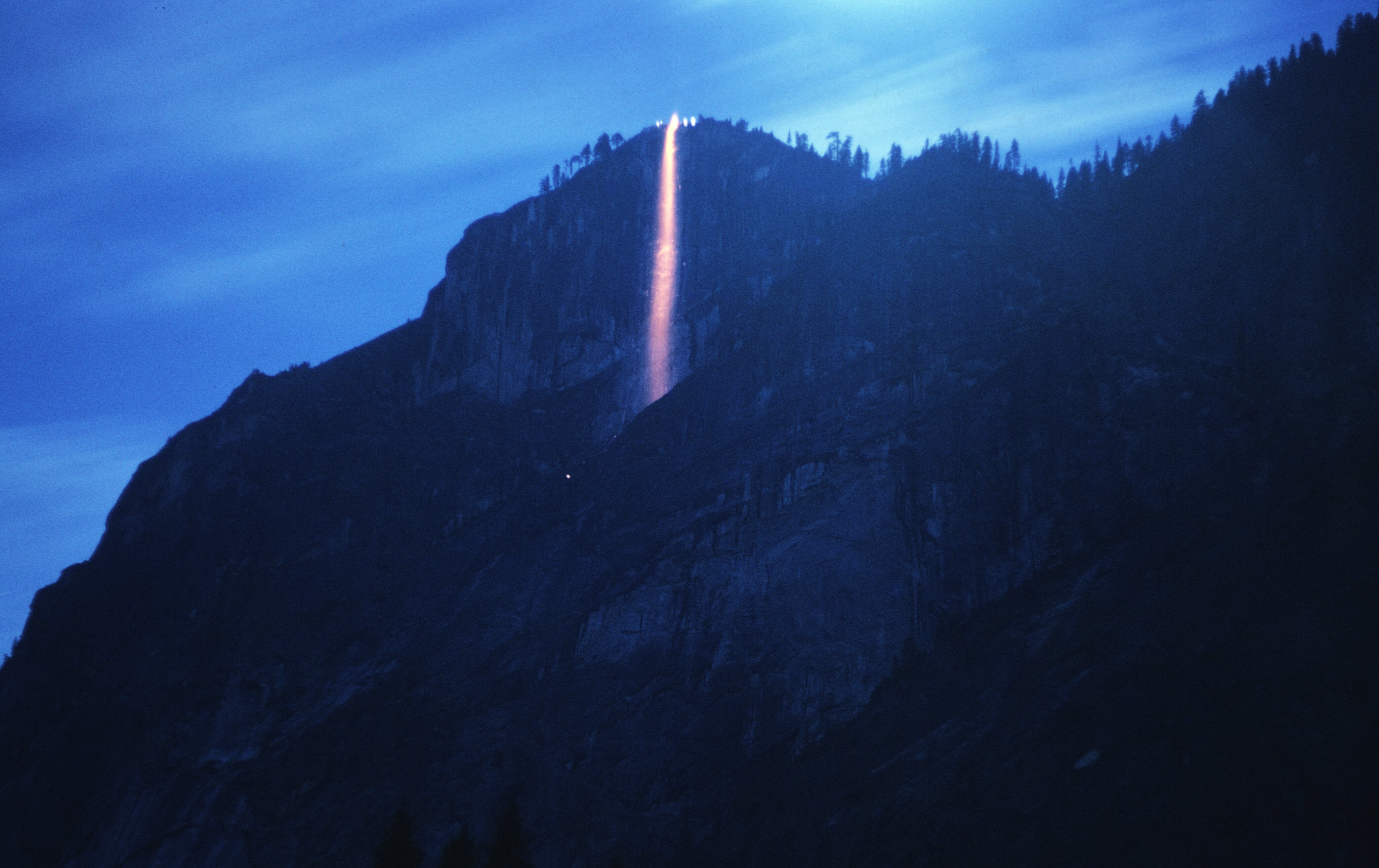
Let the Fire Fall
"Hello, Glacier Point." "Hello, Camp Curry." "Is the fire ready?" "The fire is ready." "Let the fire fall." "The fire falls." Every summer night at nine o'clock, this call-and-response ritual echoed across Yosemite Valley. Then a river of glowing embers poured off the edge of Glacier Point, 3,000 feet above the valley floor, and for a few incandescent minutes the darkness held what looked like a waterfall made entirely of fire. The Yosemite Firefall ran from the 1870s to 1968 -- one of the most beloved, most contested, and most deliberately artificial spectacles in American national park history.
The Irishman Who Kicked the Coals
It started by accident. In 1871, an Irish immigrant named James McCauley hired a crew to build the Four Mile Trail from Yosemite Valley to Glacier Point, where he opened a small hotel called the Glacier Point Mountain House. McCauley made campfires for his guests on the granite promontory overlooking the valley, and at the end of each evening, he kicked the dying coals over the edge. Visitors below were mesmerized. McCauley's sons realized people would pay for a bigger show and began hauling extra wood up the mountain on burros. The elder McCauley added a touch of showmanship -- he tied a gunny sack to a pole, dipped it in coal oil, and lit it as a signal that the embers were about to fall. The park posted a warning sign nearby that read: "It is 3,000 feet to the bottom / And no undertaker to meet you / TAKE NO CHANCES." In 1897, the Washburn brothers, owners of the Wawona Hotel, had McCauley evicted and shut the Firefall down. The spectacle might have ended there.
David Curry's Booming Voice
It did not end there. In 1899, David Curry established Camp Curry in Yosemite Valley and soon heard visitors reminiscing about McCauley's cascading embers. Curry revived the Firefall as a summer attraction, sending employees up to Glacier Point to build fires and push them off on special occasions. He called up to the point in a voice famous for its volume: "Let 'er go, Gallagher!" The Firefall became Camp Curry's signature -- performed nightly at nine as the finale to an evening entertainment program. But Curry's relationship with the government was turbulent. In 1913, Assistant Secretary of the Interior Adolph C. Miller threatened to take the Firefall away, and Curry responded by bitterly amending his nightly greeting: "Welcome to Camp Curry, where the Stentor calls and fire used to fall." The Firefall was reinstated in 1917, just weeks before Curry's death. His widow and son reopened camp that summer, and Foster Curry took over as the caller, shouting his father's line into the darkening valley for years to come.
Red Fir Bark and Presidential Delays
By the 1920s, the operation had been refined into a craft. Workers discovered that red fir bark produced the steadiest, most visually striking flow of coals -- better than wood, which burned unevenly. Each day, employees stacked bark on the valley side of Glacier Point, lit it in the evening, and spent hours building a deep bed of embers before pushing them over the edge with long-handled metal tools. Visitors at the point watched the preparation as part of the show. Down in the valley, the "Indian Love Call" was sung at Camp Curry as the embers fell, while campground audiences sang along to "America the Beautiful." Timing was everything: ranger-naturalists giving evening programs had to finish at exactly nine o'clock, or as they put it, "the fire would fall on the program." In 1962, President Kennedy visited Yosemite. An especially large fire was built for the occasion, but Kennedy was on the telephone at nine, so the Firefall was delayed half an hour while the president finished his call.
Horns on a Rabbit
The National Park Service never loved the Firefall. It was a man-made spectacle in a place dedicated to natural wonders -- an awkward contradiction that grew harder to ignore as the crowds grew larger. During World War II, the Firefall was suspended, and some within both the Park Service and the Yosemite Park and Curry Company quietly hoped it would not return. But public demand brought it back. By the 1960s, the nightly event was causing serious damage: thousands of cars clogged the valley roads, visitors trampled meadows to find viewing spots, and employees had to drive farther and farther to find dead red fir bark, which they were permitted to collect only from fallen trees. In January 1968, Park Service director George B. Hartzog ordered the Firefall discontinued, calling it as appropriate as "horns on a rabbit." The last fire fell on January 25, 1968, a Thursday in winter. No crowd was present. The Glacier Point Hotel burned down 18 months later and was never rebuilt.
Nature's Own Firefall
The story might have ended with ashes and regret, but Yosemite had one more act. Each February, when conditions align, the setting sun catches Horsetail Fall on the eastern face of El Capitan at precisely the right angle, illuminating the thin ribbon of water with an orange and red glow that looks astonishingly like a cascade of molten fire. The peak intensity usually occurs around February 21, with the golden hues appearing roughly 35 minutes before sunset and deepening to fiery orange in the final minutes. The effect depends on water actually flowing -- Horsetail Fall requires adequate snowmelt -- and on clear skies along the western horizon. When all the variables converge, it is as dramatic as anything McCauley ever kicked off a cliff, with the difference that no one has to haul bark up a mountain or argue with the Secretary of the Interior. The modern Firefall has become so popular that the park now requires reservations during the February viewing window, managing a new generation of crowds drawn to the same primal spectacle: fire, or something that looks like fire, falling through the darkness of a granite cathedral.
From the Air
Glacier Point is at 37.731N, 119.574W, 3,000 feet above Yosemite Valley floor. Horsetail Fall is on the east face of El Capitan at approximately 37.72N, 119.64W. Best viewed from 5,000-8,000 ft AGL looking east into the valley. The February natural firefall occurs at sunset and is only visible from specific angles south and southeast of El Capitan. Nearest airports: Mariposa-Yosemite (KMPI, 30 nm SW), Merced Regional (KMCE, 55 nm SW). Granite walls and late-afternoon shadows create turbulence near the valley rim.