The Ghosts in the Stumps
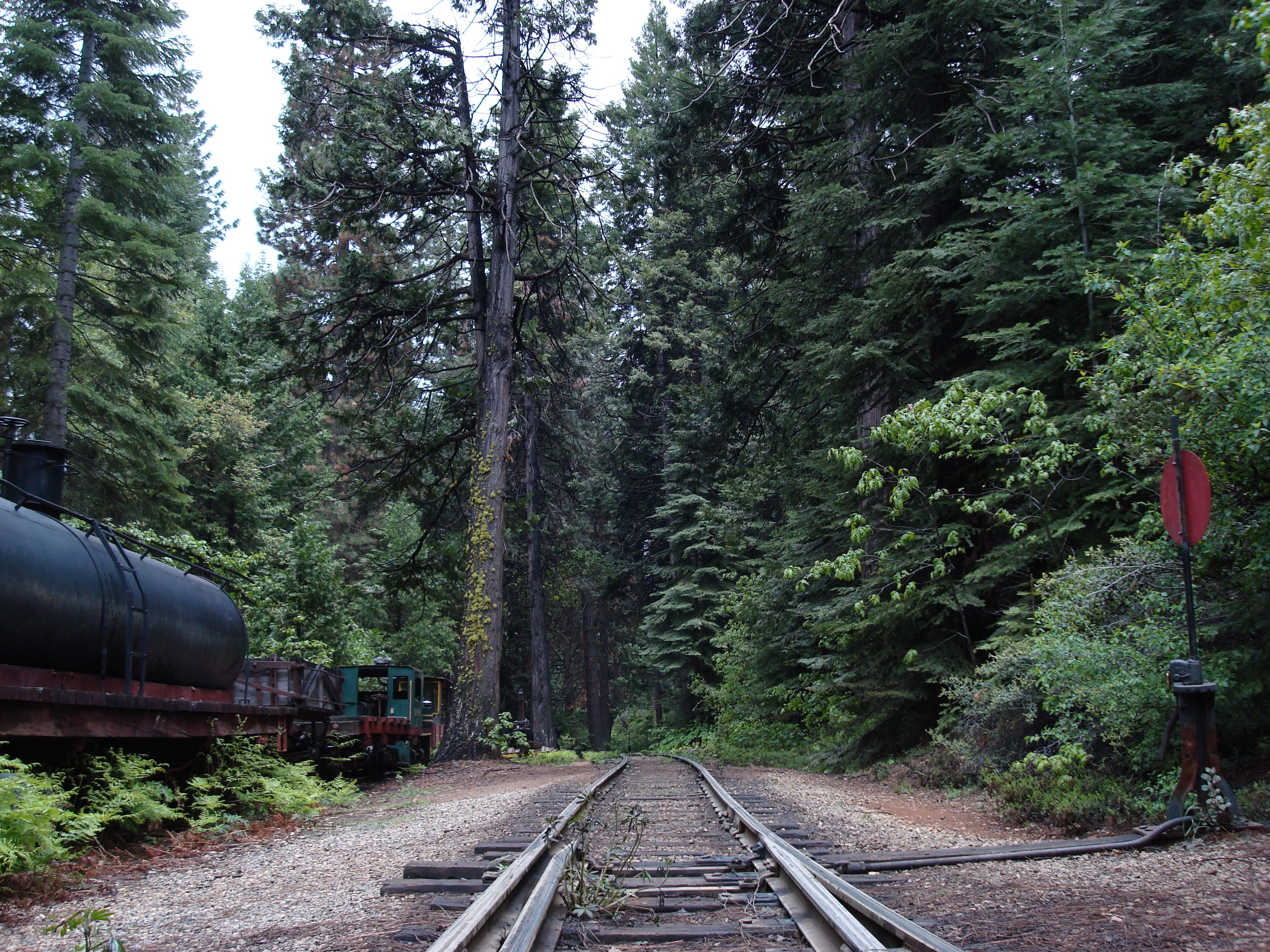
The stumps give it away. Walking along the tracks of the Yosemite Mountain Sugar Pine Railroad near Fish Camp, California, thick second-growth forest crowds in from both sides, dense enough to feel primeval. But every few yards, a massive stump rises from the forest floor, its diameter far exceeding any standing tree in sight. These are the remains of the old-growth sugar pines that once blanketed these Sierra slopes, trees so large and so numerous that an entire lumber company spent decades cutting them down. The railroad that hauled those trees to the mill is gone. In its place, a pair of century-old steam locomotives now carry tourists along the same grades, their whistles echoing through a forest that has spent ninety years quietly erasing the evidence of its own destruction.
An Empire Built on Sawdust
The Madera Sugar Pine Lumber Company began life in 1874 as the California Lumber Company, working the timber around Oakhurst. At its peak, the operation was enormous: seven locomotives, over 100 log cars, and 140 miles of narrow gauge track threaded through the surrounding mountains. A massive sawmill at Sugar Pine processed the timber, and a 54-mile flume carried the rough-cut lumber all the way down to Madera in the San Joaquin Valley. It was, by the standards of early California industry, a marvel of engineering and efficiency. It was also relentless. The company practiced clearcutting, stripping virtually every marketable tree from the stands surrounding its rail lines. By 1931, the combination of the Great Depression and the simple fact that there were no more trees to cut forced the operation to close. The railroad was abandoned. The flume fell silent. But the graded right-of-way through the mountains, carved with such effort into granite and schist, remained.
Resurrection on the Old Grade
Thirty years later, a man named Rudy Stauffer looked at that abandoned grade and saw possibility. In 1961, Stauffer organized the Yosemite Mountain Sugar Pine Railroad, purchasing historic rolling stock and locomotives to reconstruct a portion of the original line as a tourist attraction. His centerpiece acquisition was Shay locomotive No. 10, a three-truck geared engine built in 1928 by the Lima Locomotive Works for Pickering Lumber and later sold to the West Side Lumber Company of Tuolumne. No. 10 is reputedly the largest narrow gauge Shay ever constructed, and one of the last of its kind to roll out of Lima's shops. In 1986, a second Shay, No. 15, joined the roster, also from the West Side Lumber Company's stable. These were not replicas or miniatures. They were working machines from the last era of American logging railroads, given a second life hauling passengers instead of sugar pine.
Riding into the Trees
Today the railroad operates daily during summer, running its steam locomotives on a route that winds south into thick forest cover near the southern entrance to Yosemite National Park. Passengers ride in open-air or enclosed cars that were originally log disconnect cars, converted from their industrial past into something gentler. During the off-season, smaller "Jenny" railcars handle the work, each carrying about a dozen passengers. The route passes the Thornberry Museum, housed in a relocated 140-year-old log cabin, and reaches the Lewis Creek Amphitheater, where seasonal jazz concerts and melodrama performances play against a backdrop of Sierra Nevada forest. At the eastern terminus, picnic grounds spread beneath the trees. Visitors can try their hand at gold panning, a nod to the other industry that once defined these mountains.
Fire and Legacy
The Stauffer family ran the railroad for decades. Rudy retired in 1981 and handed operations to his son Max, who became a beloved figure in the local tourism community. Max Stauffer died on March 10, 2017. Just months later, the Railroad Fire ignited near the tracks in late August 2017, destroying West Side Lumber Company equipment stored on a siding. It was a cruel coincidence, fire claiming irreplaceable artifacts from the very railroad that had given the YMSPRR its identity. But the locomotives survived, and the railroad endures. The forest that the Madera Sugar Pine Lumber Company stripped bare has grown back tall and thick around the narrow gauge tracks, demonstrating both the resilience of the Sierra landscape and the passage of enough time to make devastation look like wilderness. The old stumps remain the only honest witnesses.
From the Air
Located at 37.4533N, 119.6445W, near Fish Camp along the southern entrance to Yosemite National Park at approximately 5,000 feet elevation. The railroad's route is difficult to spot from the air due to dense forest cover, but Highway 41 is visible running north toward the park entrance. Nearest airports: Mariposa-Yosemite Airport (KMPI, 25 nm west) and Fresno Yosemite International (KFAT, 45 nm southwest). Best viewed at 3,000-5,000 feet AGL. The Sierra Nevada terrain rises sharply to the east.