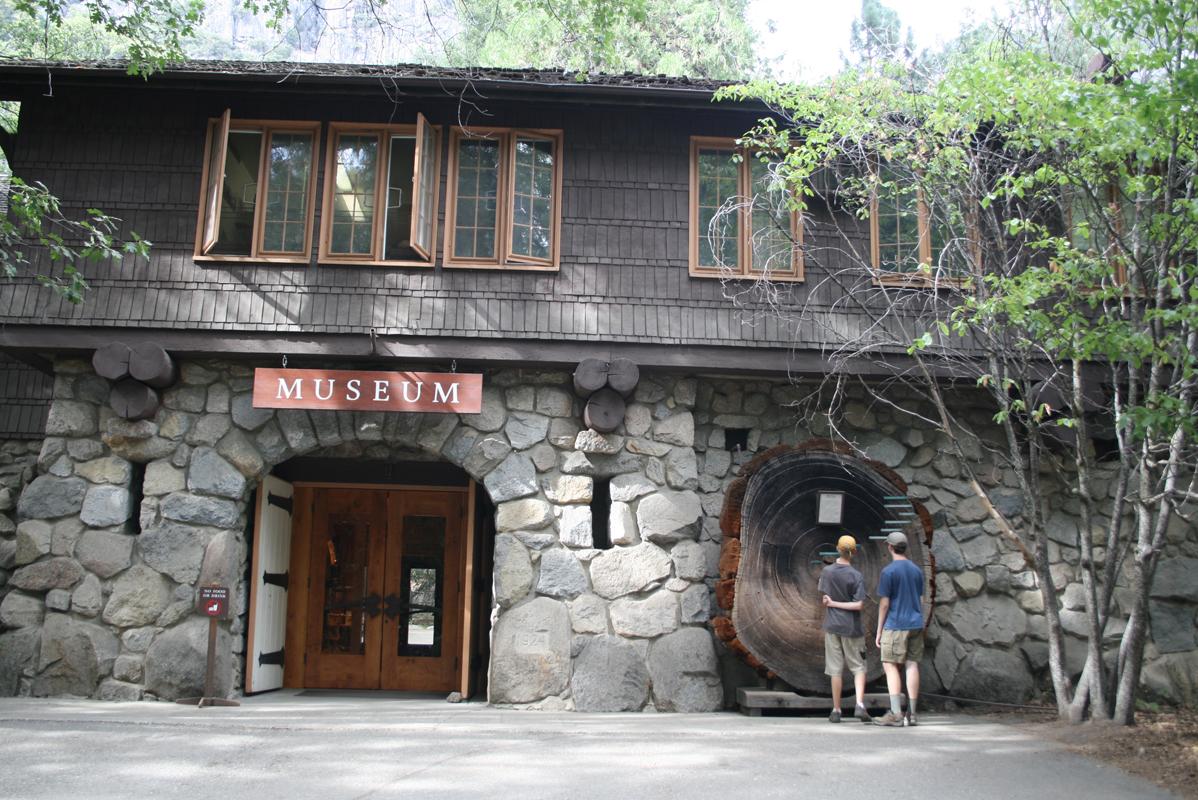
Yosemite Museum
Herbert Maier had a problem most architects would envy. His client wanted a museum in Yosemite Valley, surrounded by granite walls that rise 3,000 feet into the Sierra sky. Any building bold enough to reach upward would look absurd. So Maier did something radical for 1925: he surrendered. "The elevation of the museum stresses the horizontal," he wrote, "that seemed the logic of the situation. To attempt altitudinal impressiveness here in a building would have meant entering into a competition with the cliffs." The resulting structure - low, stone-faced, rustic - became a model for every national park building that followed. But the Yosemite Museum's most remarkable quality was never its architecture. It was the collection inside, assembled to tell the story of the people who lived in this valley for three thousand years before the first tourist arrived.
Before the Building, the Idea
The Yosemite Museum did not spring from a single inspiration. It grew in stages, each one reflecting how Americans understood their parks. The first "museum" was an arboretum planted in 1904 near the Wawona Hotel by Major John Bigelow, the park's acting superintendent - a collection of labeled trees, nothing more. By 1915, a natural history exhibit occupied a room in the park headquarters building. In 1922, the operation moved into artist Chris Jorgensen's former home and studio near Sentinel Bridge, where the extra space allowed ethnographic and geological objects to join the wildlife dioramas. Visitors loved it. The idea of outdoor education through park museums was gaining momentum nationally, and in the 1920s the American Association of Museums formed a committee specifically to promote them. The Laura Spelman Rockefeller Memorial awarded $70,500 to build a purpose-designed facility in Yosemite, one that would serve as a model for the entire National Park System. When the building opened in 1926, it was one of the first museums the Park Service had ever operated.
The Weavers and the Witnesses
Walk past the geology displays and the natural history dioramas and you reach the heart of the museum: the baskets. The Yosemite Museum holds one of the most significant collections of California Indian basketry in existence, spanning from roughly 1870 to the present. These are not generic craft objects. They include work by Lucy Telles, a Mono Lake Paiute-Southern Sierra Miwok weaver whose baskets took years to complete and won prizes at exhibitions across the country, and by Maggie Howard, known as Tabuce, whose work documented techniques passed down through generations. The Schwabacher Basket Collection preserves Mono Lake Paiute and Miwok weaving traditions that might otherwise have vanished. Alongside the baskets sit Thomas Ayres' first sketches of Yosemite from 1855, landscape paintings by Thomas Hill, Thomas Moran, William Keith, and Albert Bierstadt, over 100,000 historic park photographs, and one small object that somehow holds its own against all of it: John Muir's tin cup.
A Building That Taught a Nation
Maier's design for the Yosemite Museum did more than house a collection. It launched a philosophy. The National Park Service rustic style - native stone, rough-hewn logs, wood shingles - was not merely an aesthetic preference. It was a belief that park buildings should feel as though pioneer craftsmen had assembled them with limited tools, achieving what designers called "sympathy with natural surroundings and with the past." The two-story museum anchored an emerging village center in Yosemite Valley where every structure followed the same architectural theme. Maier took the principles he developed here and spread them across the country. In 1933, the Park Service hired him as regional director for Civilian Conservation Corps work in state parks. He developed guidebooks that taught state park designers how to apply rustic design, and those books arrived at exactly the right moment: hundreds of new parks were being built with CCC labor during the Depression. The log-and-stone visitor centers and lodges that Americans associate with national parks from Maine to California trace a direct lineage back to this one building in Yosemite Valley.
Hidden in Plain Sight
The museum's story took a quieter turn in 1966 when the new Valley Visitor Center opened nearby. The Park Service converted much of the original museum building into office space, and the vast majority of the collection went into storage. What had been a two-story showcase of geology, history, and ethnography became largely invisible to visitors. Some objects found new homes: the Indian Cultural Exhibit opened in 1976, the Museum Gallery in 1988, and additional pieces went on display at the Pioneer Yosemite History Center and the El Portal Transportation Exhibit. Objects travel regularly to other museums and research institutions. NPS staff and outside scholars still rely on the collection and the closely associated Research Library and Archives for investigations into both the human and natural history of the park. The building endures, its horizontal silhouette still deferring to the granite walls above, still housing one of the largest museum collections in the entire National Park System - even if most of what it holds remains out of sight.
From the Air
Located at 37.7486°N, 119.588°W in Yosemite Valley, near the Valley Visitor Center complex. The museum is a low-profile stone building that blends with its surroundings, making it difficult to spot from altitude. Best viewed at 2,000-4,000 ft AGL when following the Merced River through the valley. Nearest airports: Fresno Yosemite International (KFAT), 65 miles south; Mariposa-Yosemite Airport (MPI), approximately 30 miles west. El Capitan and Half Dome serve as prominent visual references.