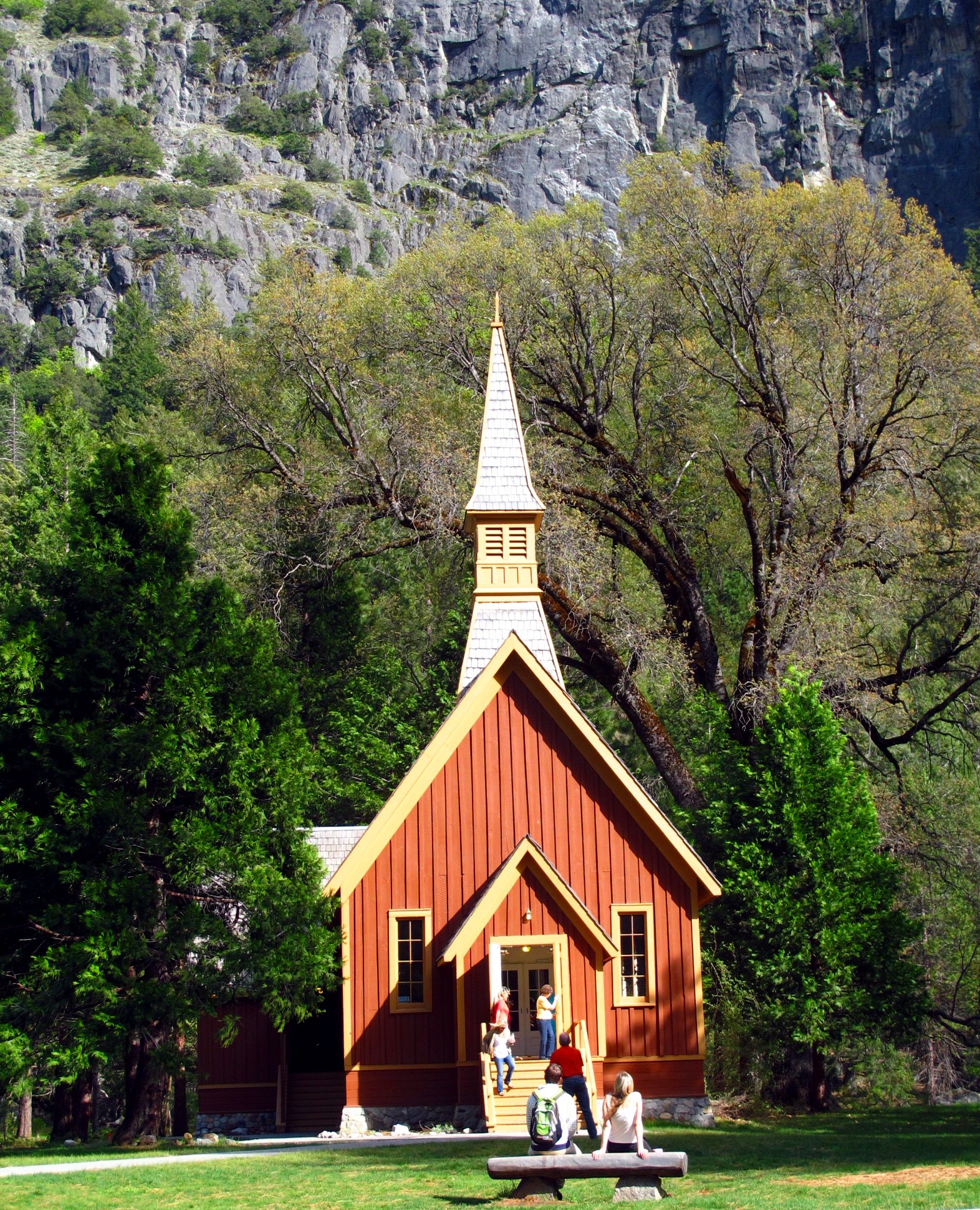
Yosemite Valley Chapel
It cost between three and four thousand dollars. San Francisco architect Charles Geddes designed it in the Carpenter Gothic style, and his son-in-law Samuel Thompson built it for the California State Sunday School Association. That was 1879. The chapel was placed in what locals then called the Lower Village, near what is now the trailhead of the Four Mile Trail. When the village dwindled, the chapel was picked up and moved to its present location in 1901. When a flood came in 1964, its foundations were raised. When another flood came in 1997, it was damaged and repaired again. Through relocations and inundations, the Yosemite Valley Chapel has outlasted every other building in the valley, making it the oldest standing structure in Yosemite - a modest wooden church stubbornly persisting in a landscape that regularly reminds humans how temporary their works really are.
Gothic Lines Against Granite Walls
The Carpenter Gothic style is defined by its ambition to mimic stone cathedral architecture using wood, and the Yosemite Valley Chapel embodies both the charm and the audacity of that enterprise. The L-shaped frame building covers roughly 1,470 square feet and seats about 250 people. Board-and-batten siding wraps its exterior, and a prominent steeple rises above the tree line - a vertical gesture that, unlike Herbert Maier's museum nearby, makes no apology for competing with the cliffs. But the steeple's scale is so modest that the competition is endearing rather than presumptuous. Seen from across a meadow with Half Dome looming beyond, the chapel looks less like a structure trying to assert itself and more like a punctuation mark in a sentence written by glaciers. Geddes designed it as an interdenominational facility, a condition stipulated in the Sunday School Association's application for permission to build on park land. That ecumenical spirit has held for nearly a century and a half.
A Church That Moved with the Times
The Lower Village where the chapel was first built no longer exists. As Yosemite's infrastructure shifted in the late nineteenth century, the small settlement near the Four Mile Trailhead lost its population. Rather than abandon the building, park authorities relocated it in 1901 to a site closer to the valley's emerging center of activity. The move was practical, but it also said something about what the chapel meant to the people who used it. This was not a building anyone was willing to let go. Weddings, memorial services, and weekly worship continued through the decades, drawing both park residents and visitors who found something compelling about attending a service in one of the most dramatic natural settings on Earth. The chapel became a fixture not just of Yosemite's built environment but of its emotional life - the place where people marked the passages that mattered most.
Tested by Water
Yosemite Valley floods. The Merced River, swollen by snowmelt or winter storms, has periodically turned the valley floor into a shallow lake, and structures built at ground level pay the price. The 1964 flood was severe enough that the chapel's foundations had to be raised during a 1965 restoration - a practical response, but also a quiet admission that the river would return. It did. The January 1997 floods were among the worst in Yosemite's recorded history, inundating much of the valley and causing extensive damage throughout the park. The chapel was hit again, requiring significant repair. Each time, the building was patched, strengthened, and reopened. On December 12, 1973, the chapel was placed on the National Register of Historic Places, a recognition that its persistence was itself historically significant. The little wooden church that Charles Geddes designed for a few thousand dollars had become, through sheer endurance, an irreplaceable part of the American landscape.
Still Standing, Still Open
What makes the Yosemite Valley Chapel remarkable is not architectural grandeur or historical drama. It is the quiet fact of continuation. Services are still held here. Couples still marry beneath its steeple. Visitors still wander in from the meadow trail, drawn by the incongruity of a small white church framed by the largest granite walls in North America. The building is interdenominational by design and by necessity - in a place visited by millions of people from around the world, exclusivity would be absurd. The chapel simply offers a room, some pews, and a view through its windows of the same cliffs and waterfalls that have drawn people to this valley for thousands of years. At 1,470 square feet, it is dwarfed by everything around it. That may be the point. In a valley where nature operates at a scale that overwhelms, the chapel's smallness is not a weakness. It is what makes the building feel human.
From the Air
Located at 37.741°N, 119.592°W on the floor of Yosemite Valley, south of the Merced River near Sentinel Bridge. The chapel's white steeple may be visible from low altitude against the meadow and forest floor. Nearest airports: Fresno Yosemite International (KFAT), 65 miles south; Mariposa-Yosemite Airport (MPI), approximately 30 miles west. Best viewed at 2,000-3,000 ft AGL. Sentinel Rock rises to the south and Yosemite Falls is visible to the northwest.