Yoshimi Hundred Caves
They called it the Hundred Caves, but the actual count is 219. Row upon row of square openings, each roughly a meter across, punctuate the tuff cliff face on the northern slope of a hill overlooking the Nogawa River in the town of Yoshimi, Saitama. From a distance the effect is startling, as though the hillside itself has been turned into a honeycomb. Step closer, and each dark opening leads through a narrow tunnel into a vaulted chamber two to three meters square, some extending several meters into the rock. These are yokoanabo, lateral-entrance tombs carved during the late Kofun period around the 7th century AD, and together they form the largest grave cluster in all of Japan.
The Debate That Launched Japanese Archaeology
When Tsuboi Shogoro of Tokyo Imperial University first excavated the site in 1887, he uncovered Jomon pottery fragments, magatama jewels, gold and silver rings, swords, and bronze mirrors. Tsuboi proposed a radical theory: these were not tombs at all, but the cave dwellings of a diminutive race, possibly the Koro-pok-guru of Ainu legend, later converted into burial chambers by the invading Yamato people. The idea captivated the public imagination but ignited fierce academic controversy. By the 1920s, researchers including Mitsutaro Shirai had marshaled enough evidence to overturn Tsuboi's theory. The cave structures and recovered artifacts matched other known Kofun-period tombs, and similar finds at the nearby Kaziwazaki Plateau, with its 5th- to 7th-century burial mounds and settlement ruins, made clear that these were purpose-built graves, not repurposed homes. The debate was settled, but Tsuboi's work had helped establish archaeology as a serious discipline in Japan.
Architecture of the Dead
Each tomb follows a similar pattern. A square opening barely large enough for a person to crouch through gives way to a narrow entrance tunnel, which opens into the main burial chamber. Inside, most caves contain an elevated platform that once held coffins or the bodies of the dead. Some chambers feature multiple pedestals, evidence that families returned over generations to inter their kin together. The entrances were originally sealed with schist slabs, locking the dead away in darkness. The tombs extend in several rows running west to east along the cliff face, their openings staggered according to the natural topography. The designation as a National Historic Site came on March 7, 1923, recognizing this extraordinary concentration of ancient burial engineering.
Green Light in the Darkness
Deep inside certain caves, where daylight never fully penetrates, a faint emerald glow emanates from the walls. This is Schistostega, luminous moss that reflects even the faintest trace of light with an otherworldly green shimmer. The moss was designated as a Natural Monument of Japan on November 30, 1928, adding a layer of biological wonder to the archaeological significance. The effect is most visible in the deeper chambers, where the moss catches stray photons and sends them back as a ghostly luminescence. The site sits within Hiki Hills Prefectural Natural Park, and the combination of ancient human engineering and this peculiar natural phenomenon makes the Hundred Caves unlike any other archaeological site in the country.
From Tombs to Factory Floor
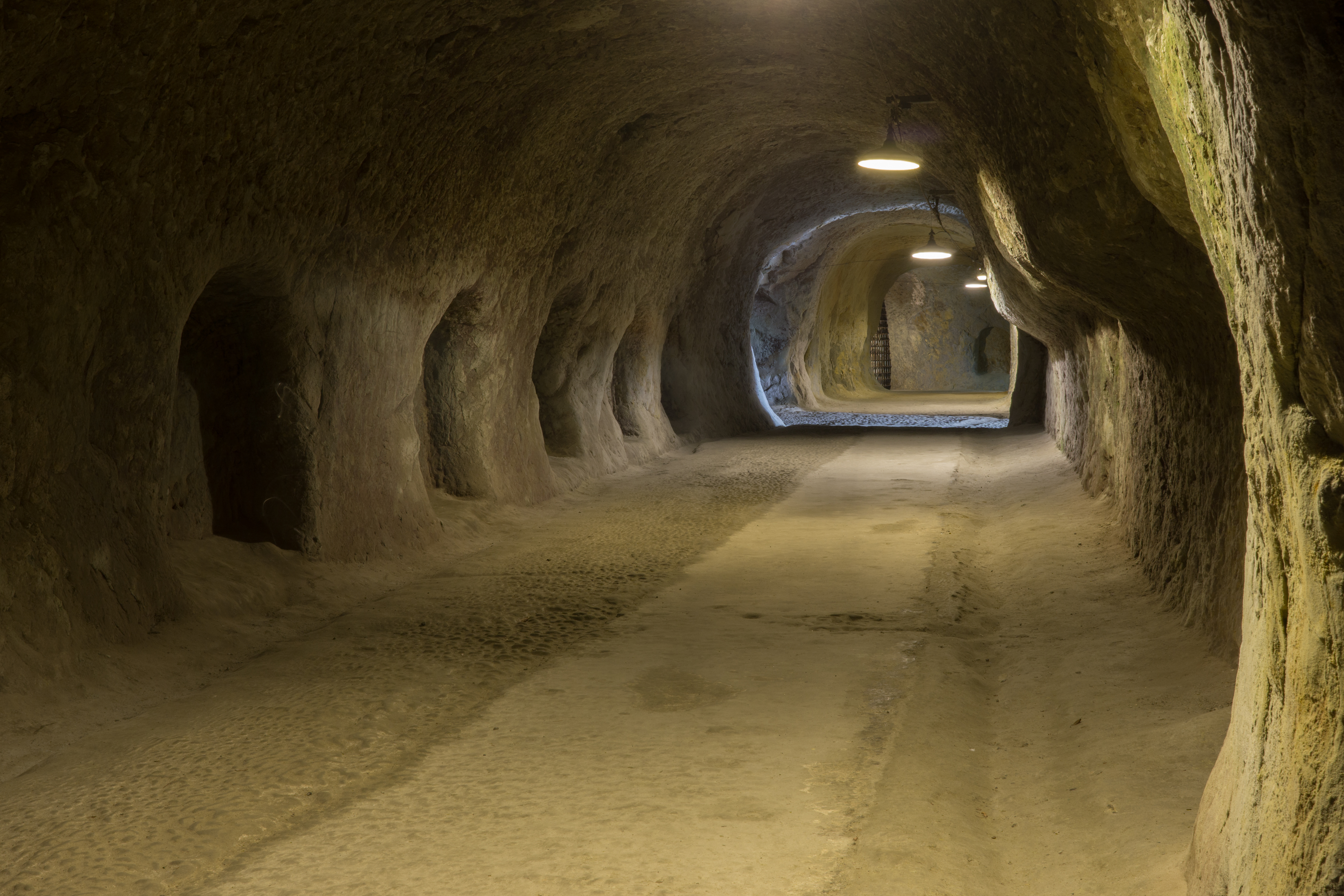
The caves endured for more than a thousand years before their most dramatic transformation. In the final months of World War II, the Japanese military commandeered the site, enlarging a portion of the ancient tombs to create an underground aircraft engine factory for the Nakajima Aircraft Company. Between 3,000 and 3,500 conscripted and volunteer laborers carved deeper into the hillside, widening centuries-old burial chambers into industrial tunnels. About one-tenth of the protected site was destroyed in the process. The factory never produced a single engine. The war ended before it became operational, leaving behind an eerie palimpsest: 7th-century tombs scarred by 20th-century desperation. Today the enlarged tunnels remain visible alongside the original grave openings, a stark juxtaposition of two very different chapters in Japanese history.
Walking Among the Openings
The site is partially open to the public, accessible by a twenty-minute walk from Higashi-Matsuyama Station on the Tobu Tojo Line. Visitors approaching from the path below see the cliff face first as a wall of shadow and texture, the dark openings arranged in rough tiers. The experience is quietly unsettling and deeply meditative. Each small square of darkness represents a family, a lineage, a community that chose this hillside to house their dead nearly fourteen centuries ago. The scale is cumulative rather than monumental. No single cave is grand, but 219 of them together, stacked along a riverbank cliff in the green hills north of Tokyo, compose something genuinely extraordinary.
From the Air
Located at 36.039N, 139.422E in the town of Yoshimi, Saitama Prefecture, on the Kanto Plain north of Tokyo. The tuff cliff face is on the northern slope of a hill overlooking the Nogawa River, a tributary of the Arakawa. Best viewed at low altitude (1,500-2,500 ft AGL) in clear conditions. The nearest significant airport is RJTT (Tokyo Haneda), approximately 60 nm to the south. RJAH (Ibaraki Airport) lies about 40 nm to the northeast. Look for the forested hillside along the river valley; the cave openings are on the north-facing slope.