Yoshiwara
Samurai had to leave their swords at the gate. That single rule tells you everything about Yoshiwara — a walled district in Edo where the rigid hierarchies of Tokugawa Japan dissolved into something more complicated. Established in 1617 as one of three licensed pleasure quarters created by the shogunate, Yoshiwara was a place of carefully managed contradiction: legal prostitution contained within defined borders, rigid social rank suspended inside a floating world of art and commerce, and women who set the fashion trends for an entire nation while remaining bound by contracts of indenture they could rarely escape.
The Walled World
The Tokugawa shogunate created Yoshiwara as a means of control, confining the sex trade to a single, licensed, surveilled district rather than allowing it to spread through the streets of Edo. The original quarter burned in the Great Fire of Meireki in 1657, and the rebuilt district — initially called Shin Yoshiwara, or "New Yoshiwara" — became the version that would endure for centuries. At its peak in the 18th century, Yoshiwara housed some 1,750 women, with records showing as many as 3,000 at a time drawn from across Japan. Most arrived through indenture, sold by impoverished families in exchange for advance payments. Contracts nominally lasted five to ten years, but accumulated debts could extend servitude indefinitely. Some women served out their contracts and married clients or returned home. Many others died of sexually transmitted diseases or failed abortions before they ever walked free.
Fashion and the Floating World
Yoshiwara generated a cultural gravity that far exceeded its physical boundaries. The highest-ranking courtesans, known as oiran, became the trendsetters of Edo-period Japan. While ordinary prostitutes were technically required to wear simple blue robes — a rule honored almost entirely in the breach — the oiran appeared in brilliant silk kimono with elaborate hairstyles held in place by ornate kanzashi hair accessories. Their fashions dictated what women of means wore across the country. The district drew not only patrons but an entire ecosystem of kabuki actors, comedians, dancers, painters from the official Kano school, and tea-shop workers. Social class dissolved within Yoshiwara's walls: a commoner with enough money received the same treatment as a samurai. Brothel patrons were legally limited to a single night and day per visit, though like most Yoshiwara regulations, enforcement was more theory than practice.
The Throw-Away Temple
Beneath the glamour of the oiran lay a harsher reality. Most women working in Yoshiwara came from poor families and faced relentless exploitation. When they died — of disease, of botched abortions, of sheer exhaustion — their bodies were carried anonymously to Jokan-ji temple and left at the back entrance, a proper burial being beyond their means. The temple became known as Nage-komi dera, the "Throw-Away Temple." A memorial consecrated during the Meiji era now honors the thousands of anonymous women interred there. The temple remains one of the most quietly devastating sites in Tokyo, a counterweight to the woodblock prints and romantic legends that have long defined Yoshiwara in the popular imagination. By 1893, the district housed over 9,000 women, many suffering from syphilis. Fire struck again in 1913, and the 1923 Great Kanto Earthquake nearly obliterated the area entirely.
Outlawed but Not Erased
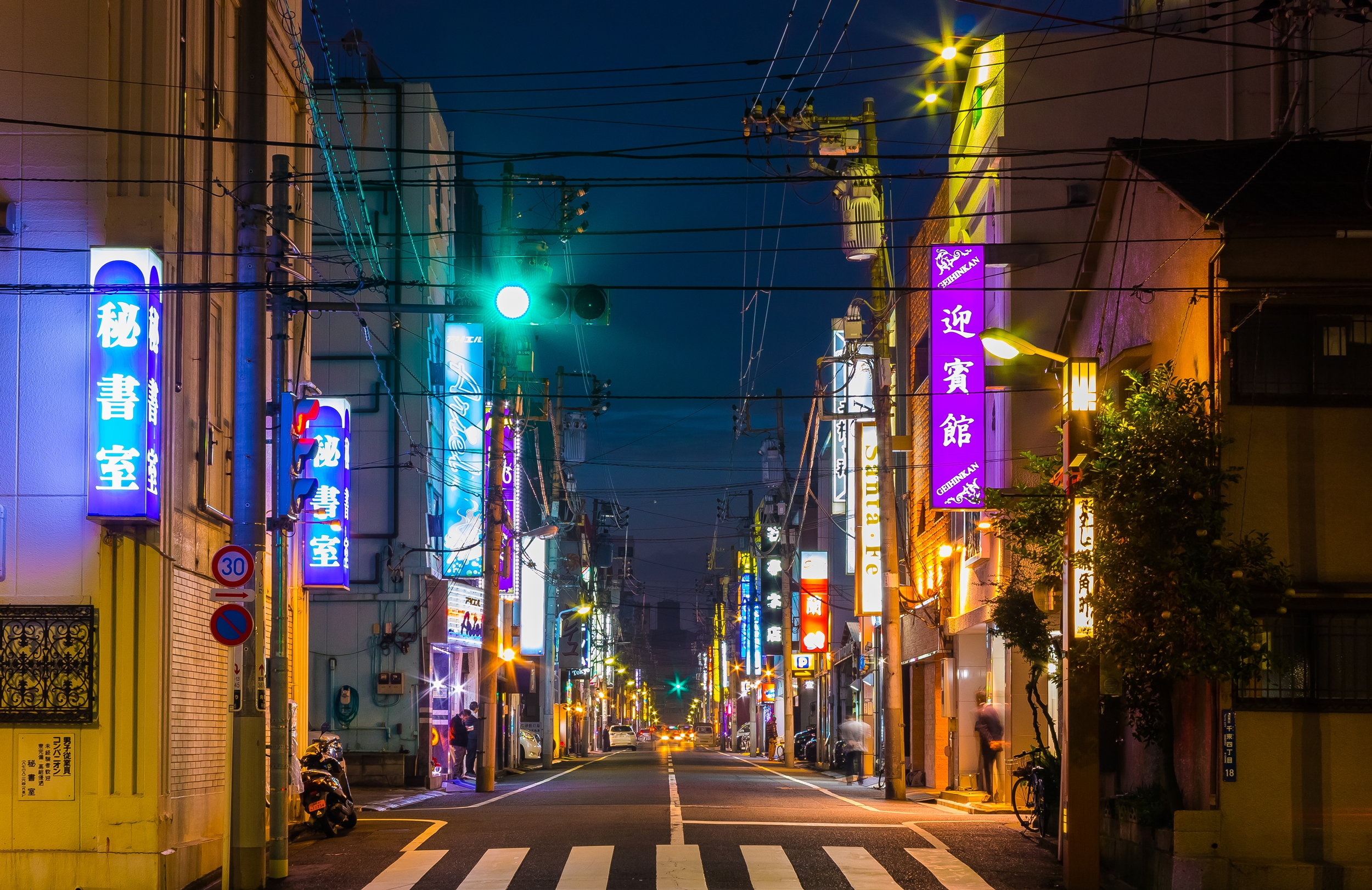
Yoshiwara persisted as a functioning red-light district until 1958, when Japan's Prostitution Prevention Law formally outlawed the sex trade. But the law defined prostitution narrowly as "compensated penetrative sex with an unspecified person," and businesses quickly adapted to operate within legal gray areas. Today, the area near Minowa Station on the Hibiya Line, now known as Senzoku Yon-chome, retains a concentration of soaplands and similar establishments. The old street grid still traces the outlines of the Edo-period quarter, and the temples and shrines that once served Yoshiwara's residents remain standing. The district lives on in Japanese popular culture as well, appearing as a setting in anime series like Demon Slayer: Kimetsu no Yaiba, in films by directors from Fritz Lang to Kenji Mizoguchi, and in Pietro Mascagni's 1898 opera Iris. Yoshiwara's legacy is inseparable from the tension at its core: a place of extraordinary artistic production built on systematic exploitation.
From the Air
Located at 35.7236°N, 139.7950°E in the Taito ward of northeastern Tokyo, north of the Sumida River. The historic district lies near Minowa Station on the Hibiya Line. From the air, the area is identifiable by its distinctive grid street pattern, a remnant of the original Edo-period layout, surrounded by dense modern urban development. Nearest airports: Tokyo Haneda (RJTT) approximately 18 km south, Narita (RJAA) approximately 60 km east. Best viewed at 2,000-4,000 ft where the street patterns and surrounding Asakusa/Taito ward landmarks are visible.