Yoshizaki-gobo
In 1465, warrior monks from Enryaku-ji on Mount Hiei stormed Hongan-ji on the outskirts of Kyoto and burned it to the ground. The man they wanted to silence was Rennyo, the eighth chief abbot, whose energetic preaching of Pure Land Buddhism had attracted followers faster than the established Tendai sect could tolerate. Rennyo fled with his life and little else. Six years later, he resurfaced in the tiny village of Yoshizaki, on the border between Echizen and Kaga provinces in what is now Fukui Prefecture. The temple he built there, Yoshizaki-gobo, became the nerve center of a religious and political upheaval that would reshape the power structures of medieval Japan. Today, its ruins sit quietly on a hillside in the city of Awara, designated a National Historic Site since 2012, the stones whispering of a time when a single monk's pen was more dangerous than a samurai's sword.
The Abbot in Exile
Rennyo had been appointed chief abbot of Hongan-ji in 1457, inheriting a Pure Land Buddhist institution founded on the teachings of Shinran. Under Rennyo's leadership, the sect expanded rapidly beyond the capital, drawing converts from farming communities and merchant classes who found its message of salvation through faith accessible in ways that the elaborate rituals of older sects were not. This success threatened the established religious order, particularly the powerful Tendai sect headquartered at Enryaku-ji, whose militant monks, the sohei, had a long history of enforcing orthodoxy through violence. When they destroyed Hongan-ji in 1465, Rennyo wandered for years before choosing Yoshizaki as his new base. The location was strategic: perched on the provincial border, it sat beyond the easy reach of any single feudal authority while remaining accessible to followers traveling the northern highways.
Letters That Built an Army
From Yoshizaki-gobo, Rennyo did something no military commander of his era could match. He wrote letters. His epistles, composed in colloquial Japanese rather than the literary Chinese favored by the religious establishment, explained Pure Land teachings in language that farmers and fishermen could understand. These letters spread through the northern provinces, reaching as far as Dewa and Oshu, carried by pilgrims who flocked to Yoshizaki in growing numbers. The town that grew around the temple provided lodgings and services for both priests and lay followers. But Rennyo's letters carried more than theology. They contained a revolutionary social vision: a semi-theocratic republic in which traditional feudal landlords would be replaced by communal landholding, with communities of lay believers governed under the guidance of the priesthood. This was the intellectual foundation of the Ikko-ikki movement, armed uprisings of religious commoners that would eventually overthrow the samurai rulers of Kaga Province entirely.
Twice Burned, Never Forgotten
Success at Yoshizaki invited the same hostility Rennyo had faced in Kyoto. The traditional political authorities of the region viewed his growing influence with alarm. In 1474, the Yoshizaki-gobo burned down. It was rebuilt, only to burn again in 1475. After the second destruction, Rennyo made the decision to leave Yoshizaki and return to Kyoto, where he would continue his work from a position of greater safety. But the movement he had launched from this small border village had taken on a life of its own. The Yoshizaki Hongan-ji continued to operate under his followers, serving as a base for the Kaga ikki movement, the peasant-led religious government that controlled Kaga Province for nearly a century. The temple was finally destroyed in 1506 by forces of the Asakura clan, the feudal lords of Echizen, who recognized that the real threat to their power was not another army but a network of believers bound together by shared faith and Rennyo's plain-spoken letters.
Quiet Ground, Loud History
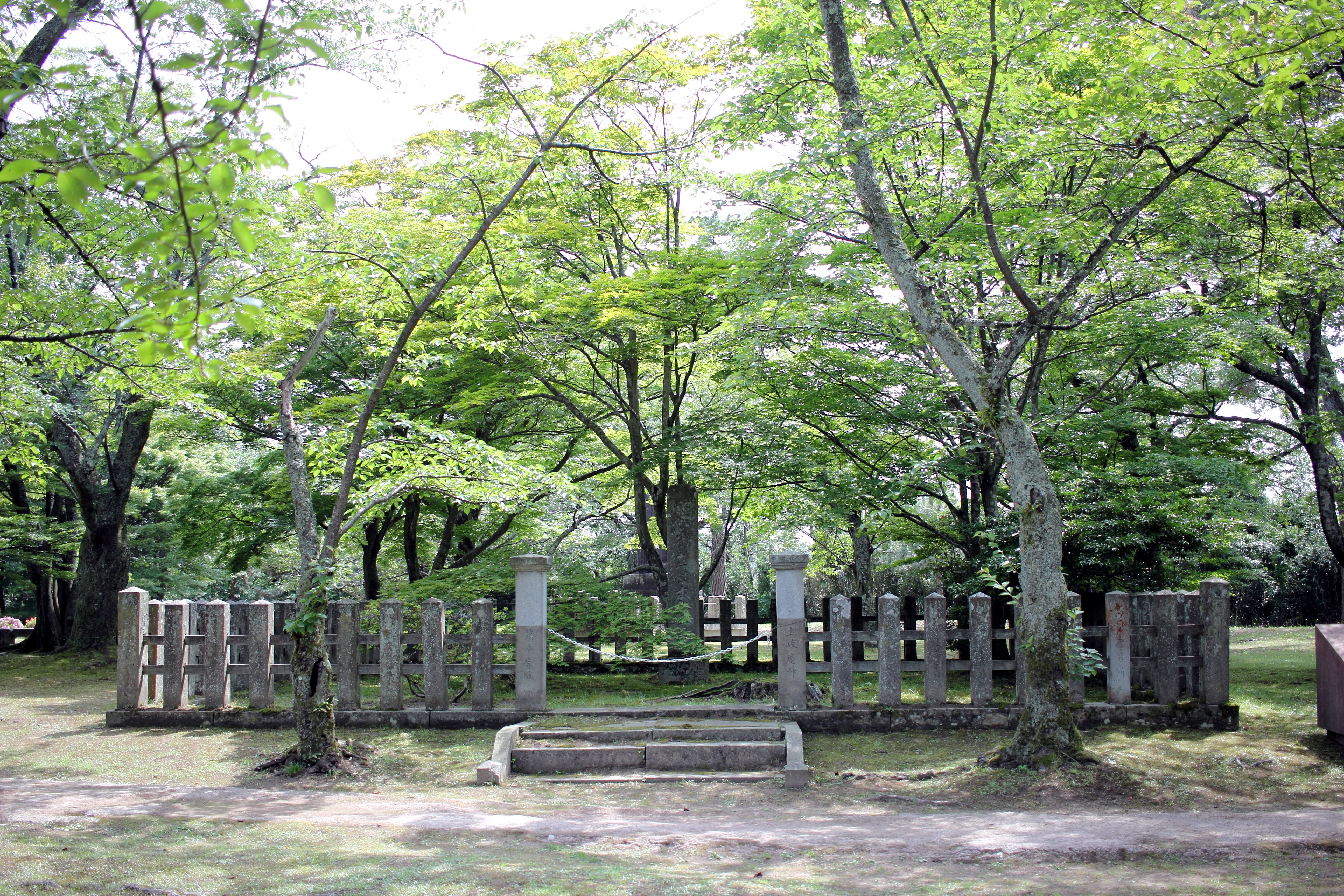
A new temple was built on the site in 1747, belonging to the Otani branch of the Jodo Shinshu movement, the institutional descendant of Rennyo's Pure Land sect. Today, the site preserves both the newer temple and the archaeological remains of the original gobo. A monument marks where the 15th-century complex stood, and a bronze statue of Rennyo gazes out from the hillside. The designation as a National Historic Site in 2012 recognized what historians have long understood: that Yoshizaki-gobo was not simply a temple but the birthplace of one of medieval Japan's most radical experiments in social organization. In an era when power flowed from the sword, Rennyo demonstrated that it could also flow from a letter, written plainly enough for anyone to read.
From the Air
Yoshizaki-gobo is located at 36.29°N, 136.25°E in the city of Awara, Fukui Prefecture, on a hillside near the border of the former Echizen and Kaga provinces. From the air, look for a wooded hilltop with temple buildings near the northern edge of Awara, between Maruoka Castle to the south and the Kaga coast to the north. The nearest major airport is Komatsu Airport (RJNK), approximately 25 km to the northeast. The Sea of Japan coastline is visible to the northwest. Best viewed at 3,000-5,000 feet AGL.