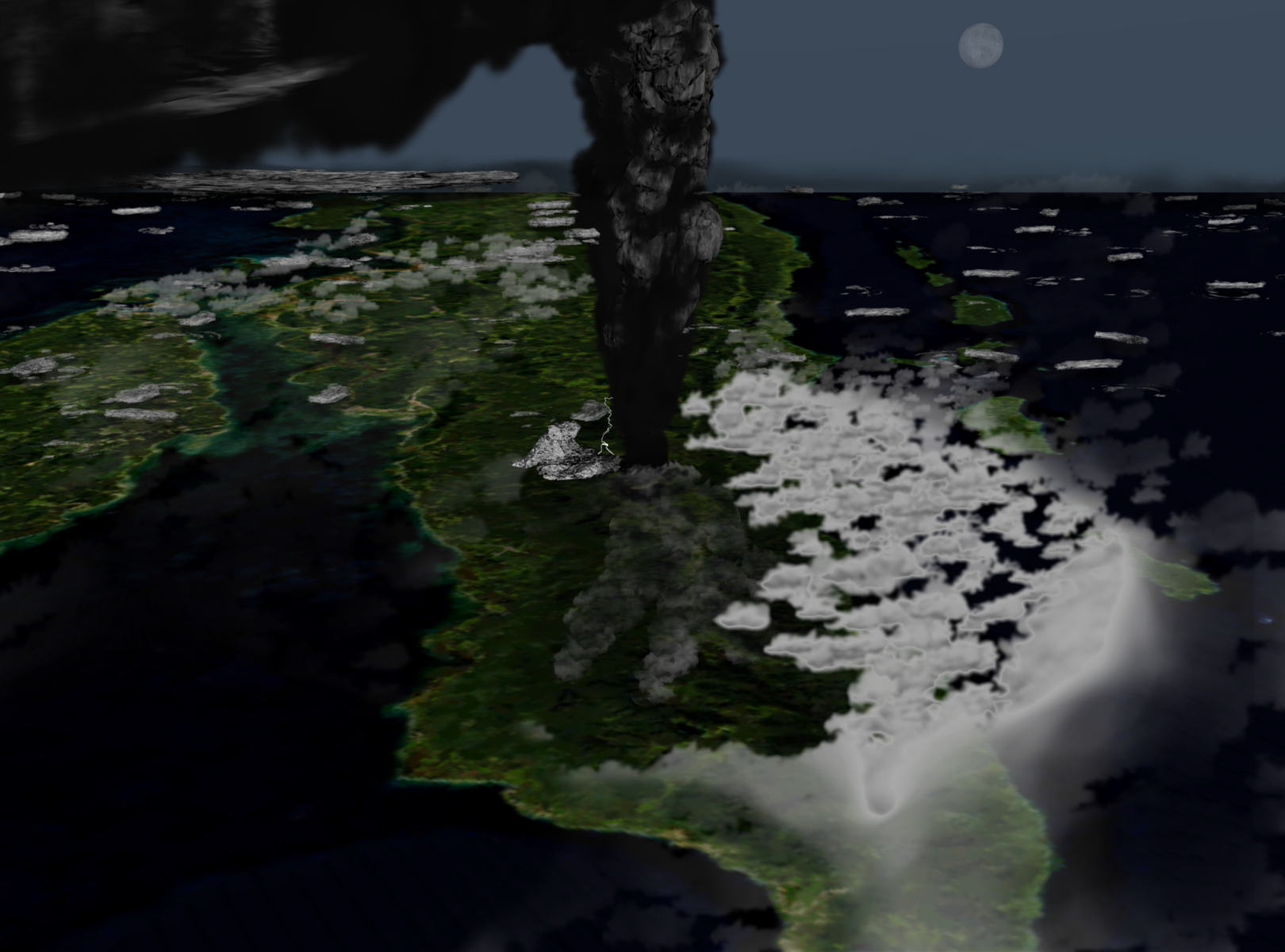
Youngest Toba Eruption
Somewhere around 74,000 years ago, during what must have been a northern summer, five distinct magma bodies beneath northern Sumatra activated within a few centuries of each other and then -- in geological terms -- detonated. The eruption that followed scored an 8 on the volcanic explosivity index, the highest possible rating, making it the largest known explosive eruption of the entire Quaternary period. Roughly 2,800 cubic kilometers of material erupted: about 2,000 cubic kilometers of ignimbrite that flowed across the ground, and some 800 cubic kilometers of ash that fell mostly to the west. When the surface collapsed into the emptied magma chamber, it formed a caldera that filled with water. Today we call it Lake Toba, and it is the largest volcanic lake on Earth.
A Blanket of Ash Across the World
The scale of the Toba eruption defies intuition. Ash from the explosion blanketed the Indian subcontinent, reached the Arabian Sea and the South China Sea, settled on the lowlands of northwest Ethiopia, dusted Lake Malawi in southeastern Africa, and left traces in Lake Chala near Kilimanjaro. In total, the ashfall covered more than 7.5 percent of Earth's surface at a thickness of one centimeter or more. Toba tephra has been identified as far afield as Huguangyan Maar Lake in South China. Pyroclastic flows inside the caldera piled up to enormous thicknesses, while the outflow sheet likely reached the Indian Ocean and the Straits of Malacca. High-precision argon-argon dating has pinned the eruption to 73,880 plus-or-minus 320 years ago -- a date that places it squarely at the onset of a millennium-long cold event known as Greenland Stadial 20, one of the sharpest climate transitions of the Late Pleistocene.
The Climate That Was Already Changing
The eruption did not occur in a vacuum. It struck during a period of rapid climate transition driven by variations in Earth's orbit -- the shift from a warmer interglacial phase into glacial conditions of Marine Isotope Stage 4. Ocean temperatures had already cooled by 0.9 degrees Celsius. Sea levels were falling, eventually dropping 60 meters. Northern Hemisphere ice sheets were expanding beyond the extent they would later reach during the Last Glacial Maximum. Into this already-cooling world, Toba injected massive quantities of sulfurous gases that formed aerosol veils in the stratosphere. Climate models suggest the eruption produced a volcanic winter with maximum global mean cooling that gradually returned to normal within about five years -- significant, but not the decade-long freeze once imagined. Environmental records from Lake Malawi show no cooling-induced change in lake ecology after Toba ash was deposited, though high-elevation forests died from drought. A Middle Stone Age site in Ethiopia, however, records a severe drought concurrent with the ash layer.
Did Humanity Nearly Go Extinct?
In 1993, science journalist Ann Gibbons proposed a provocative idea: that the Toba eruption had nearly wiped out the human species. The theory gained scientific support from anthropologist Stanley Ambrose at the University of Illinois, who argued in 1998 that the eruption crashed the global human population to just a few thousand surviving individuals -- a genetic bottleneck whose signature could be read in the remarkably low diversity of human mitochondrial DNA. The idea was dramatic, elegant, and for years widely accepted. But the evidence has grown more complicated. Stone tools found above and below the Toba ash layer at Jurreru Valley in southern India are strikingly similar, suggesting local populations survived the eruption intact. Recent whole-genome analyses reveal that non-African populations did experience a steep decline in numbers, reaching a low of only 1,000 to 3,000 individuals around 50,000 years ago -- but this bottleneck appears driven by the broader cold and arid conditions of the ice age rather than a single volcanic event. African populations experienced a milder bottleneck and recovered earlier.
Survivors of the Ash
The Toba eruption did not extinguish the human lineage, and it did not extinguish others either. Neanderthals survived it, persisting until roughly 40,000 years ago. So did Denisovans, lasting until about 55,000 years ago. Homo floresiensis and Homo luzonensis may have weathered it as well, on their island refuges in Southeast Asia. But the eruption left marks on the wider animal kingdom: Eastern African chimpanzees, Bornean orangutans, central Indian macaques, gorillas, cheetahs, and tigers all show genetic evidence of population crashes followed by expansion from very small numbers between 70,000 and 55,000 years ago. Some researchers have proposed that the eruption forced surviving humans to develop new adaptive strategies -- innovations that may have given Homo sapiens an edge in eventually replacing Neanderthals and other archaic species. Whether or not that is true, the genetic analysis has identified 56 selective sweeps related to cold adaptations in non-African populations, 31 of which occurred during the period from 72,000 to 97,000 years ago.
The Lake That Remembers
Lake Toba stretches roughly 100 kilometers long and 30 kilometers wide in the highlands of North Sumatra, its surface sitting about 900 meters above sea level. Samosir Island, in the lake's center, is a resurgent dome -- the magma chamber floor slowly pushing back up, a reminder that the system below is not dead but sleeping. The lake's extraordinary depth and the island's scale give some physical sense of what was removed from the earth 74,000 years ago. Stand on Samosir's shore and you are standing inside the wound. The caldera walls rise around you, green and terraced, farmed by Batak Toba communities who have lived on and around the lake for centuries. They fish its waters, grow rice on Samosir's plateau, and build their distinctive boat-shaped houses along its shores. The eruption that created this landscape was one of the most violent events in Earth's history. The civilization that inherited it transformed the scar into home.
From the Air
Lake Toba is located at approximately 2.57N, 98.88E in the Barisan Mountains of North Sumatra, Indonesia. The lake is one of the most prominent features visible from altitude in all of Southeast Asia, stretching roughly 100 km long and 30 km wide. Samosir Island is clearly visible in the lake's center. The lake surface sits at approximately 900 meters (2,950 feet) elevation. Nearest airport is Silangit International Airport (WIMN) on the lake's northern side. Kualanamu International Airport (WIMM) in Medan is approximately 175 km to the northeast. The caldera rim and surrounding Barisan Mountain terrain create dramatic topography visible from cruising altitude.