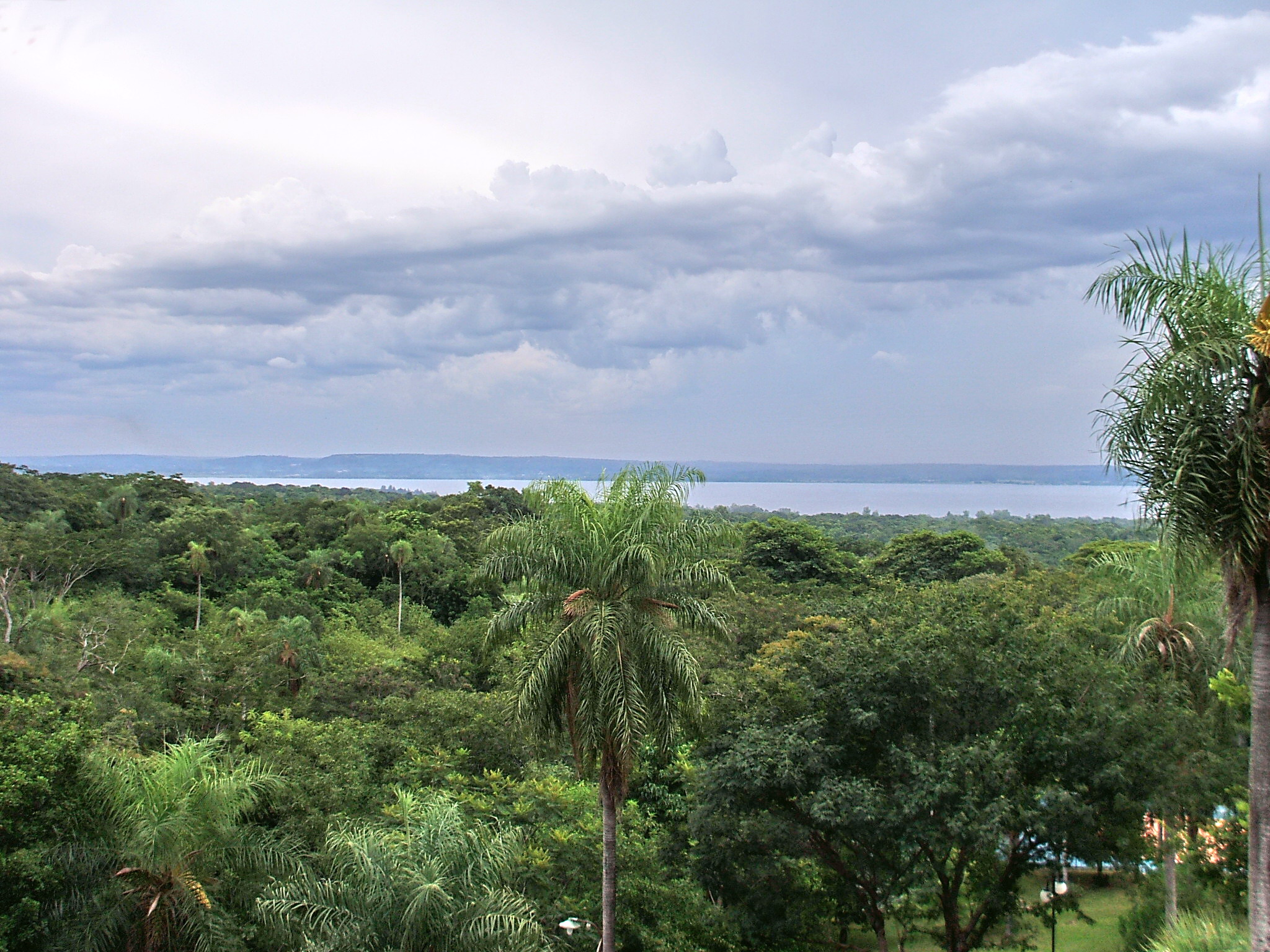
Ypacarai Lake
The Guarani name says it all: Ypacarai means "holy lake." According to legend, the Franciscan missionary Luis de Bolanos blessed these waters around 1600, and the name stuck -- outlasting the colonial period, the wars that reshaped Paraguay, and even the lake's own ecological decline. Covering 90 square kilometers about 50 kilometers east of Asuncion, Ypacarai Lake sits in the western reaches of the Asuncion-Sapucai-Villarrica graben, a tectonic depression dating to the Mesozoic Era. Three cities ring its shores -- Aregua, Ypacarai, and San Bernardino -- and for generations, Paraguayans treated it as their country's great inland playground. Then the water turned green.
A Shallow Basin with Deep History
Before it was called Ypacarai, the lake bore the name Tapycua. The reasons for the name change remain debated, but the prevailing story ties it to Bolanos and his blessing. What is not debated is the lake's geological pedigree. It occupies a graben -- a block of earth dropped between parallel faults -- formed during the Mesozoic Era, when the supercontinent Gondwana was still breaking apart. The lake stretches 24 kilometers north to south and 6 kilometers east to west, with an average depth of just 1.72 meters. That extraordinary shallowness makes it ecologically fragile. Water drains northwest through the Salado River into the Paraguay River, fed by tributaries with names that map the Guarani landscape: Yagua Resau, Yuquyry, Puente Estrella, and Pirayu.
The Green That Shouldn't Be
Ypacarai Lake is now the most polluted lake in Paraguay. The cause is familiar and depressingly cumulative: livestock farms discharge waste into feeder streams, residential development encroaches on the shoreline, large-scale deforestation strips the watershed of its natural filtration, and the shallow water offers no thermal stratification to buffer against nutrient loading. The result is a bloom of cyanobacteria -- toxic blue-green algae -- that has turned the lake's surface a vivid, unsettling green. Swimming is no longer advised. The fish are no longer safe to eat. For a lake whose name means holy water, the irony cuts deep. Cleanup efforts have been discussed for years, but the pollution sources are diffuse, the political will uneven, and the lake continues to absorb what the surrounding landscape sends it.
Three Towns, Three Personalities
San Bernardino, 48 kilometers from Asuncion, markets itself as the "Summer City" -- a resort town with beaches, cultural centers, pubs, and restaurants that come alive when temperatures climb. Aregua, 31 kilometers from the capital, draws a different crowd: writers, artists, and anyone who prefers colonial architecture to beach bars. Its artisan fairs run year-round, and the local potters sell ceramics that range from devotional to whimsical. Ypacarai, the city that shares the lake's name, anchors the cultural calendar. Since 1971, the Ypacarai Festival has gathered musicians, dancers, and theater performers each September in a celebration that the city chamber describes as an effort to "rescue and reinforce the artistic heritage of Paraguayan culture." Casa Hassler, a cultural center in town, hosts permanent and temporary exhibitions throughout the year and offers free exhibition space to artists.
The Lake from Above
From altitude, Ypacarai Lake is unmistakable -- a pale oval set into the subtropical green of Paraguay's Central Department, its color conspicuously different from the surrounding vegetation. The humid subtropical climate means warm, sunny days are frequent, with summer temperatures reaching above 20 degrees Celsius and winter lows dipping toward 3 degrees. On clear days, the three lakeside cities are visible as clusters of development against the agricultural patchwork. The lake drains visibly toward the northwest, where the Salado River carries its water toward the much larger Paraguay River. As one of the country's two main lakes, Ypacarai still provides water for drinking and irrigation -- functions that make its ongoing contamination not just an ecological concern but a public health question that Paraguay has yet to fully answer.
From the Air
Located at 25.30S, 57.35W, Ypacarai Lake is a prominent oval water feature approximately 50 km east of Asuncion. Measuring 24 km north-south by 6 km east-west, it is clearly visible from cruising altitude. The three surrounding cities -- Aregua (west shore), San Bernardino (east shore), and Ypacarai (south shore) -- serve as orientation landmarks. Nearest major airport is Silvio Pettirossi International (SGAS) in Asuncion. The lake's distinctive green coloration from algal blooms may be visible from lower altitudes on clear days.