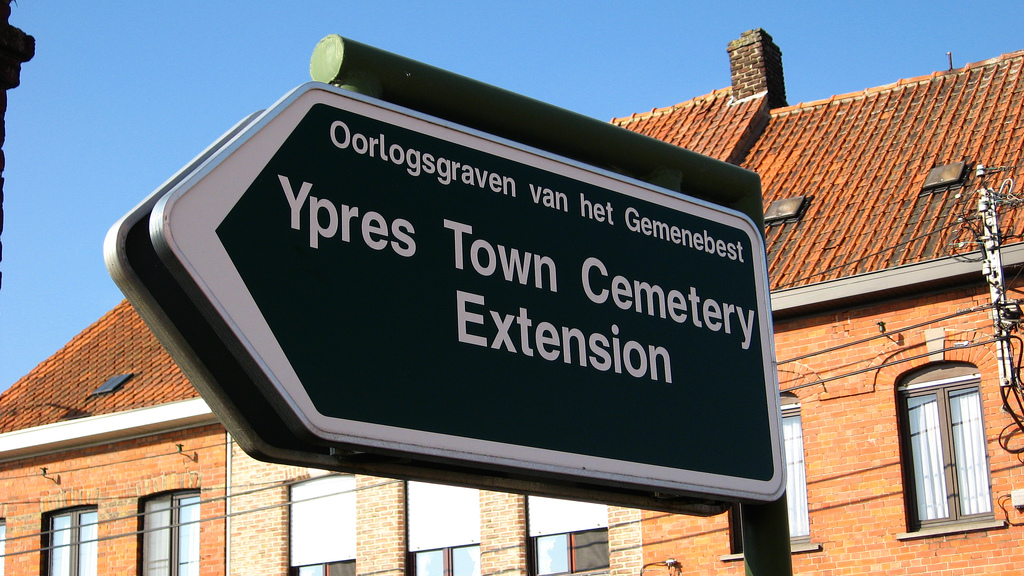
Ypres Town Cemetery and Extension
Prince Maurice of Battenberg was Queen Victoria's grandson. He was a great-grandson of the British Royal Family on his mother's side and a member of the German princely house of Battenberg on his father's. He was twenty-three years old. On 27 October 1914 he was a lieutenant in the King's Royal Rifle Corps, leading his men forward near Zonnebeke during the First Battle of Ypres, when a shell killed him. They could not get his body back to England - the war had become too dense for that. They buried him in the municipal cemetery of Ypres itself, in the same ground where the townspeople had been burying their own dead for generations.
Two Cemeteries, One Ground
Belgian towns in Flanders have always had municipal cemeteries on their edges, plain plots where the parish dead were laid in the orderly rows that local civic life produced. The cemetery on the north-east side of Ypres was no different until October 1914, when the war reached the town. The British Army, finding itself fighting in defence of a small Flemish cathedral town, began burying its dead in the local cemetery alongside the Belgian civilians. The arrangement was practical: the ground was already consecrated, the gravediggers were already there, and the front line was close enough that there was no time to find anywhere else. A separate extension cemetery, for military burials only, was opened at the same time. The two grew side by side. The civilians lay in their family plots; the soldiers lay in rows.
1914 and 1918
Most of the war's burials at Ypres Town and its Extension fall into two windows. The first is October 1914 to early 1915, when the British Expeditionary Force was holding Ypres against the German advance during the First Battle. These were the regulars and the early Territorials, often officers and men of the original BEF whose battalions had crossed to France in August. The second window is 1918, when the war returned to the town after years of being pushed back from it - the German spring offensive, then the Allied advances that eventually broke the line. Between those windows, the front had moved east and burials had moved with it, to the cemeteries that grew up around the dressing stations and battle sites of the Salient. The Extension was enlarged after the Armistice by the concentration of graves from nearby small cemeteries and battlefield burials whose original sites could not be preserved.
Prince Maurice
Maurice Victor Donald of Battenberg had grown up at Kensington Palace, the youngest child of Princess Beatrice and Prince Henry of Battenberg. His grandmother, Queen Victoria, doted on him. He went to Wellington College and then to Sandhurst, taking a regular commission in the King's Royal Rifle Corps in 1911. When war came he went out with his battalion to France in August 1914 and was at Ypres by October. The men who served with him remembered him as a competent young officer, popular with the riflemen. The shell that killed him near Zonnebeke on 27 October 1914 also killed several of his soldiers; he had been moving forward to direct an attack. The King and Queen offered to have his body returned to England for burial at Windsor or Frogmore. His mother declined. He had died with his men, she said, and he should lie with them. His headstone in the town cemetery is the same plain Portland stone as those around it, with a small royal cypher and the words she chose.
1940
The cemetery's history did not end with the Great War. In May 1940, as the German Wehrmacht swept into Belgium and the British Expeditionary Force fell back towards Dunkirk, Ypres was again on the line of retreat. Commonwealth soldiers killed in the rearguard fighting were buried in the same ground. The Extension received them. The Town Cemetery received them. Between the two cemeteries and the two wars, 788 men are buried at Ypres Town and its Extension - a number small by Salient standards, but a number that crosses a quarter of a century and two wars and two enemy armies and the same Belgian town.
The Gardeners' Plots
The Commonwealth War Graves Commission maintains hundreds of cemeteries in Belgium with the help of permanent gardeners, many of them recruited locally and passed down through families across the generations. At Ypres Town Cemetery, members of the Commission's own staff and their family members are buried in small plots set slightly apart from the soldiers' rows, their headstones a different design - flat-topped slabs rather than the rounded-top military headstone. The men and women who tended the graves are remembered alongside them. Sir Reginald Blomfield, who designed the cemetery and its extension, was the architect of the Cross of Sacrifice that stands in Commission cemeteries across the world. His cross stands here too, a quiet axis between the civilians of Ypres, the soldiers of 1914 and 1918, the dead of 1940, and the gardeners who, between wars and after them, kept the grass cut.
From the Air
Located at 50.85°N, 2.90°E on the north-eastern edge of Ieper (Ypres) town centre, just outside the medieval ramparts. The cemetery and its extension together form a single landscaped block visible from the air as a quiet green rectangle adjoining the urban grid. Recommended viewing altitude 800-1,500 ft AGL. Nearest airports: Wevelgem (EBKT), 15 km east; Ostend-Bruges (EBOS), 50 km north-west. The site is easily reached on foot from the Menin Gate Memorial in central Ieper - about 1 km north-east.