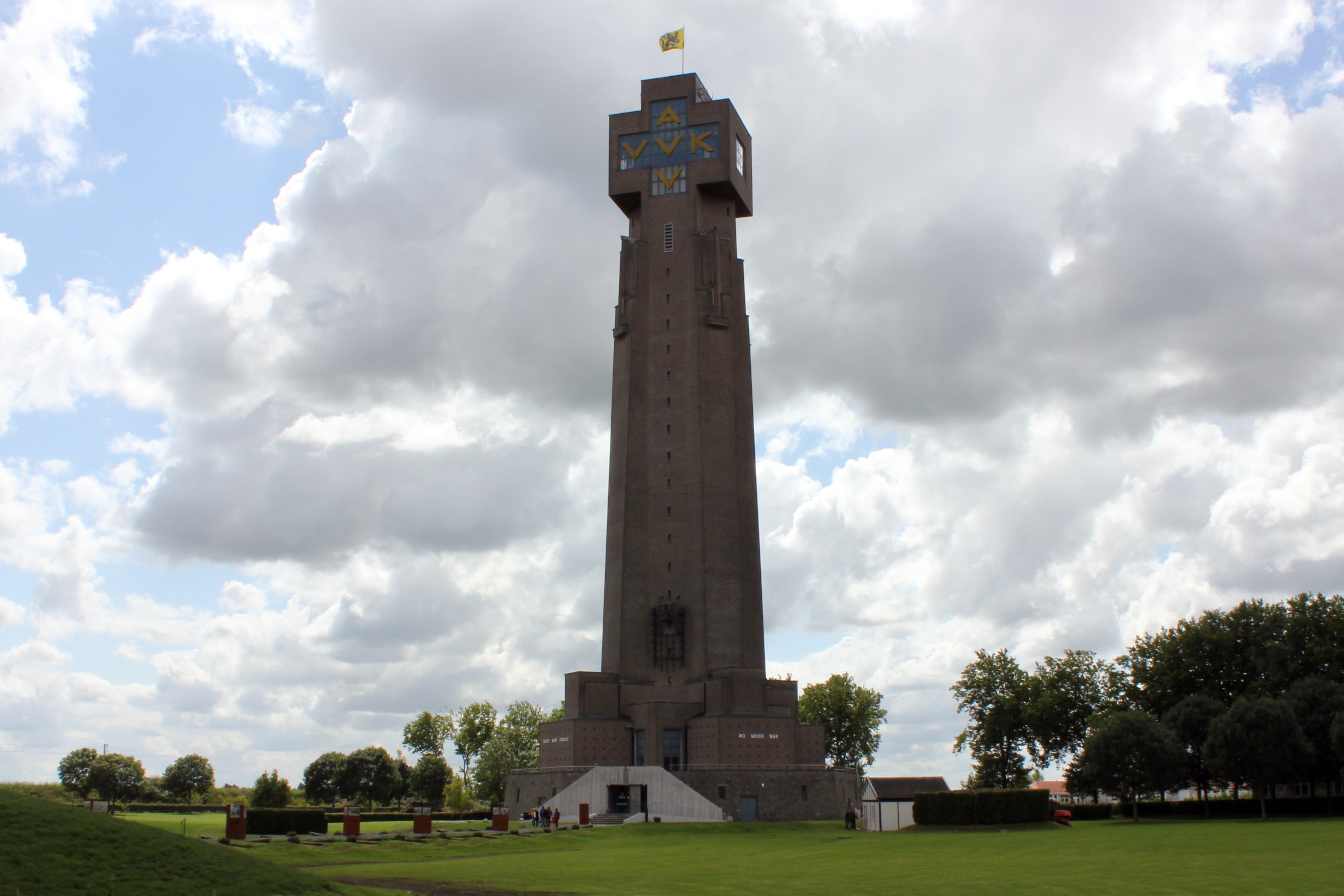
Yser Towers
On the night of March 15, 1946, two former Belgian Resistance fighters crept through the darkness toward a tower near Diksmuide. The explosion that followed brought down a monument built to honor Flemish soldiers killed in World War I, but which had become something far more complicated. The original Yser Tower, completed in 1930, bore the inscription AVV-VVK: 'All for Flanders, Flanders for Christ.' By 1946, those letters had become synonymous with collaboration during the Nazi occupation. The tower that stands today, rebuilt and even taller than the original, remains a pilgrimage site that draws thousands each year to contemplate the tangled relationship between memory, nationalism, and peace.
Blood Along the Yser
The idea for a Flemish war memorial emerged while the guns still thundered. In 1916, with the Belgian Army dug in along the Yser River, a priest named Cyriel Verschaeve began advocating for a monument to honor Flemish soldiers who had died fighting for a country that often treated them as second-class citizens. The Yser had been the front line for most of the war, a waterway that became synonymous with Belgian resistance and Flemish sacrifice. Construction began in 1928 near the village of Kaaskerke, and by 1930 a tower rose above the flat landscape. Into its crypt were placed the remains of fallen soldiers revered as symbols of Flemish identity, including the Van Raemdonck brothers and the artist Joe English.
From Pacifism to Collaboration
The tower was unveiled at the 11th annual Yser Pilgrimage in 1930, a gathering that had begun as a Christian pacifist commemoration. But the site's meaning shifted as Flemish nationalism grew more assertive during the 1930s. The tower became associated with the Flemish National League and other movements that saw Flanders' future as separate from Belgium. When Germany occupied Belgium during World War II, some of these groups collaborated with the Nazis, and the Yser Tower became tainted by association. The monument that had been built to honor the dead became a symbol of betrayal in the eyes of many Belgians who had resisted the occupation.
Destruction and Rebirth
The dynamite attack of March 1946 reduced the first tower to rubble, an act of revenge that its perpetrators were never prosecuted for. Rather than let the site disappear, Flemish nationalists preserved the ruins and shaped them into the Peace Gate in 1950. Work on a new tower began in July 1952. This second tower rose even higher than the first, reaching 84 meters. Its base carries inscriptions in Dutch, French, German, and English, all proclaiming the same message: 'Never war again.' The crypt was completed on November 11, 1958, and the tower was officially inaugurated on August 22, 1965. Inside, the Yser Museum now belongs to the United Nations network of peace museums.
A Contested Memorial
Each August, the annual Yser Pilgrimage brings thousands to this corner of Flanders. The gathering remains politically charged, drawing Flemish nationalists alongside those who come simply to remember the war dead. Inside the museum hangs 'The Golden Canvas of Flanders' by Henry Luyten, depicting an imaginary gathering of one hundred figures from Flemish history. Nearby, visitors can walk through the preserved 'Trench of Death,' a section of World War I fortifications that offers a visceral connection to the soldiers the monument honors. The tower that rises above this landscape embodies the contradictions of memory: pacifism and nationalism, reconciliation and resentment, destruction and renewal.
From the Air
Located at 51.03N, 2.85E near Diksmuide in West Flanders, Belgium. The 84-meter tower is a prominent landmark visible from considerable distance over the flat Flemish countryside. Best viewed at 1,500-3,000 feet for scale perspective. The Yser River runs nearby. Nearest airports include Ostend-Bruges (EBOS) approximately 20 km to the northwest and Kortrijk-Wevelgem (EBKT) to the southeast. The preserved World War I trenches of the 'Trench of Death' are visible adjacent to the tower complex.