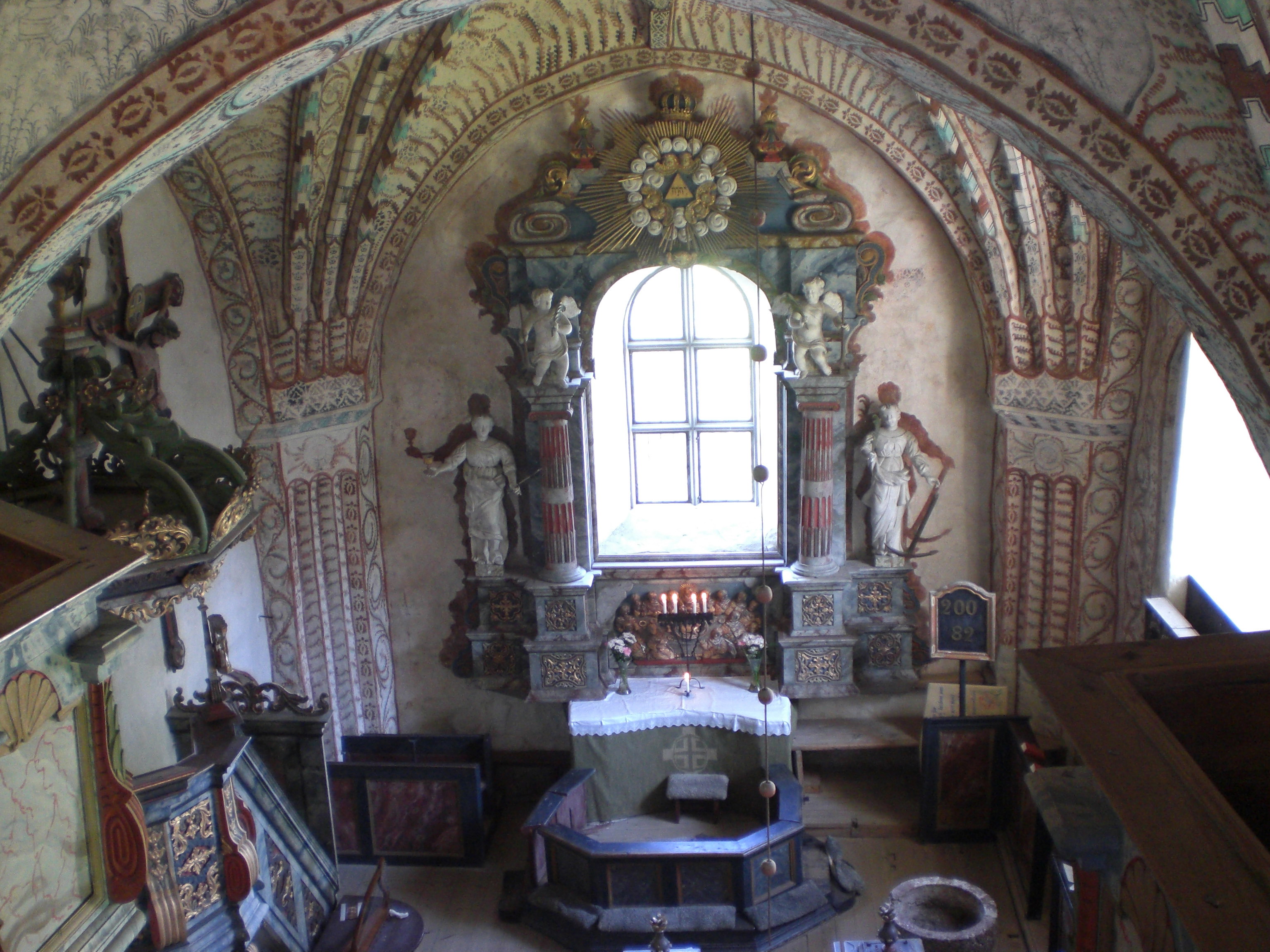
Ytterlannas Old Church
The iron door fitting is older than the building. Around the keyhole of the Romanesque outer door at Ytterlannas Old Church, an ornamental lion's head stares out from roughly the year 800, forged somewhere within the Byzantine cultural sphere around Constantinople. How it ended up on a church door in northern Sweden's Kramfors Municipality is a question the building answers in layers -- each century adding its own mark to walls that have stood since the early 1200s. This small church between the villages of Nyland and Bollstabruk, on road 333 in Vasternorrland County, contains an unbroken visual record of Scandinavian religious life spanning eight hundred years.
Centuries Written in Stone and Paint
The original 13th-century walls still stand, holding a Romanesque doorway that connects medieval Sweden to the trade routes of the wider world. From the 14th century, a marble baptismal font shipped from the island of Gotland and a crucifix mark the church's growing connections to Baltic commerce, while an altarpiece in the Lubeck style hints at Hanseatic influence. But the 15th century transformed the interior most dramatically. The choir was widened to match the nave, brick vaults replaced the original roof, and windows were enlarged to flood the space with northern light. A vestry and a vapenhus -- a "weapon-house" or porch -- were added. The Maria bell was cast. And across the new vaults and walls, a painter covered the surfaces with vivid frescoes depicting biblical scenes and saints' legends. Art historian J. Henrik Cornell initially read an inscription as maalede Eghil -- "painted by Eghil." But Einar Bager later reinterpreted the letters as simply the beginning of the alphabet, and the anonymous artist became known as the Alphabet Master, a member of the Tierp school of church painters.
The Archbishop's Gift
Around 1507, an altar cabinet arrived from the workshop of Haaken Gulleson in Halsingland. The piece, known as the Ytterlannas Madonna, bears two coats of arms: one belonging to the Archdiocese of Uppsala, to which the parish then belonged, and the personal arms of Archbishop Jakob Ulfsson -- an eagle's claw. The cabinet is believed to have been a donation commemorating the Archbishop's visit that year. The church continued to accumulate treasures. The 17th century brought pews, broad-planked wooden floors, and the beginnings of a gallery dated to 1652. In the 18th century, a rare second gallery was installed, along with a new pulpit and an altarpiece featuring a carved Last Supper with fourteen figures seated around the table. When pressure mounted to whitewash over the medieval paintings of saints, the congregation resisted. Under protest, the old frescoes, ceiling images, and decorative work were left untouched.
The Speech That Saved a Church
By the mid-19th century, the growing parish needed a larger church. The practical solution was obvious: tear down the old building and reuse its stones for the new one. The decision seemed settled until magistrate Carl Martin Schonmeyer, owner of the Angsta gard estate, rose to speak. In what contemporary accounts describe as an impassioned and rhetorical address, Schonmeyer argued for leaving the old church standing. He won. The new Ytterlannas Church opened in 1854, and the old building was simply abandoned. Its Maria bell was moved to serve as the smaller of two bells in the new structure. The abandoned church stood quietly for decades, slowly deteriorating but intact. In 1937, art historian Gustaf Nasstrom appealed publicly for donations to fund a restoration. The whitewash that had partially covered some surfaces was carefully removed. Then in 1950, to mark the centennial of the decision not to demolish the building, the Maria bell was returned to its original home.
A Living Relic
The church attracted scholarly attention through the 20th century. In 1963, architect Lars Holmer produced detailed measurements and drew elevations from three sides along with plans and cross-sections. A year later, brothers Gosta and Torsten Melin filmed what art historian Cornell certified as the first color documentary made in Sweden about a medieval church. They returned in 1978 to document an extensive renovation, and both films survive on DVD. In 1773, when the original bell tower burned, the bells were mounted directly above the church under a broken roof -- an improvised solution that became permanent. The church joined the Diocese of Harnosand when it separated from the Archdiocese of Uppsala in 1647, and its parish history stretches back to the Middle Ages. Since 1995, Ytterlannas Old Church has operated as a roadside church, opening its doors seven days a week for seven weeks each summer after midsummer. Visitors find guided tours, a coffee house, a medieval workshop, and music -- all within walls that a single persuasive speech saved from the stonemason's chisel.
From the Air
Located at 63.01N, 17.71E in Vasternorrland County, northern Sweden, between the villages of Nyland and Bollstabruk along road 333 in Kramfors Municipality. The church sits in the Angerman River valley near the High Coast region. Nearest airport is Kramfors-Solleftea Airport (ESNK), about 15 km to the southwest. The small medieval church is not easily visible from high altitude but the surrounding village pattern and river valley provide good landmarks. Best appreciated at lower altitudes of 2,000-4,000 feet.