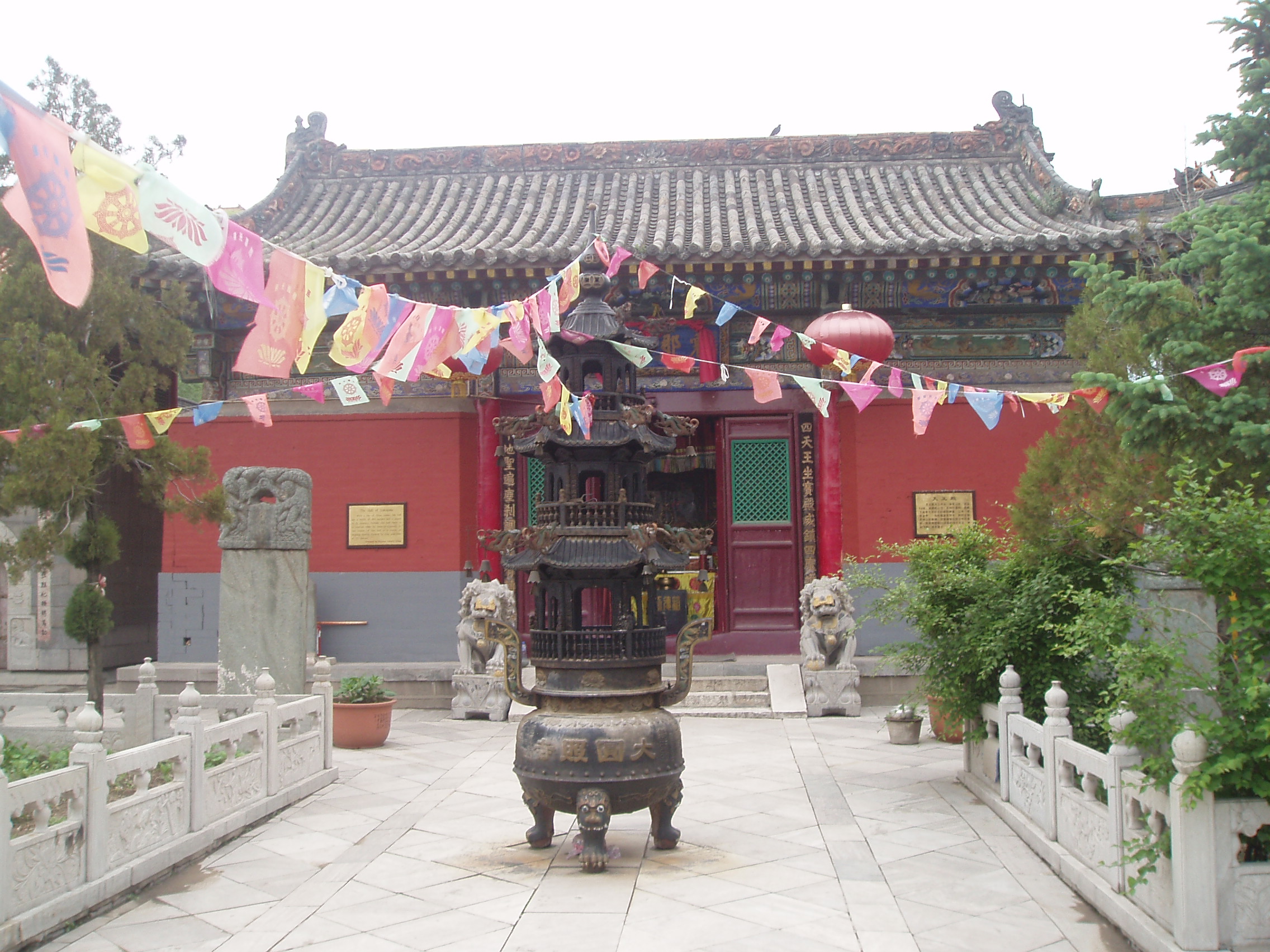
Yuanzhao Temple
Most Buddhist temples greet visitors with three gates: one large, two small, arranged in a row. Yuanzhao Temple has five. This distinctive entrance, called the Wuchaomen, sets the temple apart from the dozens of other monasteries on Mount Wutai before you even step inside. Flanked by stone guardian lions, the gate stretches 26 meters wide and 18 meters deep, announcing that what lies beyond earned special imperial attention.
A Monk's Journey from Nepal
In the early years of the Yongle period, between 1403 and 1424, a Nepalese Buddhist monk named Shilisha traveled to China to spread the dharma. The journey from Nepal to the sacred mountains of northern Shanxi would have taken him across some of the most challenging terrain in Asia, through passes and along trade routes that connected the Buddhist worlds of South and East Asia. His mission made enough of an impression that after his death, the Xuande Emperor ordered a new temple built on Mount Wutai specifically to commemorate Shilisha's contribution to Chinese Buddhism. That temple became Yuanzhao, a name meaning 'perfect illumination,' and in its backyard still stands the monk's stupa, rising about 16.67 meters above the ground.
Four Guardians at the Gate
Past the five-door entrance, the Hall of Four Heavenly Kings houses statues of the guardians believed to protect the four cardinal directions: Dhritarashtra in the east, Virudhaka in the south, Virupaksha in the west, and Vaishravana in the north. A statue of Maitreya, the future Buddha, presides over the hall. Chinese couplets hang on plaques from the side pillars, setting the devotional tone for the spaces deeper within. The hall connects the outer world of the temple grounds with the inner sanctum along the central axis, which continues through the Mahavira Hall dedicated to Shakyamuni Buddha and on to the Dugang Hall. This last hall takes its unusual name from an official position in the Later Qin dynasty, between 384 and 417 AD, which oversaw Buddhist temples and the bestowal of monastic office.
Where Tibetan and Han Traditions Meet
Yuanzhao Temple belongs to the Gelug school of Tibetan Buddhism, one of several traditions represented on Mount Wutai. This makes the temple part of a broader pattern that has defined the sacred mountain for centuries: the coexistence and cross-pollination of Chinese Han Buddhist and Tibetan Buddhist practice in a single landscape. The temple's architecture follows the central-axis layout typical of Han Chinese temple design, with the Shanmen gate, Heavenly Kings Hall, and main devotional halls arranged in careful sequence. Yet its Tibetan affiliation reflects the historical reality that Mount Wutai has drawn pilgrims and practitioners from across the Buddhist world, from Nepal and Tibet to Mongolia and Japan. The construction area of the entrance hall alone covers 495 square meters, a substantial footprint that speaks to the resources devoted to this crossroads of Buddhist culture.
The Stupa in the Garden
Behind the temple buildings, in a quieter corner of the compound, Shilisha's memorial stupa stands as the oldest and most personal element of the complex. At roughly 16.67 meters tall, it is neither the largest nor the most ornate structure on Mount Wutai, but it carries a weight of story that the grander monuments sometimes lack. A man left his homeland in Nepal, crossed mountains and borders, and devoted himself to teaching in a foreign land. After his death, an emperor found his contribution significant enough to commission an entire temple in his memory. The stupa marks where that story comes to rest, a quiet monument to the idea that Buddhist wisdom does not recognize national boundaries.
From the Air
Yuanzhao Temple sits at 39.008N, 113.589E within the Taihuai valley on Mount Wutai in northeastern Shanxi Province, China. The nearest airport is Wutaishan Airport (ZBWT) in Dingxiang County. The temple is part of a dense cluster of monasteries visible as built-up structures in the mountain basin. Surrounding terrain rises to over 3,000 meters at the north peak; maintain safe altitude and watch for mountain weather. The area is roughly midway between Taiyuan and Datong.