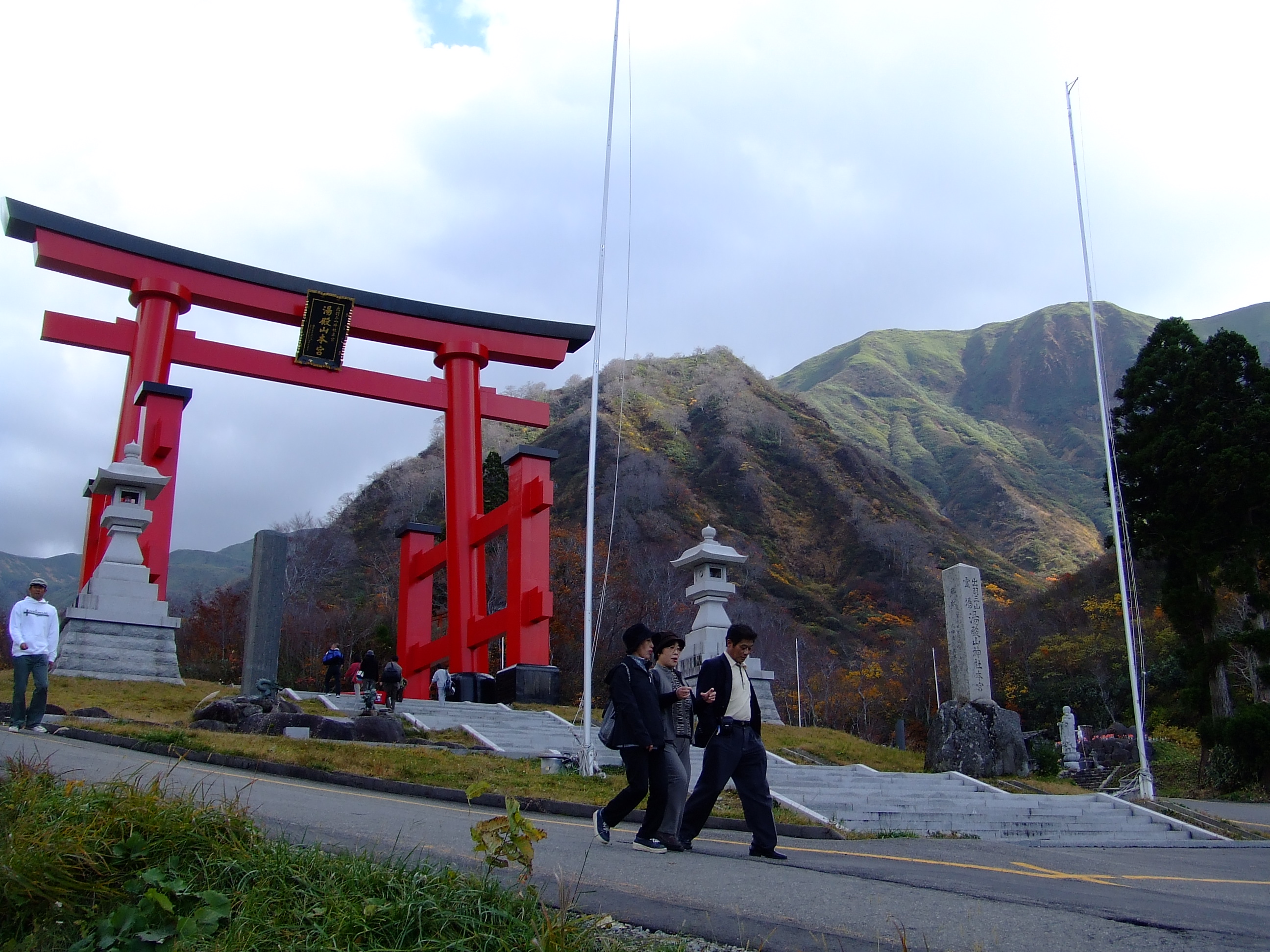
Yudonosan Shrine
There is no building. No hall of worship, no wooden beams darkened by centuries of incense. At Yudonosan Shrine, the object of reverence is the mountain itself -- specifically, a massive brownish-red rock from which hot spring water streams continuously, staining everything it touches the color of iron and rust. Photography is strictly prohibited. So is discussing what you see. Pilgrims remove their shoes, receive a purification prayer, and wade barefoot through the warm mineral water to touch the goshintai -- the physical dwelling of the divine. It is, by any measure, one of the most unusual shrines in Japan, and the spiritual climax of the Dewa Sanzan pilgrimage, a journey through three sacred mountains that the yamabushi mountain ascetics have walked for over a thousand years.
Three Mountains, Three Worlds
The Dewa Sanzan -- the Three Mountains of Dewa -- are Mount Haguro, Mount Gassan, and Mount Yudono, clustered in the rugged interior of Yamagata Prefecture. Shugendo tradition assigns each peak a spiritual stage. Mount Haguro, at 414 meters, represents the present life; its five-story pagoda and 2,446-step cedar-lined staircase are the most accessible of the three. Mount Gassan, the highest at 1,984 meters, represents death and the past -- a place where souls of the deceased are believed to gather. Mount Yudono, at 1,504 meters, represents rebirth and the future. Pilgrims are meant to visit in sequence, journeying through this life, through death, and emerging reborn at the hot spring rock of Yudonosan. The shrine sits in a valley between Mount Yudono and Shinakurasan Mountain, buried under meters of snow each winter and accessible only during the warmer months.
The Secret That Cannot Be Spoken
Yudonosan Shrine has no main hall because the mountain is its own kannabi -- a place where the divine resides in the landscape rather than in a structure built by human hands. The sacred rock, classified as an iwakura, serves as the shintai: the physical vessel of the kami. Hot mineral water flows over and around it, and the iron-rich deposits have given the rock its distinctive reddish-brown patina over centuries. What happens at the rock stays at the rock. The prohibition on photography and recording is not a modern rule imposed for crowd control; it is an ancient injunction rooted in the belief that the sacred experience of encountering the goshintai is too intimate to be reduced to an image or a secondhand account. Visitors pay 500 yen for a purification prayer before approaching barefoot through the warm water.
Where Monks Became Mummies
Mount Yudono's spiritual intensity attracted practitioners to extremes that few other religious sites in the world can match. The mountain is the epicenter of sokushinbutsu -- the practice of Buddhist monks deliberately self-mummifying through years of ascetic deprivation. The process began with a three-year diet of nuts, seeds, and fruit combined with intense physical exertion to strip away body fat. A second three-year phase restricted intake to bark and roots, further desiccating the body. Monks drank tea brewed from the toxic urushi tree, whose lacquer-like properties helped preserve tissue from within. Of the twenty known sokushinbutsu mummies surviving in Japan, eleven were monks who trained on Mount Yudono. The earliest dates to 1683; the last was sealed in his burial chamber in 1903. Several can still be viewed at temples near the Dewa Sanzan, seated in meditation posture, their skin drawn tight as parchment.
Walking the Yamabushi Path
The yamabushi who still walk the Dewa Sanzan are practitioners of Shugendo, a syncretic tradition blending Shinto, esoteric Buddhism, and Taoist mountain worship. Dressed in white robes and conch-shell horns, they undertake demanding austerities: fasting, sutra recitation under ice-cold waterfalls, sleepless vigils on exposed ridgelines. Yudonosan is the final destination of their pilgrimage circuit, the place where spiritual death on Gassan gives way to rebirth. The shrine's designation as a Beppyo shrine -- a category recognizing sites of particular national significance in the Shinto system -- reflects its standing among Japan's most important religious sites. For secular visitors, the experience is no less striking. The combination of mineral-scented steam, warm water underfoot, and the sheer strangeness of worshipping a rock in an open-air valley delivers a sensory encounter that no photograph could capture -- which may be exactly why they forbid the attempt.
From the Air
Located at 38.53N, 139.98E on the western slopes of the Dewa Mountains in central Yamagata Prefecture. Mount Yudono (1,504 m) is part of the Dewa Sanzan cluster visible as a trio of prominent peaks from moderate altitude. The shrine is situated in a valley that is inaccessible in winter due to deep snow cover. Nearest airport: Shonai Airport (RJSY/SYO), approximately 50 km to the northwest on the Sea of Japan coast. Yamagata Airport (RJSC/GAJ) is roughly 60 km to the southeast. Mountain weather is highly variable with rapid cloud buildup; approach with caution and maintain safe altitude above the surrounding peaks.