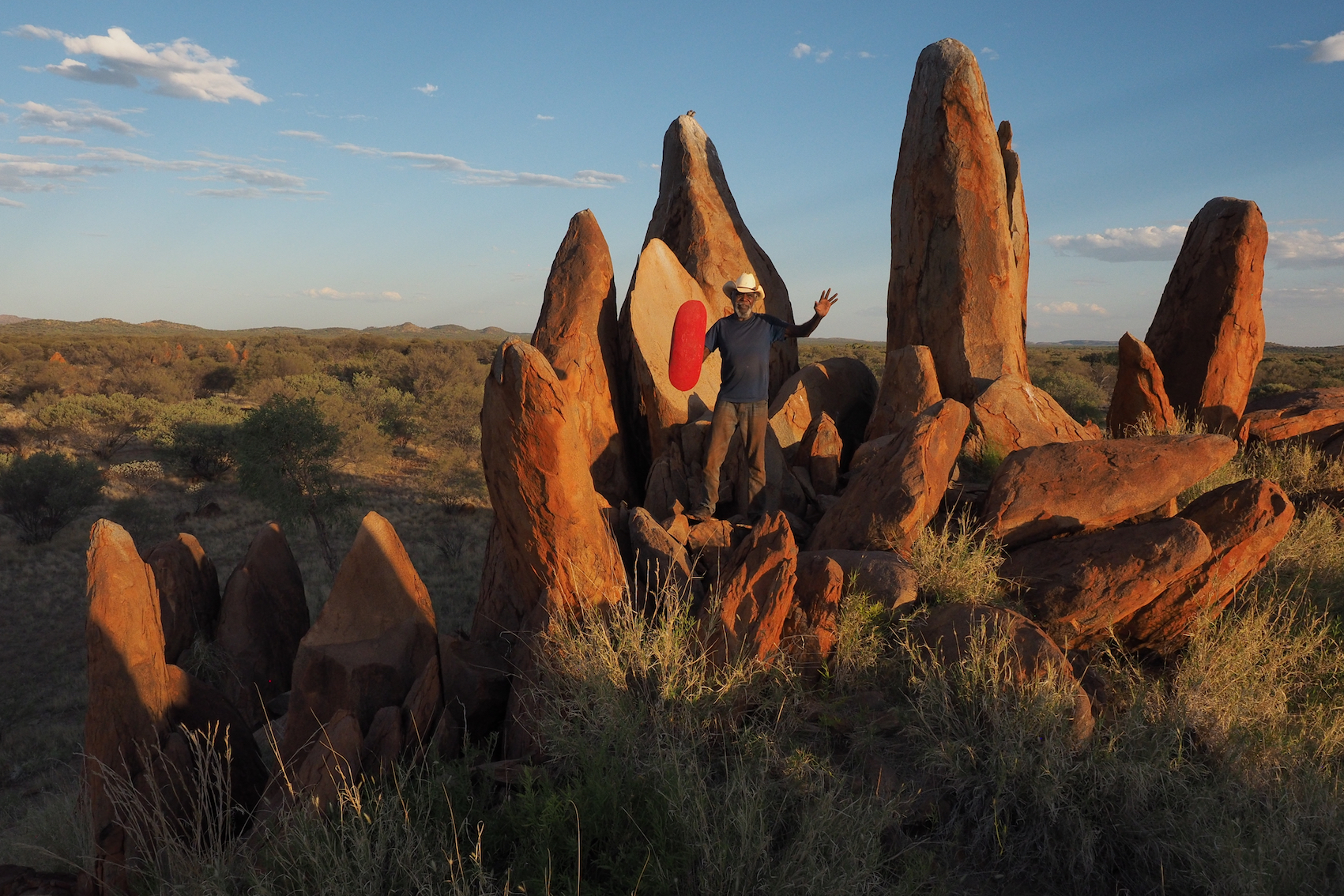
Yuendumu
In 1982, five Warlpiri elders walked into the primary school at Yuendumu and asked to paint the doors. All thirty of them. The school administration agreed. What followed was not a beautification project but something closer to an act of cultural assertion: the elders painted 36 ancient kuruwarri designs — sacred patterns passed down through generations — in vivid, fauvist colours on wood that children opened every morning. The Yuendumu Doors are now held by the South Australian Museum. They started the entire Warlpiri art movement.
Edge of the Tanami
Yuendumu sits on the edge of the Tanami Desert, northwest of Alice Springs on the Tanami Road, on traditional Warlpiri land. It takes about three hours to drive from Alice Springs along a mostly sealed road. The community was established in 1946 by the Native Affairs Branch of the Australian Government to deliver rations and welfare services — a bureaucratic origin that gave little indication of what the community would become. By 1955, many Warlpiri and Anmatyerr Aboriginal people had settled there. The population today is around 740. Yuendumu is a dry community; possession of alcohol by anyone, including visitors, is prohibited.
The Art That Changed Everything
The five men who painted the school doors — Paddy Jupurrurla Nelson, Roy Jupurrurla Curtis, Paddy Japaljarri Stewart, Paddy Japaljarri Sims, and Larry Jungarrayi Spencer — were not working in a vacuum. They were responding to a felt need: to make the school a place where children could see their own culture reflected back at them. The paintings illustrated kuruwarri, ancient designs carrying meaning that extends deep into Warlpiri cosmology. The doors became a symbol of elders caring for children and of what was called "two-way education" — learning that didn't require abandoning who you were. From that beginning, Warlukurlangu Artists Aboriginal Association grew into one of Australia's most productive art centres, producing and selling over 10,000 paintings a year. At the 2022 Darwin Aboriginal Art Fair, Warlukurlangu artists' work sold for significant sums across three days.
Bush Mechanics and the Media Centre
Yuendumu is also home to Pintubi Anmatjere Warlpiri Media, known as PAW Media — an Aboriginal media organisation that has operated in the community for over 25 years. PAW Media produced the television series Bush Mechanics, which followed Warlpiri men improvising repairs on outback vehicles using whatever came to hand. The show became a cult classic, celebrated for its humour, its deep mechanical ingenuity, and its portrait of life on country. It was also quietly radical: television made by and about remote Aboriginal Australians, on their own terms. An exhibition and book marked the series' legacy in 2018 and 2019.
Midnight Oil Country
Yuendumu earned an unlikely place in Australian pop culture in 1987, when Midnight Oil namechecked it in "Beds Are Burning": Four wheels scare the cockatoos / From Kintore east to Yuendumu. The song, from the album Diesel and Dust, was written after Midnight Oil and Warumpi Band's 1986 tour to remote communities, documented in Andrew McMillan's book Strict Rules: The BlackfellaWhitefella Tour. The community has produced athletes as well as artists — footballer Liam Jurrah grew up in Yuendumu and was drafted into the AFL, starring for the Melbourne Football Club. Yuendumu elders also founded the Mt Theo Program in 1993, a substance abuse diversion programme that became a national model for youth development in remote communities.
From the Air
Yuendumu is located at approximately 22.26°S, 131.80°E, northwest of Alice Springs on the Tanami Road. The community has a sealed airstrip (YYND). Flying at 3,000–5,000 feet over the Tanami Desert, Yuendumu appears as a distinct settlement of red-dirt roads and community buildings in otherwise sparse, flat mulga scrubland. Alice Springs (YBAS) is the nearest major airport, approximately 290 km to the southeast. The Tanami is best flown in the dry season (April–October).