Yuguang Street Church
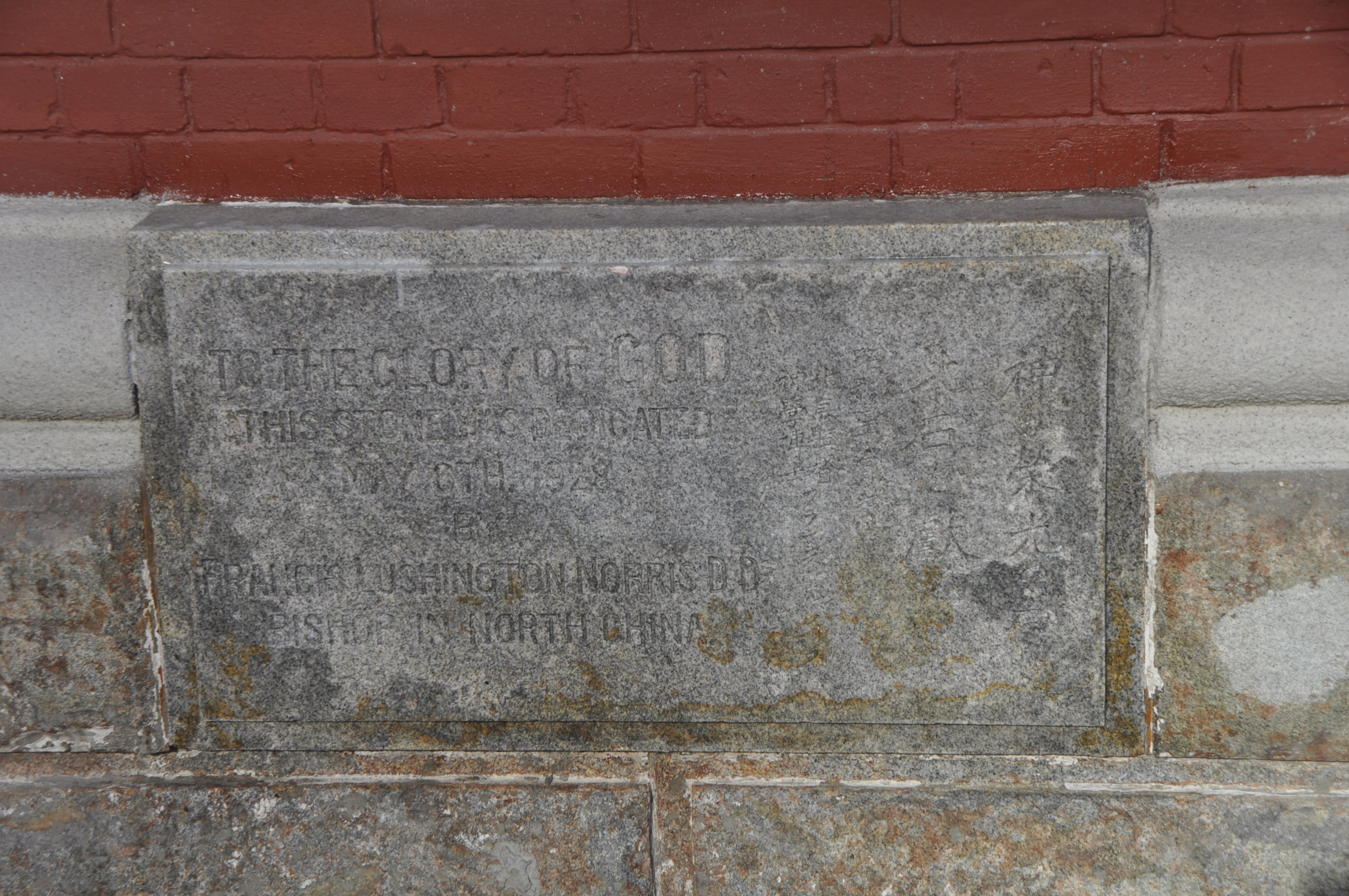
The cornerstone inscription, carved in both English and Japanese, tells the story before you even step inside: "To the glory of God this stone was dedicated May 6th 1928 by Francis Lushington Norris D.D. bishop in north China." Two languages on one stone, laid in a Chinese city that was at the time under Japanese administration on land that had previously been leased to Russia. Yuguang Street Church, originally the Dalian Anglican Church, is a building whose very existence required the cooperation of colonial powers that would soon be at war with each other.
Two Empires, One Church
An earlier Anglican church had been built on the premises of the British consulate in Dalian in the early 20th century, when the city was still known as Dairen under Japanese control. By the late 1920s, a more permanent structure was needed. In 1928, the Church of England and the Anglican-Episcopal Church of Japan pooled resources to build the second-generation church, naming it the Dalian Anglican Church. Services were held in both English and Japanese, reflecting the congregation's binational character. The church belonged to the North China Diocese of the Anglican-Episcopal Province of China, known formally as the Chung Hua Sheng Kung Hui. It was a rare example of British and Japanese institutions collaborating in a region where their geopolitical interests were increasingly divergent.
Surviving Through Ownership
When World War II ended in 1945, the Chinese government confiscated all Japanese-owned buildings in Dalian. Religious buildings seized in this way were never returned to religious use. But Yuguang Street Church survived because of a legal technicality rooted in its binational origins: Britain owned half of the church. This shared ownership protected the building from being repurposed, and it was simply renamed Yuguang Street Church and allowed to continue functioning as a Christian place of worship. It was a narrow escape, and a consequence that neither the Church of England nor the Japanese Anglican Church could have foreseen when they divided the construction costs decades earlier.
Broken Glass, Borrowed Purpose
The Cultural Revolution, which convulsed China from 1966 to 1977, spared no religious institution. At Yuguang Street Church, the stained glass windows were smashed and all religious activities were suppressed. The building was converted into a children's activity center, its sanctuary repurposed for secular gatherings. It was not until the early 1980s, as China began to relax restrictions on religious practice, that Christian services resumed. The church came under the post-denominational China Christian Council, the state-sanctioned body that oversees Protestant Christianity in China, erasing the Anglican identity that had defined the congregation for half a century.
A Protected Relic
In 2001, Yuguang Street Church was designated one of approximately 100 Protected Historical Buildings in Dalian, a recognition of its architectural and cultural significance to a city whose built environment reflects layer upon layer of foreign influence. The church stands near Zhongshan Square, with the Dalian World Trade Center Building visible in the background, a juxtaposition of colonial-era architecture against modern commercial development. The cornerstone remains in place beside the entrance, its bilingual inscription now a historical artifact rather than a statement of living partnership. The building endures as a working church, its congregation worshipping in Mandarin in a space designed for English and Japanese services, in a city that has been Chinese, Russian, Japanese, Soviet, and Chinese again.
From the Air
Located at 38.92N, 121.64E in the Zhongshan District of Dalian, near Zhongshan Square. The church is a small structure amid urban development and is not easily distinguishable from altitude, but Zhongshan Square's distinctive circular layout serves as a visual landmark. Nearest airport is Dalian Zhoushuizi International (ZYTL). The Dalian waterfront and the Yellow Sea coastline provide broader orientation.