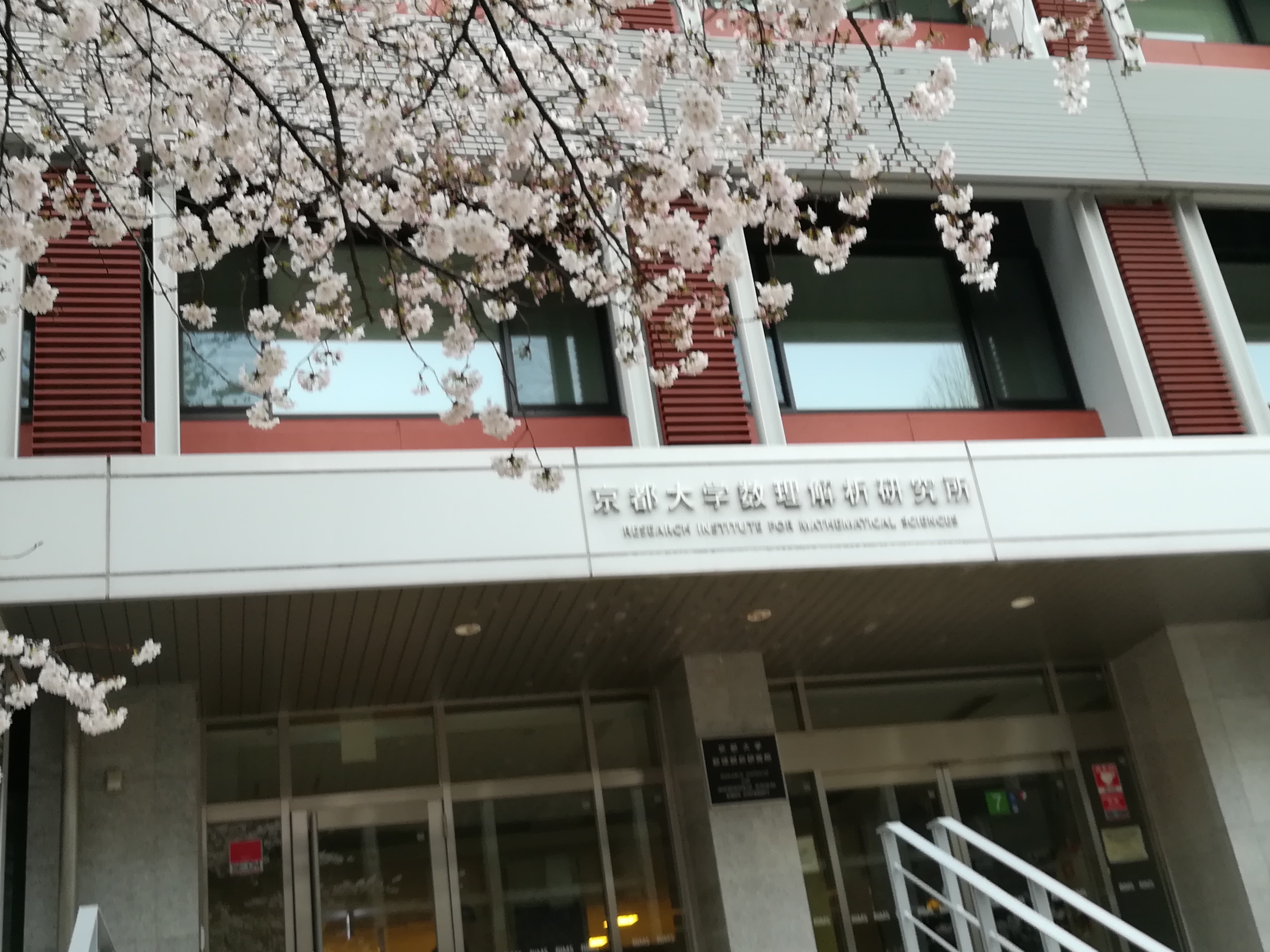
Yukawa Institute for Theoretical Physics
In 1935, a 28-year-old physicist at Osaka Imperial University published a paper predicting that an undiscovered particle held atomic nuclei together. The idea was elegant and radical: protons and neutrons exchanged a carrier particle roughly 200 times the mass of an electron, creating the strong nuclear force that keeps matter from flying apart. Fourteen years later, after experimentalists confirmed his prediction, Hideki Yukawa became the first Japanese citizen to receive the Nobel Prize. The celebration that followed was not just scientific. A nation still rebuilding from war saw in Yukawa's achievement proof that Japan could lead the world in something other than military ambition. Within months, Kyoto University's president proposed building a memorial hall on campus. What emerged was something far more ambitious: a national center for theoretical physics that would shape Japanese science for the next seven decades.
From Memorial Hall to National Mission
Yukawa Hall opened on Kyoto University's Kitashirakawa campus in 1952, and by 1953 it had been formally designated the Research Institute for Fundamental Physics. Yukawa himself served as its first director. The vision was deliberately grand: Japanese physicists looked to the Niels Bohr Institute in Copenhagen and the Institute for Advanced Study in Princeton as models. The new institute would belong formally to Kyoto University but operate under a governance structure unique in Japanese academia -- its policies set not by the university administration alone, but by elected representatives of physicists from across the country. The institute began with just four academic staff, Yukawa among them, but grew steadily. By 1961 it had 13 positions spanning condensed matter theory, field theory, nuclear physics, particle theory, statistical mechanics, and astrophysics.
The Ghost of Hiroshima
The institute's history cannot be separated from the atomic bomb. In Hiroshima, a parallel institution -- the Research Institute for Theoretical Physics at Hiroshima University -- had been founded in 1944 by mathematician Yoshitaka Mimura to study the mathematical foundations of theoretical physics. On August 6, 1945, the bomb erased it. Two faculty members and a staff member were killed. Every facility was destroyed. The survivors re-established the institute in 1948 in Takehara, a quiet coastal town east of Hiroshima, where it operated for four decades in relative obscurity. In 1990, the two institutes merged. All academic staff from Hiroshima relocated to Kyoto, and the combined institution adopted a new English name: the Yukawa Institute for Theoretical Physics. The merger nearly doubled the institute's size overnight, but Yukawa Hall had no room for the newcomers. For five years, the institute operated across two campuses 20 kilometers apart.
A Forum for the Frontier
What distinguishes the Yukawa Institute from a typical university department is its role as a national commons. From the beginning, the institute was designed to host visiting researchers, organize topical workshops, and provide a physical meeting place where physicists from rival universities could collaborate without institutional politics. This open-door tradition continues. Each year the institute hosts dozens of workshops covering the full breadth of theoretical physics: string theory, quantum field theory, gravity, cosmology, particle physics, nuclear physics, statistical physics, condensed matter, and biophysics. Yukawa himself set the tone. He directed the institute for 17 years, retiring in 1970, and founded the journal Progress of Theoretical Physics in 1946, which became a leading publication in the field. Among his successors as director was Toshihide Maskawa, who would go on to win the 2008 Nobel Prize in Physics for his work on CP violation.
The Campus Today
In 1995, a new building was completed next to the original Yukawa Hall, finally reuniting the scattered institute under one roof. The modern facility houses offices for 22 academic staff, visiting researchers, postdoctoral fellows, and students, along with a library and computing center. Yukawa Hall itself still stands, used now for conferences, workshops, and administrative offices, including the director's office. The building retains the quiet authority of mid-century Japanese academic architecture -- understated, functional, built for thinking. The institute sits on the northern edge of Kyoto, where the city gives way to the forested slopes of the Higashiyama mountains. It is an easy place to miss if you do not know what you are looking for. But inside these walls, physicists continue the work Yukawa began: probing the fundamental forces that hold the universe together, one equation at a time.
From the Air
Located at 35.031N, 135.786E on the Kitashirakawa campus of Kyoto University, in the northern part of Kyoto. The campus sits near the base of the Higashiyama mountains. The institute buildings are modest in scale and not individually distinguishable from the air, but the broader Kyoto University campus area is identifiable. Nearest airports: Osaka Itami (RJOO) approximately 25nm southwest, Kansai International (RJBB) approximately 45nm south. Kyoto is situated in a basin surrounded by mountains on three sides, which can influence low-altitude wind patterns and visibility.