Yuma: The Sunniest City on Earth Where Outlaws Became School Spirit
Yuma holds a Guinness World Record most cities would decline: the Sunniest City on Earth. The sun shines here roughly 90% of all daylight hours, creating 175 days annually where temperatures exceed 90 degrees Fahrenheit. In 1995, the thermometer hit 124 degrees. Only Death Valley rivals Yuma for extreme weather in the continental United States, and Death Valley isn't a city with 95,000 people trying to live normal lives. But extremity has always defined Yuma - the place where Spanish explorers in 1540 recognized the only natural crossing of the Colorado River for hundreds of miles, where the California Gold Rush funneled through a single ferry landing, where outlaws went to territorial prison and the prison later became a high school. Yuma is what happens when geography forces a city into existence and climate tests whether it should survive.
The Hellhole of the West
The Yuma Territorial Prison opened on July 1, 1876, accepting its first seven inmates into cells they had built themselves. For 33 years, 3,069 prisoners served time here for crimes ranging from murder to polygamy - including 29 women, most famously Pearl Hart, a stagecoach robber who became a national celebrity. The prison earned its nickname 'The Hellhole of the West' through desert heat and iron discipline. When overcrowding forced a move to Florence in 1909, the abandoned prison found unlikely reuse: Yuma High School's building had burned, and the cellblocks became classrooms. For four years, students studied in cells, and the athletic teams embraced their location - they became 'The Criminals,' a mascot the school still uses today. During the Great Depression, the empty cells provided free lodging for hobos riding the freight trains.
The Crossing
In 1540, Spanish explorers Hernando de Alarcón and Melchior Díaz immediately recognized what the Colorado River offered at this precise location: a crossing. The river narrowed here to less than a thousand feet, the only manageable ford for hundreds of miles. Every major expedition west - Juan Bautista de Anza in 1774, the Mormon Battalion in 1848, the California Column in 1862 - crossed at Yuma. During the Gold Rush, the Yuma Crossing became the gateway to California, ferry operators growing rich on desperate miners. The city changed names three times - Colorado City, Arizona City, finally Yuma in 1873 - but its purpose remained constant: the place where the Southwest funneled through a single point. The Great Flood of 1862 destroyed the original settlements; they rebuilt on higher ground, because some locations are too strategic to abandon.
The Winter Lettuce Capital
Yuma's brutal sunshine, which makes summer nearly uninhabitable, creates winter agricultural conditions found nowhere else in America. From November through March, Yuma County provides 90% of all leafy vegetables consumed in the United States - lettuce, spinach, kale, the entire salad section of every supermarket. The city calls itself the Winter Lettuce Capital of the World, and the numbers support the boast: over 175 different crops grow here, the irrigation systems turning desert into greenhouse. On New Year's Eve 2018, Yuma embraced its identity with the 'Iceberg Drop' - instead of a ball descending like Times Square, a head of iceberg lettuce drops from the water tower at midnight. The agricultural workforce creates statistical oddities: Yuma regularly ranks among America's highest unemployment cities, not from economic collapse but from seasonal harvest patterns.
Military City
Marine Corps Air Station Yuma conducts what few places in America can offer: year-round flight training under guaranteed clear skies. The Yuma Proving Ground, one of the Army's largest installations, tests military equipment across desert terrain that won't be obscured by weather for approximately 350 days per year. The military presence provides economic stability that pure agriculture cannot, the bases employing thousands and bringing families who need schools, hospitals, shopping. Yuma has produced unlikely celebrities from this military-adjacent culture: UFC heavyweight champion Cain Velasquez wrestled here before fighting professionally. Civil rights leader Cesar Chavez worked the Yuma fields before organizing farmworkers. The desert heat that breaks most people seems to forge certain others.
Visiting Yuma
Yuma is served by Yuma International Airport (YUM). The Territorial Prison State Historic Park preserves the cellblocks where Pearl Hart posed for mugshots and high schoolers later attended class; admission includes the cemetery where 104 prisoners remain buried. The Yuma Quartermaster Depot tells the military supply story that supported every Arizona fort. For outdoor escape, the Colorado River runs along the city's edge, though escape from heat is seasonal - visit October through April unless you want to understand why prisoners considered this place hell. The Mexican border lies just south; crossing requires driving into California first due to the river. For food, the agricultural abundance means fresh produce everywhere, and the Tex-Mex is authentic. Snowbirds swell the population by 70,000 each winter, proving that sunshine eventually wins every argument.
From the Air
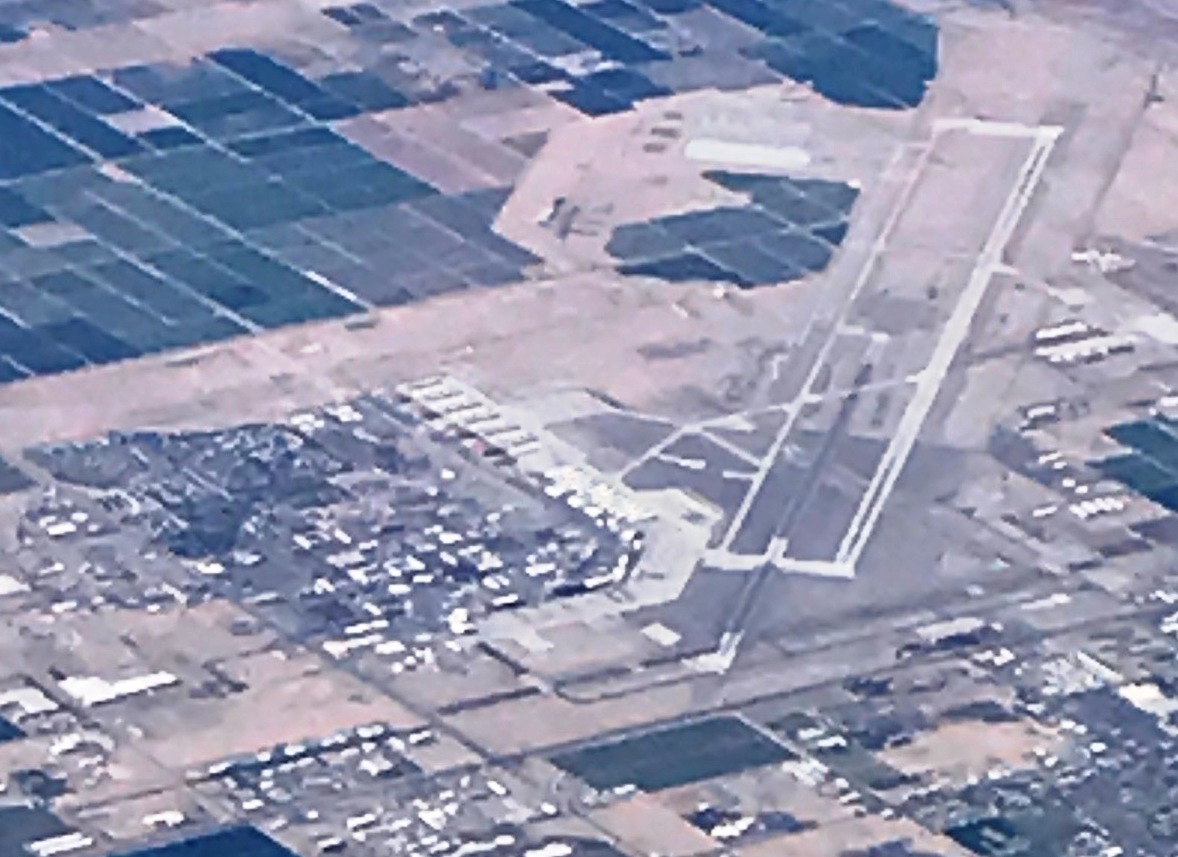
Located at 32.69°N, 114.62°W in Arizona's extreme southwest corner where the Colorado River marks the California border. From altitude, Yuma appears as irrigated green agriculture surrounding urban development in otherwise tan desert - the river visible as the boundary line, the military installations sprawling east. What appears from altitude as desert oasis is the Sunniest City on Earth - where the Territorial Prison became a high school, where 90% of America's winter lettuce grows, and where the only natural Colorado River crossing for hundreds of miles created a city that geography demanded.