Yuma Territorial Prison
On a bluff overlooking the muddy confluence of the Gila and Colorado rivers, seven convicts stepped off a dusty wagon on July 1, 1876, and became the first inmates of Arizona Territory's new prison. What awaited them was a fortress of adobe and granite carved from the desert itself, a place that would earn the nickname 'Hell Hole' for its brutal summer temperatures that could reach 120 degrees Fahrenheit. Over the next 33 years, 3,069 prisoners would pass through its iron gates, including some of the Old West's most notorious outlaws, a stagecoach-robbing woman, and a Mexican revolutionary whose ideas would help topple a dictator.
The Hell Hole on the Colorado
The prison rose from the Arizona desert through the forced labor of its own inmates, who quarried granite from nearby hills and molded adobe bricks under the unforgiving sun. The location was strategic: the confluence of two rivers made escape nearly impossible, and the scorching Sonoran Desert surrounding it served as a natural deterrent for anyone desperate enough to try. Each cell measured nine feet by eight feet, with walls four feet thick to keep out the summer heat. Iron strap bunks lined the walls, and a small ventilation shaft provided the only relief from temperatures that made the stone cells feel like ovens. Yet by territorial standards, Yuma was considered progressive: it had electricity before the town did, a library, and a hospital. Prisoners who behaved could even earn small wages for their labor.
Outlaws, Revolutionaries, and One Remarkable Woman
The prison's roster reads like a who's who of frontier infamy. Burt Alvord, a Cochise County lawman turned train robber, served time here after masterminding a series of daring heists. 'Buckskin Frank' Leslie, the gunfighter who killed Billy Claiborne, paced these same yards. Pete Spence, entangled in the bloody Earp-Clanton feud, stared at these same walls. But perhaps the most famous inmate was Pearl Hart, who in 1899 became one of the last stagecoach robbers in American history. She dressed as a man to hold up a stage near Globe, Arizona, and her trial became a national sensation. Behind the prison walls, she posed for photographs that made her a celebrity. Less remembered but perhaps more consequential was Ricardo Flores Magon, a Mexican revolutionary whose writings from this very prison helped spark the Mexican Revolution that would soon reshape a nation.
From Prison Cells to Classrooms
When the last prisoner shuffled out on September 15, 1909, bound for the new state prison in Florence, the old fortress fell silent. But not for long. The following year, fire destroyed Yuma Union High School's building, and the town faced an unusual solution: the empty prison. For four years, from 1910 to 1914, students attended classes in former cellblocks. The hospital became an assembly hall. Teenagers studied algebra where outlaws once plotted escapes, and football teams practiced in the yard where chain gangs had broken rocks. It remains one of the most peculiar chapters in American educational history, a high school behind prison walls where students adopted 'Criminals' as their mascot, a name the school keeps to this day.
What Remains
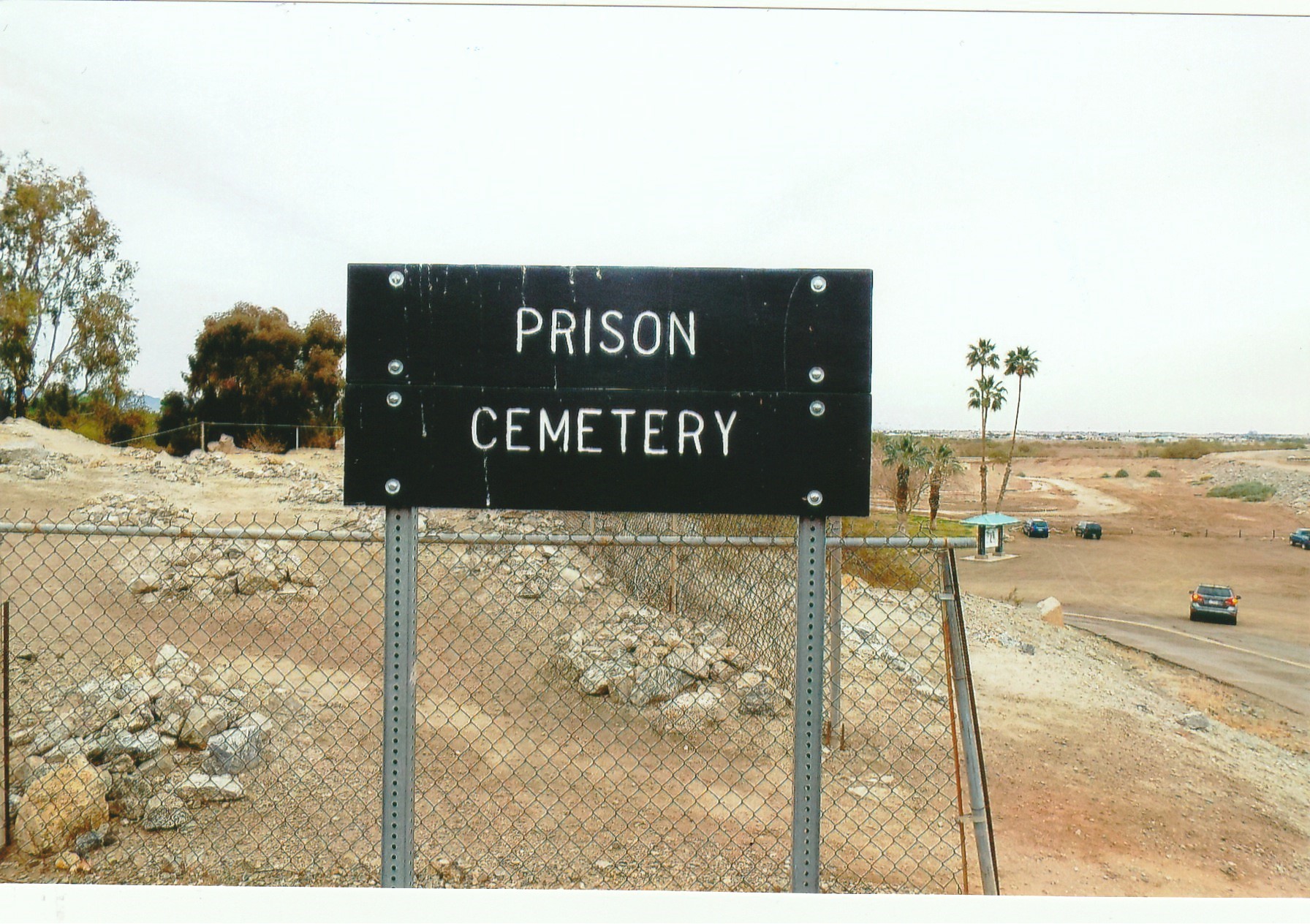
Today, the crumbling granite walls and iron cell doors stand as Arizona's third state historic park, a testament to the rough justice of the territorial era. The main guard tower still watches over the yard. A cemetery holds 104 prisoners who never left, their graves marked by simple wooden crosses. The prison's legend has only grown with time, immortalized in Elmore Leonard's Western novels and the iconic film '3:10 to Yuma,' which has been made twice. Ghost hunters claim the cells still echo with the voices of those who suffered here, and USA Today has named it one of America's most haunted destinations. But the real ghosts are historical: the stories of desperate men and women who did hard time in the desert, some emerging reformed, others broken, all of them part of the violent, complicated story of how the West was won.
Viewing from Above
From the air, the prison complex appears as a cluster of dark stone buildings perched on a bluff where Yuma's urban grid gives way to the river bottoms. The distinctive guard tower rises above the granite walls, and the layout of the cellblocks and yard remains clearly visible. The Colorado River flows just to the west, its waters now controlled by upstream dams. Looking north across the border, you can see the same harsh desert that made this location such an effective prison, a landscape that offered no refuge for those who dared to run.
From the Air
Located at 32.727N, 114.615W on a bluff overlooking the Colorado River in downtown Yuma, Arizona. Best viewed from 2,000-3,000 feet AGL approaching from the east. Yuma International Airport (KNYL) lies 3 miles south. Marine Corps Air Station Yuma (KYUM) is 5 miles southwest. The prison sits at the historic Yuma Crossing, where the dark granite walls contrast with the green river corridor.