Yungang Grottoes
Fifty-one thousand Buddhas watch from the sandstone. Carved into a cliff face stretching 800 meters long and up to 18 meters high, the Yungang Grottoes outside Datong represent one of the supreme achievements of Buddhist art anywhere in the world. UNESCO calls them a "masterpiece of early Chinese Buddhist cave art" and a record of the moment when religious imagery from Central Asia merged with Chinese aesthetic traditions to create something entirely new. The site earned World Heritage status in 2001, and in 2024, the video game Black Myth: Wukong turned Yungang into one of the most visited cultural sites in China almost overnight.
Where the Silk Road Met the Steppe
Buddhism reached Datong along the North Silk Road, the 2,600-kilometer route that connected the ancient capital of Xi'an to Kashgar and onward to Parthia. When the Tuoba clan of the Northern Wei dynasty made Datong -- then called Pingcheng -- their capital, they adopted Buddhism as their state religion and began the most ambitious rock-carving project in Chinese history. The first phase of construction, lasting until 465 AD, produced what are now caves 16 through 20, each containing colossal Buddha figures that may represent individual Northern Wei emperors. A second phase from 471 to 494 AD, under direct imperial patronage, created the richly decorated twin caves and the extraordinary Cave 6.
A Thousand Square Meters of Sacred Art
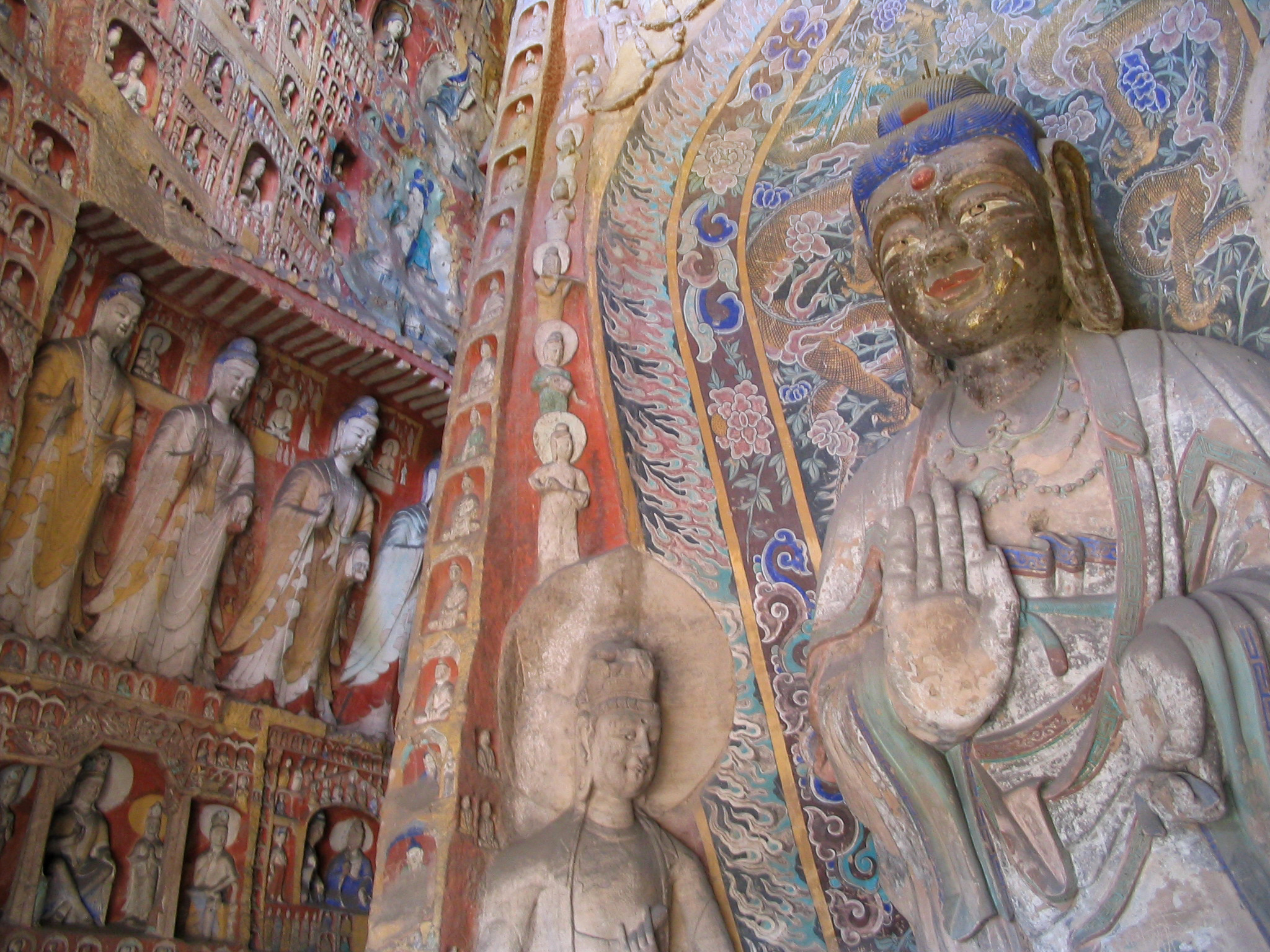
Cave 6 is the crown jewel of Yungang. Constructed between 465 and 494 AD by Emperor Xiao Wen, its interior spans approximately 1,000 square meters, every surface carved and painted. A stupa pillar rises from floor to ceiling at the center, its faces covered in relief sculpture. The walls divide into two stories: the upper tiers host carvings of standing Buddhas, Bodhisattvas, and monks among celestial figures, while the lower registers tell narrative sequences from Buddhist scripture. The cave has been repainted as many as twelve times over the centuries, layering colors upon colors until the original scheme has become nearly impossible to determine.
Threats From Sand and Smoke
The grottoes were carved from soft sandstone, and their survival has never been guaranteed. Windblown dust from the nearby Gobi Desert, air pollution from industrial Datong, and particulate matter from coal mines and highways have all accelerated the erosion of carved surfaces. During the Cultural Revolution, Red Guards damaged many carvings, and bullet marks remain visible on some figures. Conservation efforts since the 1950s have included sealing cracks with grout and planting trees to reduce sandstorm damage. In 1991, a Caltech research team measured airborne pollutants inside the caves and found that nearly all contamination consisted of mineral dust and carbon particles, helping focus preservation strategies on those specific sources.
Guardians Across the Centuries
When imperial patronage ended in 494 AD with the move of the Wei court to Luoyang, private donors continued commissioning caves until 525, when regional uprisings halted construction for good. But the story of Yungang is as much about preservation as creation. During the Liao dynasty, between 1049 and 1060, the "ten temples of Yungang" were built to shelter the main caves -- though fire destroyed them sixty years later. Wooden buildings erected in 1621 during the early Qing dynasty still protect caves 5 and 6. A Ming-era fort crowns the cliff above. From the air, the grottoes appear as a series of dark openings in a long, south-facing sandstone escarpment, the cliff's horizontal line broken by the roofs of protective structures, a geological feature turned into one of humanity's most extraordinary galleries.
From the Air
Located at 40.11°N, 113.12°E, approximately 16 km west of Datong city center. The grottoes are carved into the south face of a sandstone cliff in the Shi Li River valley at the base of the Wuzhou Shan mountains. Nearest airport is Datong Yungang Airport (ZBDT), about 10 km to the southeast. The cliff face runs roughly east-west and is visible from moderate altitude as a light-colored escarpment.