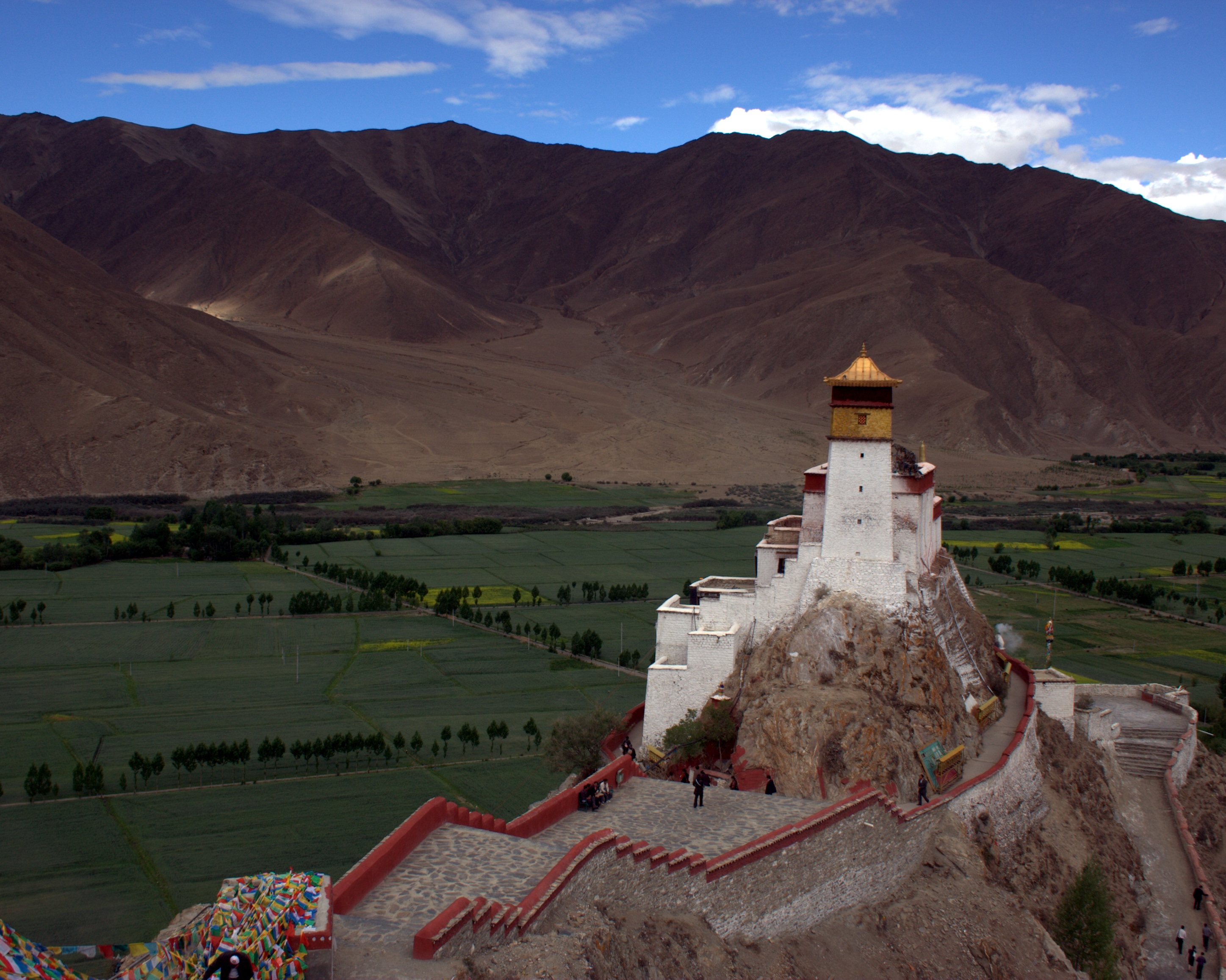
Yungbulakang Palace
According to Tibetan legend, King Nyatri Tsenpo did not walk into the Yarlung Valley. He descended from the sky into a field of yaks, and the nomadic herders who witnessed it carried him on their shoulders and made him their chief. That was 127 BCE, the beginning of the Tibetan Royal Era. The palace they built for him still stands, or rather stands again, on a hilltop above the Yarlung River: Yumbulagang, reputed to be the oldest building in Tibet.
The Hilltop Fortress
Yumbulagang rises from a rocky promontory at a bend in the Yarlung Tsampo River, on the eastern bank of the Yarlung Valley. It sits about 192 kilometers southeast of Lhasa and nine kilometers south of Tsetang. The palace is divided into front and rear sections. The front is a three-story building; the rear is dominated by a tall tower that gives the whole structure the look of a small castle. From its perch, the palace commands views of the valley floor below, where barley fields stretch toward the river. Inside, statues of Thiesung Sangjie Buddha, King Nyatri Tsenpo, and Songtsen Gampo preside over a space that feels more shrine than residence, which is what it became centuries ago when Tibetan rulers moved their capital to Lhasa.
Gifts That Fell from the Sky
Five generations of kings passed before Yumbulagang's next defining moment. During the reign of the 28th king, Thothori Nyantsen, in the 5th century AD, a golden stupa, a tsa-tsa mold, and a Mahayana sutra are said to have fallen from the sky onto the palace roof. The king could not read the text. One version of the story attributes the delivery to an Indian Buddhist monk who told the king to safeguard the objects for five generations, when someone would come who could understand them. Another account says a voice from the sky announced the same prophecy. That someone turned out to be the 33rd king, Songtsen Gampo, who reigned from 604 to 650 AD and commissioned the creation of the Tibetan written language and alphabet, giving his people the tools to read what the sky had delivered.
Destruction and Resurrection
Yumbulagang survived for roughly two millennia before the Cultural Revolution reached the Yarlung Valley between 1966 and 1976. The palace and its shrine were demolished. What had weathered centuries of conflict, weather, and the slow erosion of time could not survive a decade of systematic destruction. Only fragments of the original base remained. Reconstruction began in 1983, restoring the palace's silhouette to the hilltop. Then in November 2017, a further round of restoration work valued at 1.5 million dollars addressed crumbling wooden foundations and cracked walls. The palace reopened to the public in April 2018. Each rebuilding adds new materials to ancient foundations, creating a structure that is at once a faithful reproduction and something entirely its own.
The First Field
Northwest of the palace lies Zorthang, traditionally regarded as the largest cultivated area in Tibet and possibly its first. Even today, farmers from across the region sprinkle soil from Zorthang on their own fields to ensure a good harvest, a practice that transforms ordinary dirt into a kind of agricultural blessing. A temple called Lharu Menlha once stood near Zorthang, housing images of the Eight Medicine Buddhas, though it no longer survives. The tradition of Zorthang speaks to something deeper about Yumbulagang's significance. This is not merely the site of a palace. It is the place where Tibetans locate the beginning of their settled life: the first king, the first building, the first field. Whether those claims are historically precise matters less than the fact that an entire civilization has chosen this spot on the Yarlung Valley floor as the place where it all started.
From the Air
Yumbulagang Palace is at 29.14N, 91.80E, perched on a hilltop along the Yarlung River in southeastern Tibet. Elevation approximately 3,700 meters. The palace tower is visible from the air as a small structure on a rocky promontory above the valley floor. Nearest major airport is Lhasa Gonggar (ZULS), about 190 km northwest. Approach from the north along the Yarlung Valley. Best viewed at 8,000-12,000 feet AGL. Tsetang is 9 km to the north.