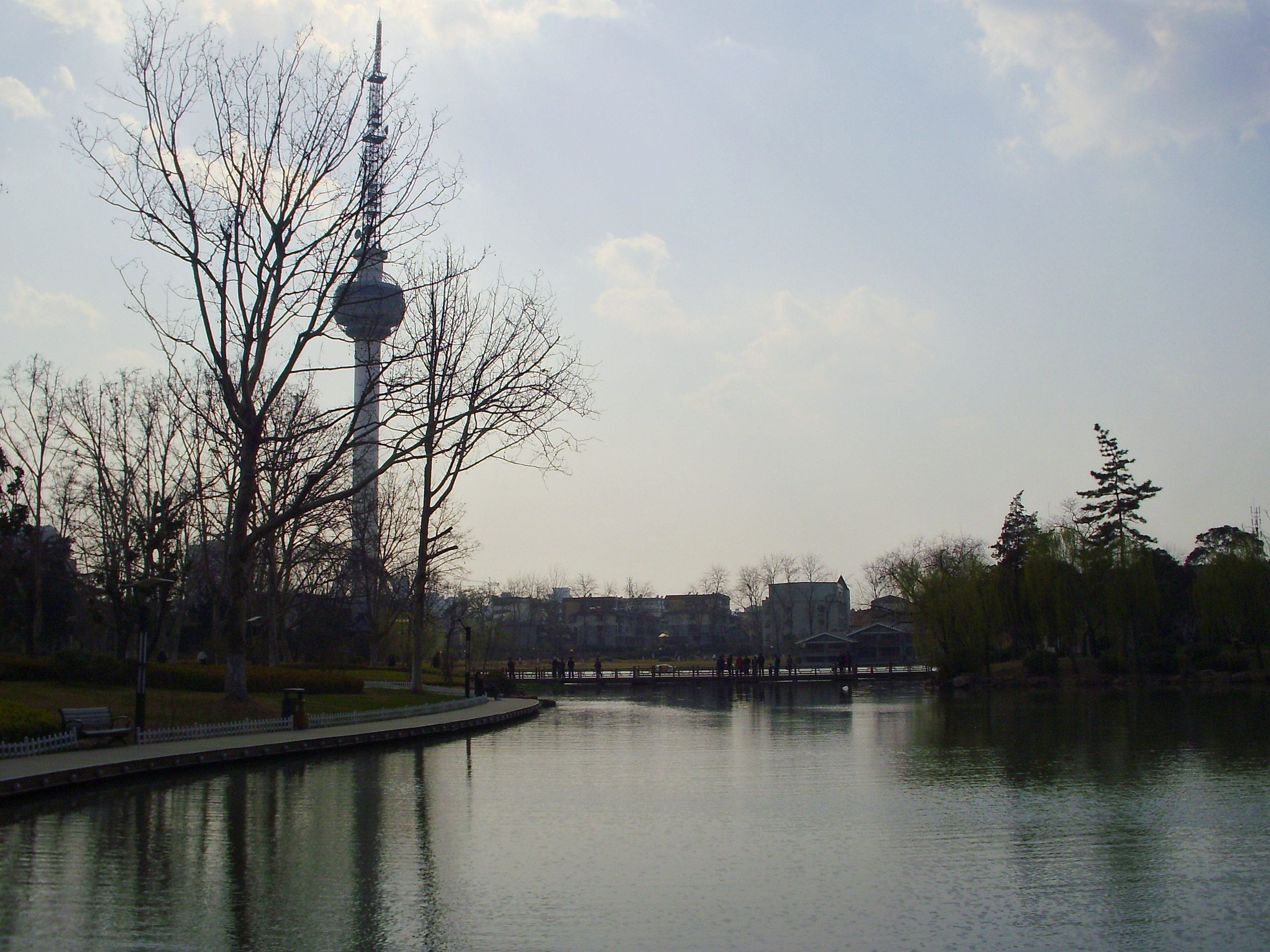
Yunlong Park
Before it was a park, it was a cemetery. Christians and Buddhists were buried here side by side before the Chinese Civil War, an unlikely coexistence that the city of Xuzhou quietly erased when it transformed the grounds into a public park in 1958. The name they chose, Yunlong, means "cloud dragon" in Chinese, drawn from nearby Yunlong Mountain and Yunlong Lake to the north. It is a name that carries more poetry than the site's origins might suggest, and the park itself has grown into something that honors both its layered past and the 1.7 million visitors who pass through its gates each year, free of charge.
A Garden in the Classical Tradition
Covering 25 hectares in southwestern Xuzhou, with eight hectares of water surface, Yunlong Park was designed in the tradition of Chinese classical gardens. It is organized into six distinct areas: the Bonsai Garden, Zhi Chun Isle (the "Isle of Knowing Spring"), the Waterside of Lotus, the Galleries of Rockery and Flower, the Parterre, and an amusement park. The layout borrows from centuries of Chinese garden philosophy, where every rock placement and water feature is meant to evoke something larger than itself. Paths wind rather than proceed directly. Views reveal themselves gradually. The effect is of entering a space that has been composed rather than merely planted.
The Swallow Pavilion
Among the park's attractions, the Swallow Pavilion carries the deepest history. Originally built during the Tang dynasty, it has been destroyed by war and rebuilt multiple times across its long life. The present structure, reconstructed in 1985 near the original site, is a faithful echo rather than an exact replica. Its survival through so many cycles of destruction and renewal mirrors the story of Xuzhou itself, a city that has been fought over, occupied, and rebuilt so many times that resilience is not so much a quality as a defining characteristic. The pavilion's name evokes the swallows that return each spring, a metaphor the builders surely intended.
Tombs Beneath the Trees
Northeast of the park lies a burial mound covering 400 square meters, shaded by evergreen trees. It is said to be a mausoleum of the Western Han dynasty, one of many such tombs scattered throughout the Xuzhou region. The mound sits quietly among the park's recreational spaces, a reminder that the ground here has served the dead far longer than it has served the living. Xuzhou was once known as Pengcheng, the seat of the ancient Chu kingdom, and the hills around it are laced with tombs from successive dynasties. This particular mound is unmarked and unexcavated, its occupant unknown, which only adds to the sense that the park rests on top of stories still waiting to be told.
The Cloud Dragon Today
Yunlong Park sits close to the city center, making it an accessible refuge from Xuzhou's urban bustle. The decision to make admission free has ensured that the park remains genuinely public space rather than a ticketed attraction. On any given day, elderly residents practice tai chi beside the lotus ponds, families stroll through the Bonsai Garden, and the rockery galleries draw visitors who appreciate the art of composed stone. The park occupies a curious position in Xuzhou's landscape: it is both deeply local, shaped by the specific history of this particular city, and broadly traditional, drawing on garden design principles shared across Chinese culture for centuries.
From the Air
Located at 34.245N, 117.15E in southwestern Xuzhou, Jiangsu Province. The park's water features and tree canopy are distinguishable from low altitude. Yunlong Mountain and Yunlong Lake lie to the north. Nearest major airport is Xuzhou Guanyin International Airport (ZSXZ), approximately 50 km southeast. The city of Xuzhou spreads across flat terrain at the junction of major rail lines.