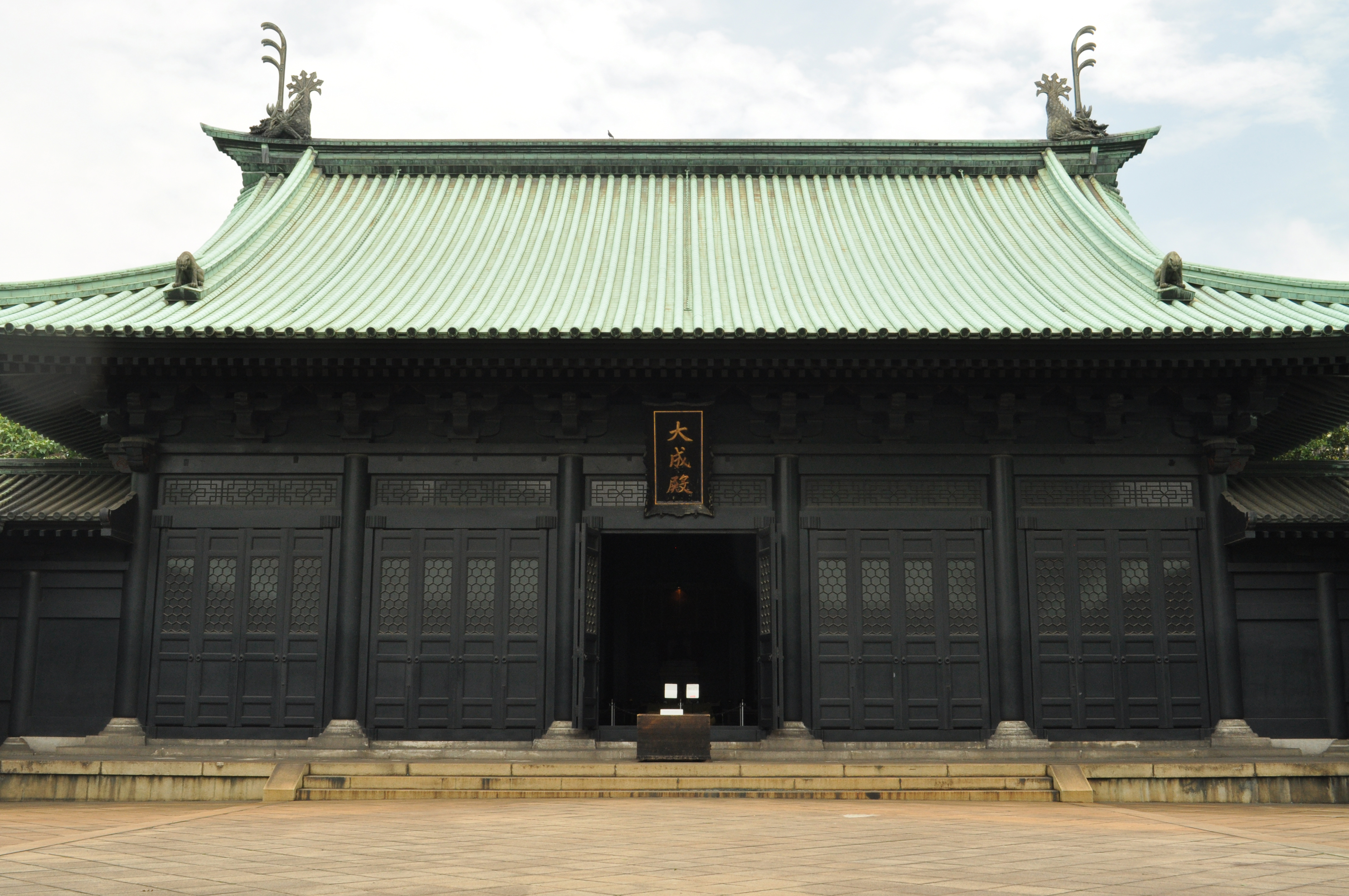
Yushima Seidō
Inside the compound stands the world's largest statue of Confucius, a 4.5-meter bronze figure donated by the Lions Club of Taipei in 1975. The gesture is fitting, because few places on earth owe more to Confucian thought than this quiet hilltop in Tokyo's Bunkyo ward. Yushima Seido is a Confucian temple that, for nearly two centuries, served as the intellectual headquarters of the Tokugawa shogunate — the place where the political philosophy of an entire nation was studied, codified, and taught to the sons of Japan's ruling class. The institutions that grew from its grounds would become the University of Tokyo, the Tokyo National Museum, and the predecessor of the National Diet Library.
Confucius on the Kanda Hill
The story begins in 1632, when Tokugawa Yoshinao, the ninth son of Tokugawa Ieyasu and lord of the Owari Domain, received permission to build an academy in Edo for the study of Confucianism. The neo-Confucian scholar Hayashi Razan constructed the first structure, the Sensei-den, on his own grounds at Shinobu-ga-oka, in what is now Ueno Park. Under the Hayashi clan's stewardship, the teachings of the Chinese philosopher Zhu Xi became the official orthodoxy of the Tokugawa regime — the philosophical framework that justified and guided shogunal rule. In 1691, the fifth shogun Tokugawa Tsunayoshi relocated the temple and its school to the present hilltop site in the Yushima district, where the main hall was renamed the Taiseiden. The move signaled that Confucian learning had graduated from a private scholarly pursuit to an instrument of state power.
The Academy That Shaped a Nation
After the Kansei Edict formalized neo-Confucianism as Japan's official state philosophy, the school became a government-sponsored academy in 1797 known as the Shoheiko, named after the supposed birthplace of Confucius. The rector of Shoheiko held a position equivalent to head of the entire educational system in Edo. Three kinds of students attended: the Keikonin, sons of hatamoto and gokenin families who were direct vassals of the shogunate and commuted from their Edo estates; the Shosei, scholarship students from feudal domains across the country who lived in dormitories; and commoners who attended open lectures. The residential students debated endlessly among themselves, forging an alumni network that spanned Japan and proved instrumental during the upheaval of the Meiji Restoration. The curriculum centered on the Four Books and Five Classics of Confucian thought, studied through careful reading of Chinese texts. Examinations ranged from yearly assessments of junior students to the prestigious Gakumon Ginmi, held only 19 times in the school's entire history.
Fire, Earthquake, and Reinvention
The Taiseiden was originally painted in vermilion with verdigris accents. After burning down multiple times, it was rebuilt in 1799 in the style of the Confucian temple in Mito, this time in black lacquer. The Meiji Restoration of 1868 swept Confucianism from official favor, and the academy closed in 1871. But the grounds proved too valuable to abandon. Japan's first teachers' college rose on the site. Part of the grounds hosted the country's first museum, later relocated to Ueno as the Tokyo National Museum. The predecessor of the National Diet Library was also built here. The compound became a National Historic Site in 1922, but the following year the 1923 Great Kanto Earthquake destroyed every surviving Edo-period structure. The current Taiseiden, designed by the architect Ito Chuta in reinforced concrete and completed in 1935, is the building visitors see today. Its opening ceremony was attended by representatives from both the Republic of China and Manchukuo.
Where Students Still Come to Pray
Tokyo Medical and Dental University now occupies part of the former academy grounds, a fitting continuation of the educational mission that has defined this hilltop for nearly four centuries. The compound today holds the bronze Confucius statue alongside statues of the Four Sages: Yan Hui, Zengzi, Kong Ji, and Mencius. The colonnade along the courtyard sides and the tablet above the Taiseiden's entrance evoke the gravity of the site's long scholarly tradition. Along with the nearby Yushima Tenman-gu shrine, Yushima Seido draws a particular kind of visitor each year — students praying for success in their examinations, continuing a tradition of academic aspiration that stretches back to the hatamoto sons who once climbed this same hill to study the Chinese classics and debate the philosophy that governed their nation.
From the Air
Located at 35.7008°N, 139.7664°E in Bunkyo ward, central Tokyo, on a hilltop in the Ochanomizu district near the Kanda River. The temple sits adjacent to Tokyo Medical and Dental University and near the distinctive Nikolai Cathedral dome. Nearest airports: Tokyo Haneda (RJTT) approximately 15 km south, Narita (RJAA) approximately 60 km east. Best viewed at 1,500-3,000 ft where the temple's black-painted Taiseiden hall and surrounding institutional buildings of the Ochanomizu academic district are visible against the dense urban fabric. The Kanda River provides a useful visual reference for navigation.