Yushima Tenmangū
Every January and February, a quiet panic grips the students of Tokyo. University entrance exams are approaching, and when cramming fails to calm the nerves, thousands of them file through the stone torii of Yushima Tenmangu in Bunkyo ward to ask a thousand-year-old scholar for help. They write their prayers on small wooden tablets called ema -- stack upon stack of them, sometimes a meter deep -- petitioning Tenjin, the god of learning, for the exam scores that will shape the rest of their lives. The shrine has been standing here since 458 AD. It has heard a lot of prayers.
A Scholar Becomes a God
Yushima Tenmangu was not always dedicated to scholarship. When it was first established in 458, during the reign of Emperor Yuryaku, the shrine honored Ameno-tajikaraono-mikoto, a kami associated with sports and physical strength from the ancient texts of the Kojiki and Nihon Shoki. The shrine's transformation came in February 1355, when it was expanded to enshrine the spirit of Sugawara no Michizane (845-903), a brilliant Heian-period scholar, poet, and politician who was deified after death as Tenjin, the kami of learning. Michizane's story is one of genius brought low by court intrigue -- exiled from Kyoto by political rivals, he died in disgrace, only to be elevated to divine status when a series of calamities convinced the imperial court that his angry spirit demanded appeasement. Today, both kami share the shrine grounds, the ancient god of strength standing alongside the scholar-god -- a pairing that any student pulling an all-night study session would appreciate.
The Warlord's Patronage
In October 1455, the samurai lord Ota Dokan (1432-1486) -- the same strategist who built the original Edo Castle that would become the Imperial Palace -- ordered Yushima Tenmangu rebuilt. Under Dokan's patronage the shrine gained stature, and its reputation grew further during the Edo period, when Tokyo was the seat of the Tokugawa shogunate. Confucian scholars like Hayashi Doshun (1583-1657) and Arai Hakuseki (1657-1725) visited regularly, lending the shrine intellectual prestige that extended far beyond religious devotion. The proximity to what would become the University of Tokyo -- Japan's most elite institution, located just a short walk away -- cemented Yushima Tenmangu's identity as the spiritual heart of academic aspiration in the capital.
Plum Blossoms and Perfect Timing
Over 300 plum trees fill the shrine grounds, most of them the fragrant white Shirokaga variety. Each February and March, they erupt in blossoms during the Ume Matsuri, a plum festival that draws visitors from across Tokyo. The timing is no accident of nature -- or rather, it is a happy one. Plum trees bloom just as exam results are released, so the shrine becomes simultaneously a celebration of spring and a nervous vigil over academic futures. Sugawara no Michizane himself was known for his love of plum blossoms; a famous poem attributed to him bids farewell to his beloved plum tree as he departs Kyoto for exile. The trees at Yushima carry that literary weight. Walking beneath their branches in late February, surrounded by students clutching ema and parents murmuring prayers, the air sweet with blossom scent, the connection between beauty, learning, and longing feels entirely real.
Cypress and Continuity
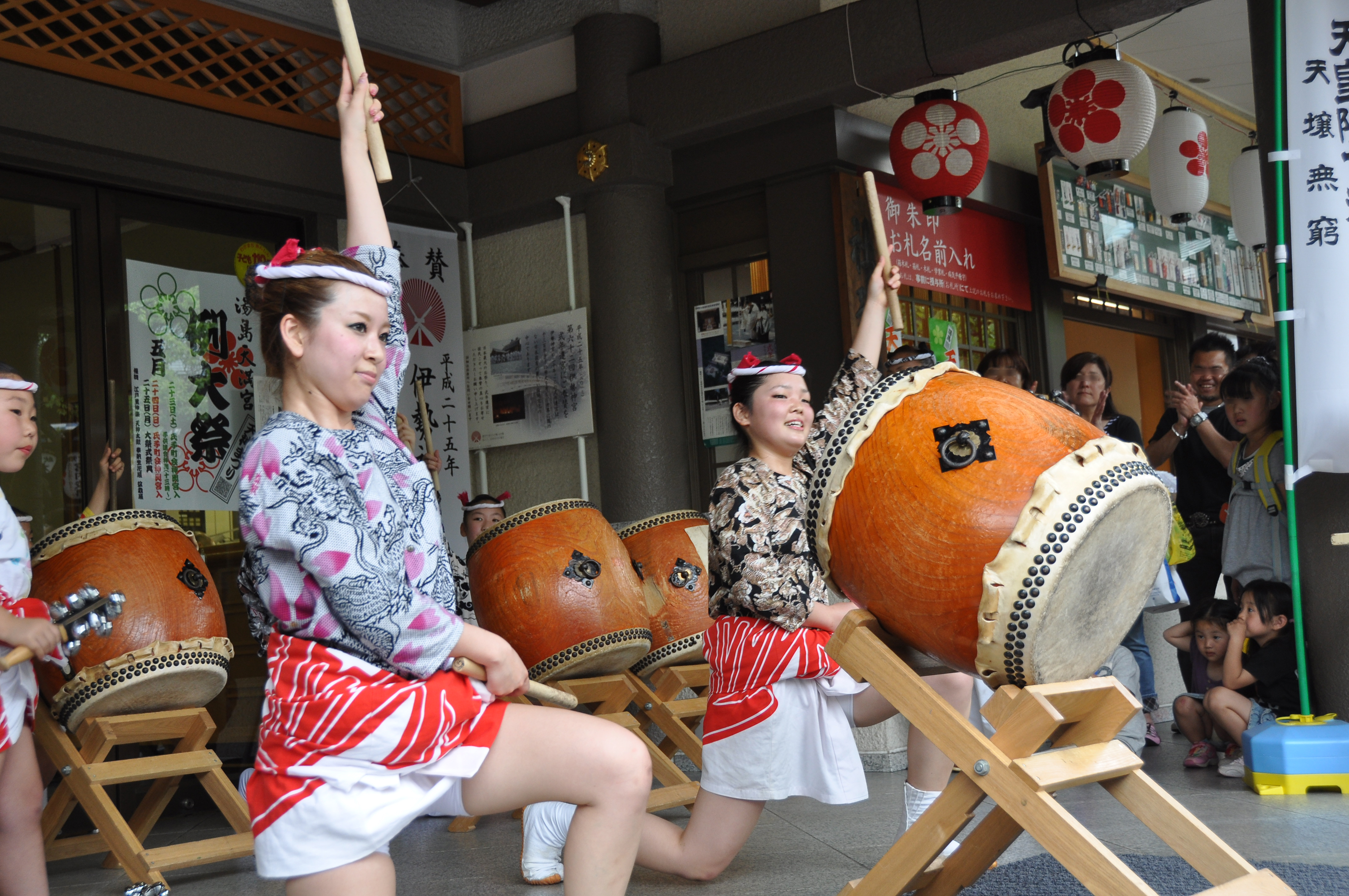
The current structures of Yushima Tenmangu date to 1995, built entirely from cypress wood in strict accordance with traditional Shinto architecture. The reconstruction was deliberate in its conservatism -- no steel framing, no modern shortcuts, just timber joinery and craftsmanship passed down across generations. The shrine sits near Ueno Park on a hillside in Bunkyo ward, its stone steps rising from a neighborhood of universities, bookshops, and quiet residential streets. Four annual festivals mark the calendar: Hatsumode for New Year's in January, the Ume Matsuri in February and March, the grand Tenjin-sai festival on May 25, and the Kiku Matsuri chrysanthemum festival through November. There is no admission fee. The gates open at six in the morning and close at eight at night, and in exam season the grounds are rarely empty.
From the Air
Located at 35.708N, 139.768E in the Bunkyo ward of central Tokyo, near the northwest edge of Ueno Park. The shrine grounds are modest in footprint and not individually distinguishable from altitude, but the larger Ueno Park complex -- with its museums, zoo, and Shinobazu Pond -- serves as a clear visual reference. The University of Tokyo's Hongo campus lies approximately 500 meters to the north. Nearest major airport is Tokyo Haneda (RJTT), approximately 16 km south. Narita International (RJAA) is about 60 km east-northeast. Tokyo Skytree (634 m) is visible roughly 3 km to the east-southeast as an unmistakable landmark.