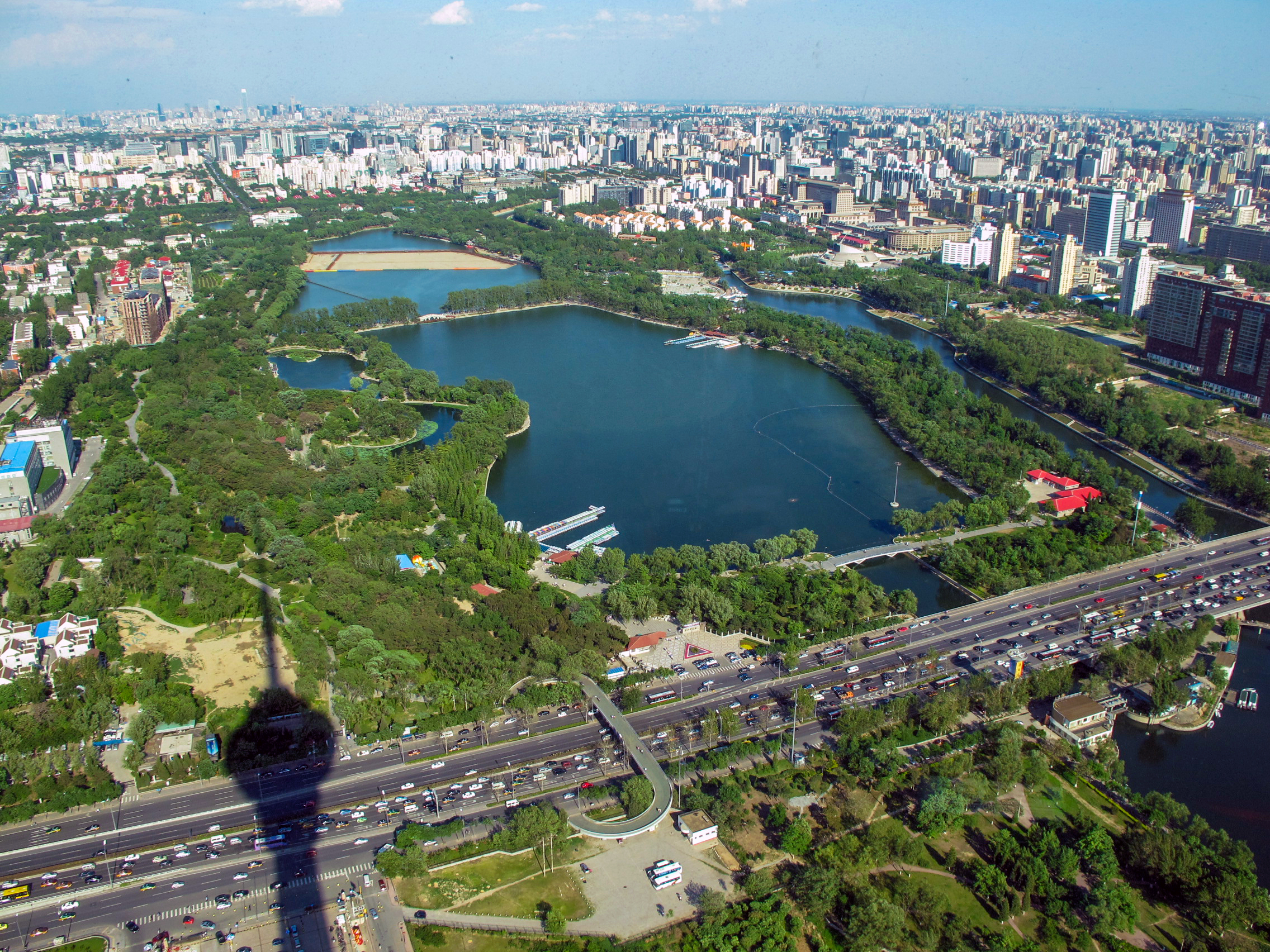
Yuyuantan Park
Every March and April, hundreds of thousands of visitors descend on a 137-hectare park in western Beijing to see cherry blossoms. They photograph the pale pink canopy reflected in the lake, pack the walkways until movement becomes a group negotiation, and post so many images online that Yuyuantan briefly becomes one of the most photographed places in China. What most of those visitors do not realize is that the lake beneath those blossoms was engineered by an eighteenth-century emperor, nearly dried up and disappeared, and had to be resurrected with river water in 1960.
From Lowland to Imperial Lake
Long before the lake existed, the site was simply low ground outside the walls of the Liao and Jin dynasty capital. During those dynasties, from the tenth through the thirteenth centuries, the area attracted visitors as open countryside beyond the city gates, but there was no body of water to speak of. The transformation came in 1773, when the Qianlong Emperor ordered springs from the Fragrant Hills channeled into the depression and impounded to form a lake. He built a small imperial palace on its shores for short stays, a retreat from the Forbidden City's formality. The name Yuyuantan, roughly translating to Jade Spring Pool, captured the clarity of those mountain-fed waters.
Abandonment and Revival
Imperial attention proved fickle. In the later Qing dynasty, the lakeside palace fell into disuse, and without maintained water channels, the lake shrank toward oblivion. By the early twentieth century, what the Qianlong Emperor had created was little more than a marshy depression. In 1960, the Beijing municipal government intervened decisively, diverting water from the Yongding River to refill the basin. The lake came back to life. Over the following decades, the surrounding land was gradually developed into a proper urban park, with the most consequential addition arriving in the 1990s: thousands of cherry trees, planted in groves that transformed Yuyuantan into Beijing's premier spring destination.
A Park Between Landmarks
Yuyuantan sits in a neighborhood thick with significance. The Diaoyutai State Guesthouse, where foreign heads of state are hosted, borders the park to the east. The China Millennium Monument stands just to the south. The Central Radio and TV Tower rises nearby, its silhouette visible from within the park grounds. Water covers 61 of the park's 137 hectares, making it one of the largest water bodies in central Beijing. In a city defined by density and development, Yuyuantan offers something increasingly rare: open space with deep historical roots, where an emperor's landscaping project became a public commons.
From the Air
Located at 39.92°N, 116.31°E in western Beijing's Haidian District. The park's large lake is visible from altitude, appearing as a significant water body amid dense urban development. The Central Radio & TV Tower is a prominent nearby landmark. Nearest airport: Beijing Capital International (ZBAA), approximately 28 km northeast. Beijing Nanyuan (ZBNY) is about 18 km south.