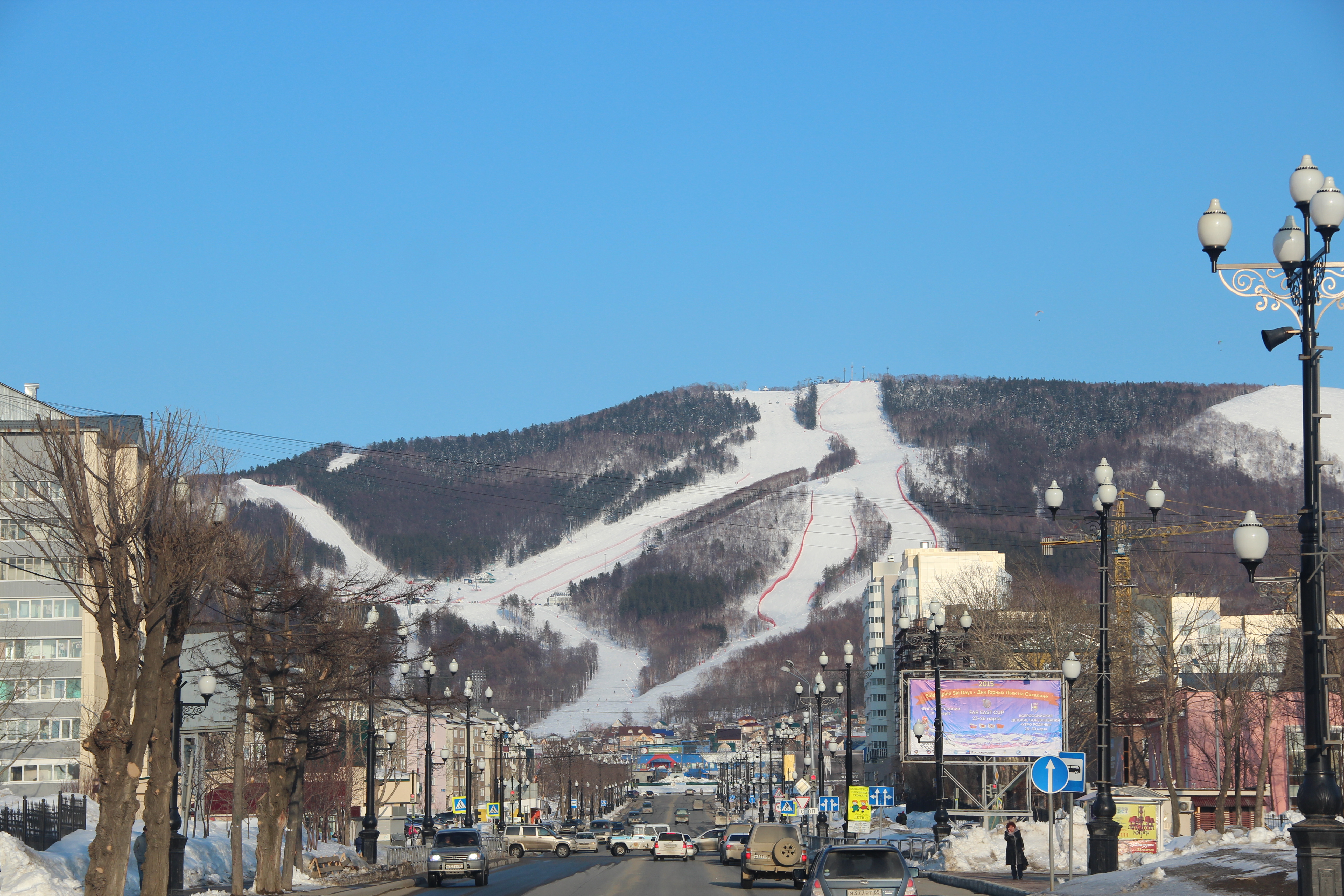
Yuzhno-Sakhalinsk
The building that houses the Sakhalin Regional Museum looks like it belongs in Kyoto, not in Russia's Far East. Its pagoda-style roofline and classical Japanese proportions are holdovers from the decades when this city was called Toyohara and served as the capital of Karafuto Prefecture. Step outside, and the surrounding Soviet-era apartment blocks snap you back to a different imperial project entirely. Yuzhno-Sakhalinsk is a city that has been conquered, renamed, and reinvented so many times that its architecture reads like a geological cross-section of competing civilizations.
Convicts, Colonists, Conquerors
The city began in 1882 as Vladimirovka, a settlement populated by liberated convicts on an island that Tsarist Russia used as a penal colony. After Japan won the Russo-Japanese War in 1905, the southern half of Sakhalin became Karafuto Prefecture, and the village was renamed Toyohara -- the new colonial capital. The Japanese built railways, government buildings, and infrastructure that transformed a backwater into a functioning administrative center. They also deported Korean laborers to the island in the 1930s to work in mines and factories, creating a diaspora that persists today: roughly 20,000 ethnic Koreans still live in Yuzhno-Sakhalinsk, denied repatriation by the Soviets until the mid-1980s and by then too rooted to leave.
Soviet Concrete, Japanese Bones
When Soviet forces swept through Karafuto in August 1945, they inherited a Japanese city. Most of its architecture was systematically demolished and replaced with the standardized concrete apartment blocks that define Soviet urban planning. Only a handful of Japanese structures survived the ideological purge, including the museum building, the House of the Garrison Court dating from 1908, and a small bridge on Sakhalinskaya Street. What the Soviets could not erase was the human legacy: the Korean community, the Japanese-gauge railway that continued to operate for decades, and the seismic vulnerability that keeps buildings low-rise across a city flanked by mountains on both sides and prone to the earthquakes that ripple along Sakhalin's active fault lines.
Black Gold at the Edge of the World
Sakhalin's transformation from remote outpost to energy hub began with the discovery of massive offshore oil and gas deposits. The Sakhalin-1 and Sakhalin-2 projects brought billions in foreign investment, along with expatriates from Europe and America who created a parallel economy of upscale hotels, English-language signage, and an expat district that would have been unthinkable during the Soviet era. Hotel rooms became absurdly expensive. The city of roughly 180,000 people suddenly had international flights to Seoul, Sapporo, Osaka, and Harbin, alongside the nine-hour haul to Moscow. For visitors, the surreal result is a city where you can eat Korean kimchi, Japanese sushi, and borscht within the same block, in a place that takes more than half a day to reach from Russia's own capital.
Mountains and Mud Volcanoes
Yuzhno-Sakhalinsk sits in the Susuya River valley, 25 kilometers north of Aniva Bay and the same distance west of the Sea of Okhotsk. Mountains rise on both sides, and the six-hour hike up Chekhov Peak -- the trailhead begins behind the Santa resort -- rewards with panoramic views of the valley and the sea beyond. The city also serves as the gateway to Sakhalin's wilder landscapes: mud volcanoes that bubble and hiss through the forest floor, Lake Tunaycha with its sandy coastline and summer swimming, and the port towns of Korsakov and Kholmsk, from which ferries depart for Japan and the Russian mainland. Fog rolls in frequently during summer, softening the hard edges of the Soviet architecture and lending the city a quality of atmospheric impermanence appropriate for a place that has belonged to so many nations and none of them permanently.
From the Air
Located at 46.95°N, 142.73°E in the Susuya River valley of southern Sakhalin Island. Yuzhno-Sakhalinsk Airport (UHSS) is the island's main air hub with flights to Moscow, Seoul, Sapporo, and regional Russian cities. The city is visible from altitude as a grid pattern in a mountain-flanked valley. Mountains to the east and west frame the urban area, and the railway line running north-south through the city center is a prominent landmark.