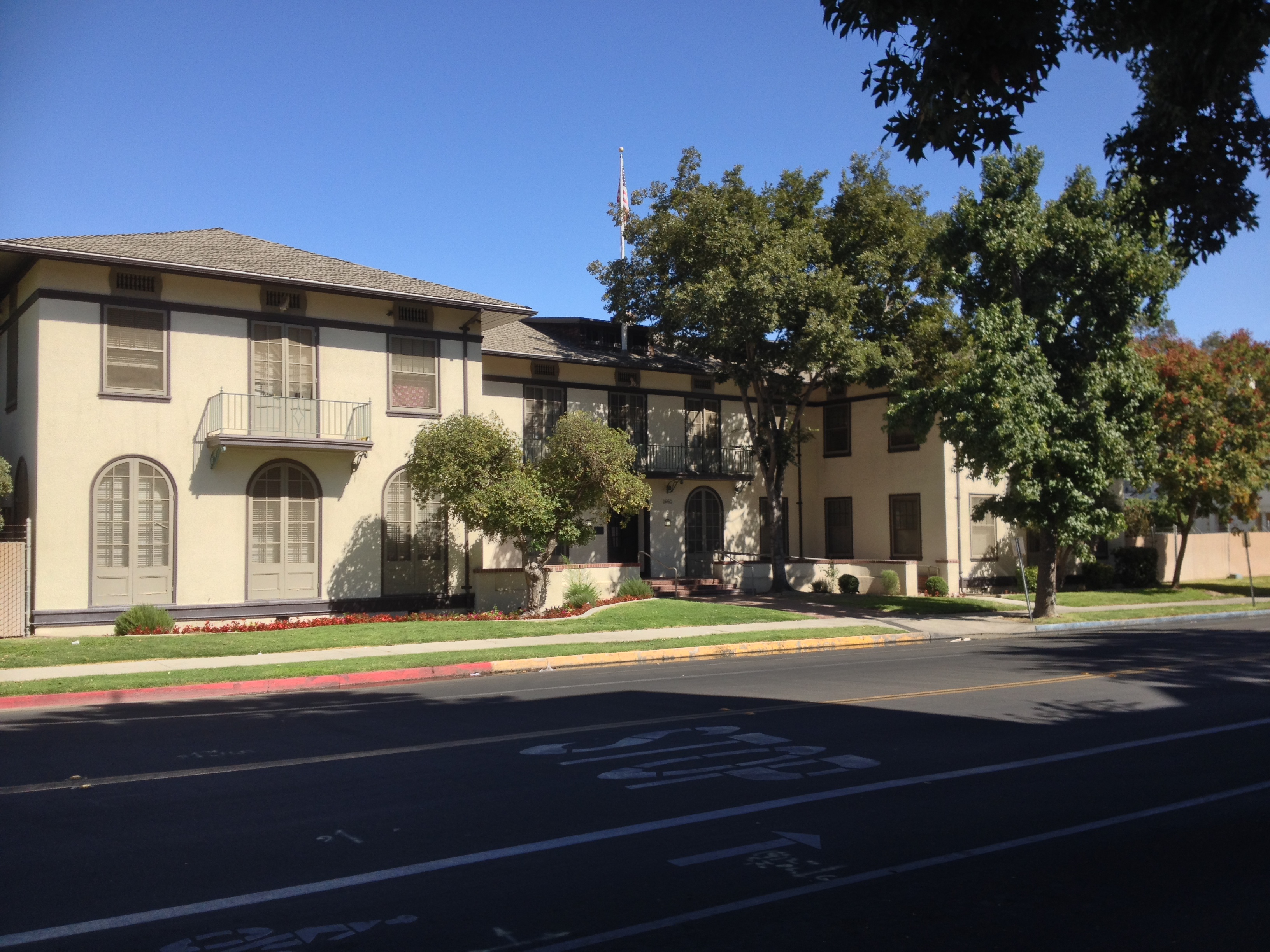
The YWCA Building That Became a Shelter
Julia Morgan traveled to Fresno to check on the construction herself. The architect who would design Hearst Castle -- who had been the first woman admitted to the architecture program at the Ecole des Beaux-Arts in Paris, the first woman licensed as an architect in California -- came to the San Joaquin Valley to make sure the brickwork was right on a YWCA building. It was 1922, and the Young Women's Christian Association of Fresno needed a residential building for the women arriving in a Central Valley city that was booming with agriculture and short on safe, affordable housing. Morgan gave them an Italian Villa, blending Renaissance Revival styles into an H-shaped building with balconies, a screened sleeping porch for the brutal valley summers, and a sewing room on the second floor. A century later, the building still stands, though the women who shelter inside it now arrive under very different circumstances.
Women Building for Women
The YWCA of Fresno was founded in 1904 by local women who recognized what the city's rapid growth was failing to provide: safe spaces for the young women migrating to the valley for work. By 1920, the organization had grown large enough to need a purpose-built residential building, and they hired the best architect they could find. Julia Morgan was already well known by then -- her portfolio included churches, schools, and YWCA buildings across California. She understood the assignment intuitively: a building that would function as both home and institution, domestic in its comforts and public in its purpose. Construction began on a site along M Street, and in addition to the residential building, Morgan designed a YWCA Recreation Center on Tulumne Street that opened in 1923. The Fresno YWCA now had two Morgan-designed buildings anchoring its presence in the city.
An Italian Villa in the Valley
Morgan's design for the residential building blends Italian Renaissance Revival with Spanish Renaissance Revival into what architectural historians call the Italian Villa style. The H-shaped layout divides the building neatly: common areas on the first floor -- lobby, library, reception room, offices -- and private quarters on the second, with bedrooms, bathrooms, kitchens, dining rooms, and a sewing room. The attic held a screened-in sleeping porch, a concession to the San Joaquin Valley's merciless summers, where temperatures regularly exceed 100 degrees and nights offer little relief. When air conditioning eventually arrived, the porch was enclosed. Simple entablature trim and balconies give the exterior a Mediterranean warmth that feels slightly improbable against the flat, sun-bleached landscape of central Fresno. The National Register of Historic Places listed the building in 1978, recognizing both its architectural merit and its connection to Morgan's prolific career.
From Summer Camp to Crisis Line
For decades, the Fresno YWCA operated as YWCAs do everywhere -- offering affordable housing, exercise classes, community programs, and a summer camp called Mar-Y-Mac. In 1950, the organization purchased an adjacent house on M Street and converted it into the YWCA Activity Unit, expanding its footprint and services. The post-war years brought steady, unremarkable growth. Then, in 1979, everything changed. Marjaree Mason, a young Fresno woman, was kidnapped, raped, and murdered by a Fresno County deputy sheriff. The crime shocked the community, and the YWCA responded by setting up an emergency domestic violence hotline. What had been one program among many quickly became the organization's central mission. The YWCA of Fresno increasingly focused on domestic violence intervention and the safety of women, repurposing its buildings as the Marjaree Mason Center.
A Name That Carries Weight
The transformation was not merely a rebrand. In 1998, the organization formally disaffiliated from the national YWCA to become an independent agency, free to focus entirely on its domestic violence mission. The Marjaree Mason Center now provides emergency shelter, court accompaniment, group counseling, and community education. The building that Julia Morgan designed as a residence for young women seeking opportunity in the valley still houses women -- but these women are fleeing violence, and the building's thick walls and institutional solidity serve a purpose Morgan could not have anticipated. The name Marjaree Mason ensures that the woman whose murder catalyzed this change is not forgotten, and that the deputy sheriff who killed her is remembered for what he was. The center operates from the same block of M Street where the YWCA first put down roots, a century of women's history compressed into a few buildings that have changed meaning without changing address.
From the Air
The YWCA Building is located at 36.74296N, 119.79422W in central Fresno, near M Street in the downtown core. From the air, the Italian Villa-style building is difficult to distinguish from surrounding structures at altitude, though the downtown Fresno grid provides orientation. Fresno Yosemite International Airport (KFAT) lies approximately 6 nautical miles to the east-southeast. Fresno Chandler Executive Airport (KFCH) is about 3 nautical miles to the south. The flat San Joaquin Valley provides clear sightlines in all directions, though winter tule fog can reduce visibility to near zero and summer haze is common.
Sources
- YWCA Building (Fresno, California)
- Pioneering Architect Julia Morgan Remembered for Fresno Work
- A Guide to Historic Architecture in Fresno, California: Julia Morgan (1872-1957)
- National Register of Historic Places Inventory-Nomination Form: Y.W.C.A. Building
- Xanadu's Architect
- Marjaree Mason Center
- YWCA Building (Fresno, California) - Wikipedia